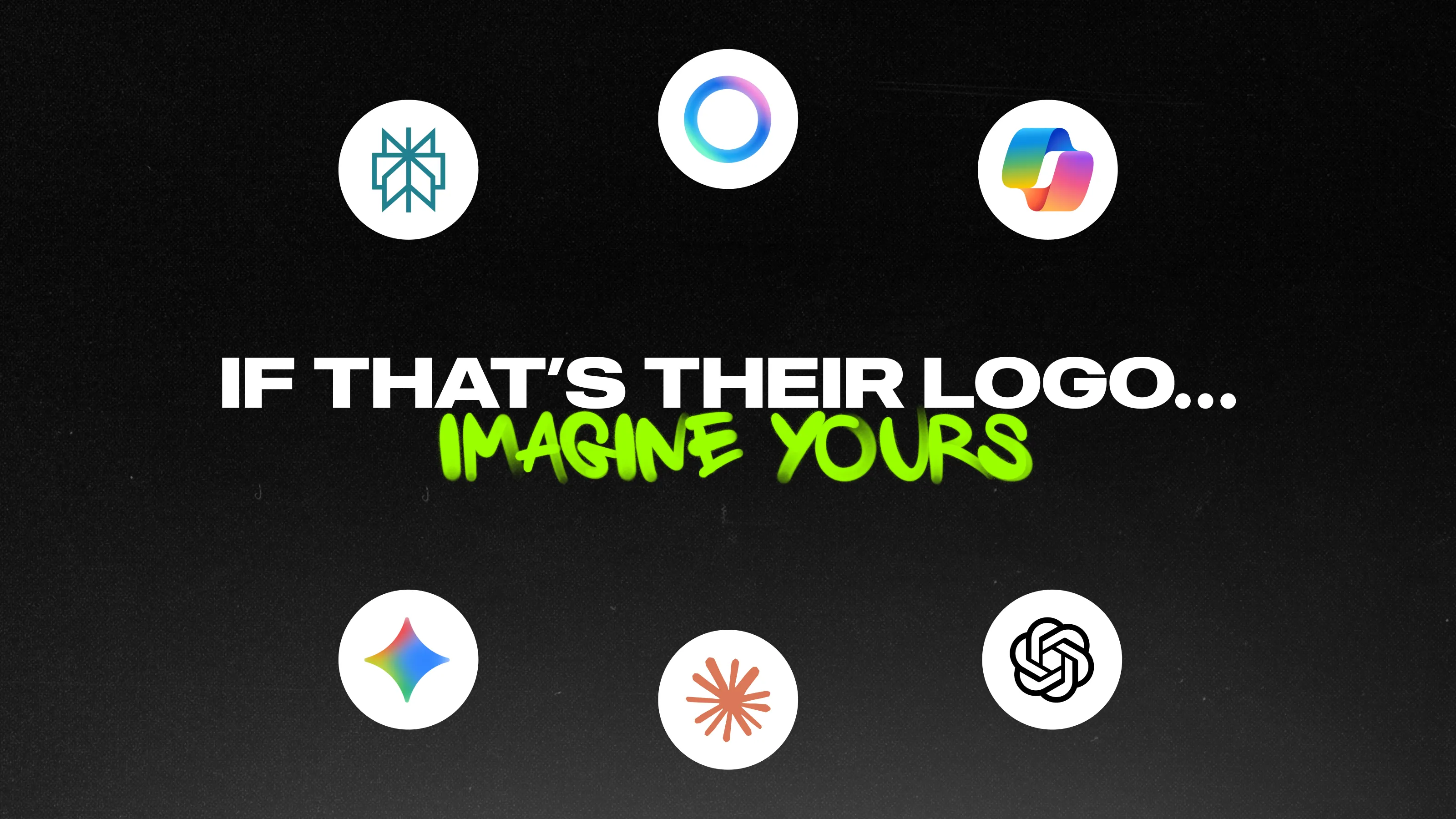
Yes, AI can generate your logo in 30 seconds. And it will look fine.
Here's the thing about "fine": it's the most dangerous place your brand can land. Not bad enough to fix, not strong enough to work. "Fine" means you exist, but you don't register. "Fine" means a potential client sees you but moves on. "Fine" means your competitor, who invested in a real brand identity, wins the deal before the conversation even starts.
We're not here to tell you AI tools are useless. They're not, and anyone saying otherwise is selling something. Midjourney, Sora, ChatGPT: powerful, fast, and genuinely impressive. The problem isn't the tools. The problem is what they're optimized for. AI is optimized for output. Branding is optimized for perception. And those two things are not the same.
When everyone has access to the same tools and the same outputs, "decent" becomes a trap. You're not paying a designer for a logo file. You're paying for the strategic thinking that makes your brand mean something: in the room, in the feed, in the mind of the person deciding whether to trust you with their money.
AI doesn’t think about your business, it just repeats what it's already seen
AI doesn't understand your business. It understands patterns. When you ask Midjourney or DALL-E to create "a logo for a fintech startup," it isn't analyzing your market, reading your customer profiles, or thinking about how you're perceived next to your competitors. It produces an averaged result from everything that already exists. Statistically acceptable. Strategically—dangerous.
AI is a probability machine. It generates whatever appeared most often next to your prompt in the training data. And that training data is the entire internet, where your competitors have already posted their branding.
As a result, you get a logo that subconsciously looks like everyone around you. The gap between AI and a designer is the gap between a spell checker and an editor. A spell checker catches mistakes. An editor tells you why your pitch isn't working.
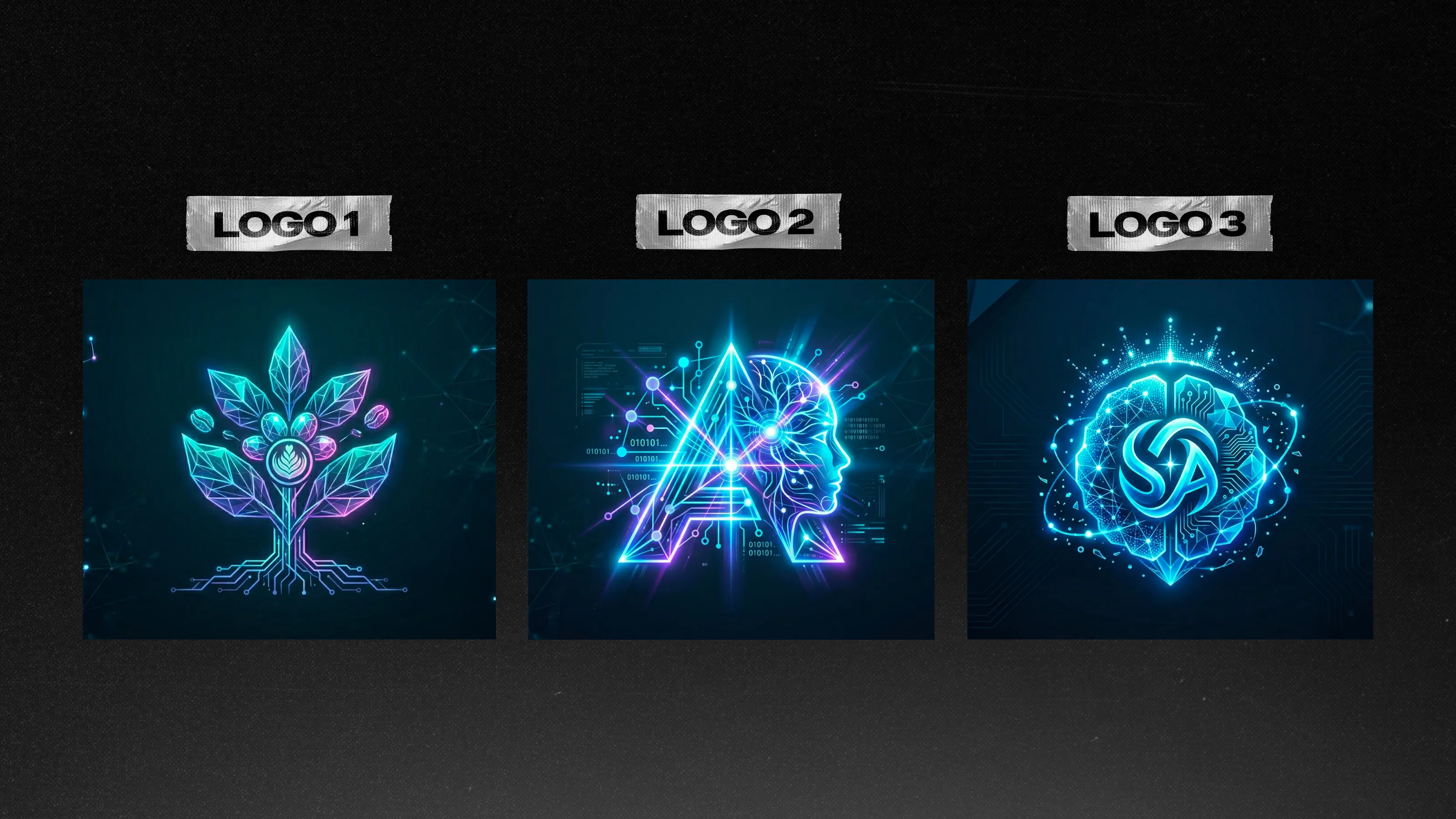
This was meant to be a clean, minimal logo for an AI assistant—clearly AI, but not generic. Instead, it’s overloaded with details, inconsistent shapes, and elements that don’t scale
What actually breaks when you build a brand with AI
Let's be real about where AI holds up—and where it quietly breaks your brand.
Color. AI can suggest "typical colors for a B2B SaaS platform"—and it will. But will they work across a dark-mode dashboard, a pitch deck for investors, and a co-branded integration page with a partner? That's a systems question. And AI doesn't build systems.
Consistency. Run a simple audit: product UI, landing page, LinkedIn, sales deck, onboarding emails, documentation. Brands built on AI output almost always have a mix of fonts, slightly different shades of "the same" color, and a logo in three different proportions across touchpoints.
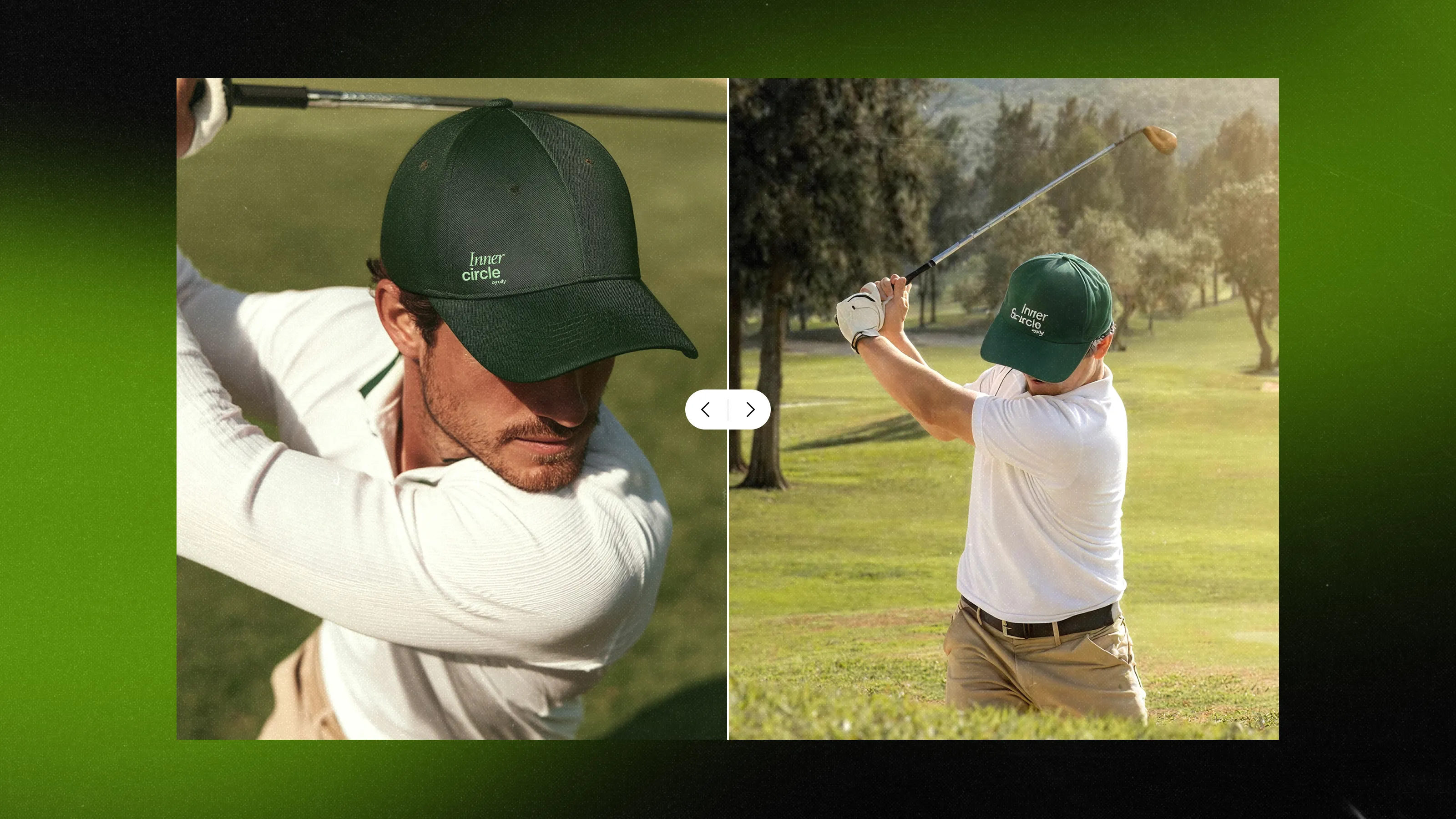
Feels like “spot the 10 differences”—except there are way more: from messed-up text to someone randomly standing in a bush with a golf club.
Scalability. Your brand isn't a logo. It's a system that needs to work on a conference booth backdrop and a 16×16-pixel favicon at the same time—and still feel like the same company when an enterprise client opens your NDA on their end. AI outputs, as a rule, don't scale—they look fine in the one format they were generated in.
Voice and style. AI can write "consistent" copy if you give it detailed guidelines. But if you ask AI to create those guidelines, you get an averaged brand voice assembled from every other tech startup that ever wrote "we make teams more productive." No one will feel your point of view. Because there isn't one.
Why "cheap now" means "expensive later"
There's a logic that seems obvious: "I'll launch the product with AI branding first, then redo it properly once the money comes in." The problem is that a brand isn't wallpaper you can swap out over the weekend.
When you enter the market with a certain identity, you're already building a first impression with customers, partners, and investors. Rebranding is rebuilding the website, as well as all marketing materials, packaging, social media, decks, and email signatures. That's real resources—time, money, and team attention.
And more importantly, it's rebuilding perception. People who've already seen "version one" need to update the picture in their heads. That's harder than simply showing something new to someone who doesn't know you yet.
A temporary bridge isn't always cheaper. Rebranding is more expensive because, in addition to creating a new brand, it also includes transition costs
What AI simply won't do for you and where it helps
Where AI can’t compete with a designer:
Strategic positioning. Before drawing anything, you need to answer: who are you in the market? Who are you not? Why should someone choose you over someone who looks similar? AI doesn't ask these questions. It just executes the prompt.
Understanding your customer. A real designer digs into audience profiles, competitive landscape, and category clichés. They know that a "minimal logo" in fintech right now isn't a differentiator. AI doesn't know your category's visual standard.
Storytelling. A brand isn't a set of assets. It's a point of view—the way your company sees the world and what it wants to change. Instead of a point of view, AI has a dataset.
The human process. This might sound soft, but it's a business argument. When a client goes through a branding process with a team, they understand their brand. They can explain it to their team, their partners, and their investors. They know why each decision is what it is. An AI process doesn't give you that.
It sounds like this is a manifesto against technology—and that's not what this is. AI is a great tool in the right hands and in the right place.
Where АІ genuinely helps:
- Generating mockups and rough concepts for internal discussion
- Quick exploration of color directions before committing
- Automating repetitive tasks—resizing, format adaptation, asset exporting
- Written content as a first draft when you already have detailed guidelines to feed it
AI helped cut production costs—fast. We generated a product video for the client without bringing in a full shoot crew. And yeah—our team knows how to make some damn good stuff with AI.
The most accurate analogy is that AI is a prompt engineer without subject-matter expertise. It can write technically correct code—but it won't tell you which architecture to choose.
So, when is the right time to invest in real branding?
Earlier than you think.
- If you're launching a new product, the right moment is before, not after your first thousand customers. First impressions form fast, and correct slowly.
- If you have an established business but your brand "grew on its own"—you're probably already feeling the symptoms: hard to explain who you are, marketing that doesn't hold together, and a website and social presence that feel like different universes.
- If you're entering a new category or market, your old brand may simply not work in that context.
Somewhere right now, three of your competitors are generating the same logo with the same prompt. Same "clean, modern, professional" output that says nothing about any of them.
You could join them. Or you could build something that actually means something. Your call.