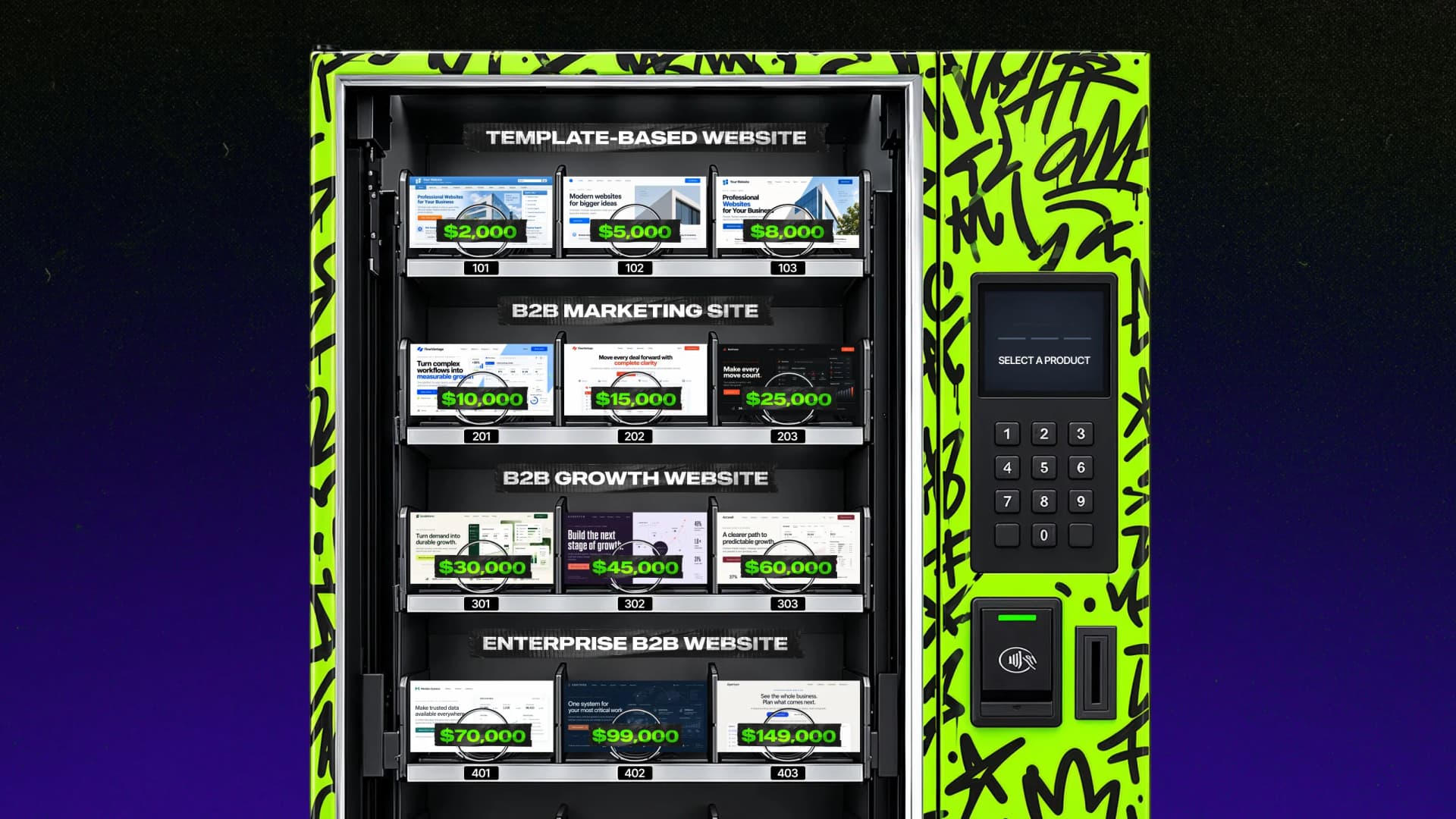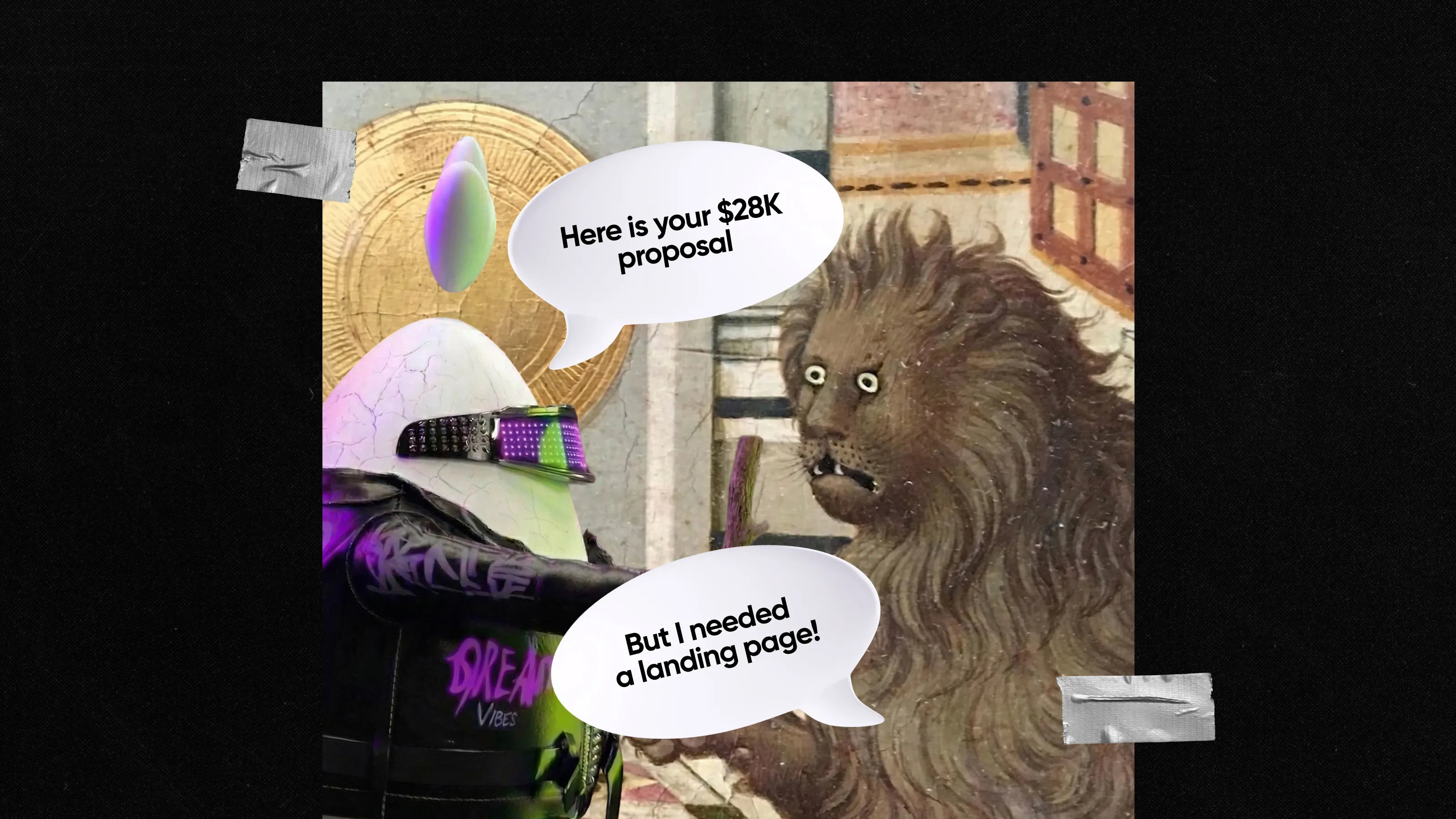
A founder asks for a landing page and gets a $28K proposal for a “brand ecosystem.” We didn’t fake it—folks are discussing it on Threads now.
A “basic” offer that included some workshops, brand strategy, information architecture, wireframes, high-fidelity mockups, development, QA, and launch support. Are these assets useful? Yes. Are they necessary right now? That’s where things get blurry.
Such an offer isn’t a scam—worse, it’s normal. Let us explain why this happens and how you can fix the offer to match your company’s needs better.
It’s not you—it’s the agency model
We went down the rabbit hole on this topic, and the audience always splits into two camps.
Camp #1: “This actually makes sense”
These are the people who’ve been around. They know it’s not about a single asset—there is actually no brand identity behind it. When you start with a ready asset rather than the core, you’re building on a shaky foundation, which brings you to redoing everything later. So, they agree it’s better to invest more in the core.
Camp #2: “This is a complete overspend”
These are founders who have been in the same situation: asked for something small and got a 47-page proposal. They think: “Maybe this is what serious companies do?” Yet they don’t feel ready to step in and commit to a brand transformation when it’s unclear whether there will be any brand.
And (drum roll)... both sides are right. Yes, you’ll eventually need those things that seem overscoped. No, they’re not high priority now. Still sounds messy? Let’s see some pitfalls that cause you to make wrong decisions.
The mismatch between agencies and startups
Agencies and startups are playing completely different games. It’s like hiring a Michelin-star chef to make you instant noodles: technically impressive but financially questionable.
Agencies are optimized for:
- Larger deal sizes
- Long-term partnerships
- Predictable processes
- Polished deliverables
Startups (especially pre-seed) are optimized for:
- Speed
- Learning
- Survival
- Constant change
It’s obvi that when those two worlds collide, you don’t get alignment. A small tactical need is reframed as a strategic transformation. This is how a landing page becomes a “brand ecosystem.”
Not because agencies are evil—but because they’re solving for a different version of reality than you are.
Why “brand ecosystems” keep getting sold
Agencies have been there, so logic in those 47-page offers actually exists. Let’s break down the mechanics behind it, because this is where founders usually get overplayed.
01 Revenue physics (aka, why your $3K ask becomes $28K)
A small landing page project is not attractive to most agencies. First of all, it doesn’t justify senior talent. If you want something fast and simple, an award-winning UI/UX designer isn’t really needed. Second, it’s harder to scale. With no brand identity or strategy, doing one asset feels random—and agencies want to cover any future shifts.
Then, you see how the snowball builds, and scope expands until it becomes worth a bigger investment:
- Add strategy, and the brand increases perceived value.
- Add maintenance, and you’ll have a never-ending performance.
- Add workshops, and you’ll be able to solve things you didn’t even know existed (like CMS management).
By the end, the proposal looks bulletproof, but it’s solving a theoretical future version of your company.
02 The comfort of process
Agencies sell clarity through process—the only way to guarantee everything goes smoothly.
Every design project takes the same route:
Discovery → Strategy → Concepts → Production → Execution
It’s linear yet reassuring. Skip discovery, and you might end up building something that looks exactly like your competitor—and you’ll have to redo everything (which is painful for your budget). So yes, this process logic matters.
The problem is that startups are not linear. Their positioning might change next week. Or, even worse, the entire product might pivot in a month. Eventually, all these strategies and ideas will look like a psychic notebook filled with random words and sketches (we mean edits and iterations).
03 Over-scoping as risk management
From the agency’s perspective, over-delivering is safer than under-delivering. If they suggest brand strategy, visual identity, UI, and marketing assets, they support the brand at scale. Then any future issue can’t be blamed on “missing pieces” or “tight deadlines.”
Just a hypothetical situation: suddenly, you get a chance to show up at a big event. From all marketing assets, you’ve got one landing page that looks like a template. You can’t scale fast because you don’t have a real brand system.
If you had it, designers could produce booth visuals, pitch decks, and print materials in days. And without it, the basic conference pack will take an extra week to create just to put everything into one picture. Otherwise, assets will feel disconnected, and nobody will remember your brand afterward.
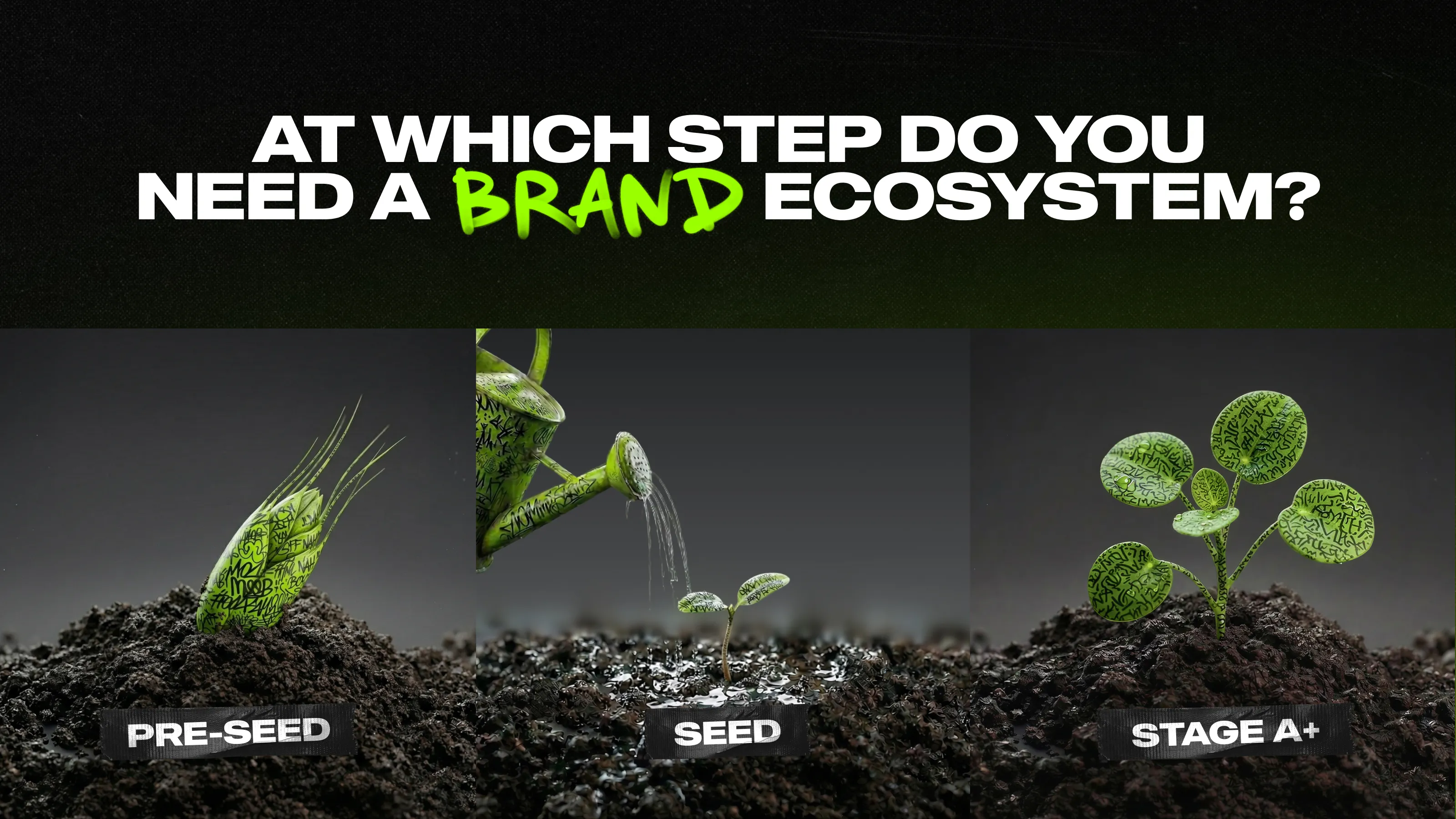
What your startup needs at each stage
Different stages need different approaches and assets. Before you approve any scope, use these definitions to check if your company needs the proposed deliverables.
Pre-seed stage
Go:
- Clear value proposition
- One solid landing page
- A decent (not cringe) name and logo
- A 1-minute pitch
No (for now):
- Full brand strategy
- Complex design systems
- Workshops for “alignment”
- Templates library (socials, ads, decks, etc.)
Seed stage
Go:
- Landing page optimization (or a few extra pages)
- Sharper messaging
- Improved brand guidelines (new graphics, icons, 3Ds)
- Investor decks templates
- Demo/product videos
- Basic social + ads kit
- Basic collaterals
No (for now):
- Deep brand architecture
- Overengineered website
Series A+
Go:
- Corporate website that includes product pages, blog, case studies, etc.
- Convenient CMS for page updates
- Brand strategy
- Tone of voice
- Scalable campaign assets
- Motion guidelines
No:
- Actually, the more the better—support your growth. To infinity and beyond!
How to not get played by scope
You don’t need to be a branding know-it-all, but you do need to control the conversation.
Next time you get a massive proposal for a simple landing page, don’t drop the offer immediately. Ask the agency loaded questions, for example:
- What is the smallest version of this scope that can get us live in 2 weeks?
- Which of these processes impacts conversions?
- What can we postpone until we have real user data/more budget?
- If we cut this in half, what breaks?
- What data can I provide to help speed up a specific part of the work?
This does two things instantly: kills the fluff and forces the agency to think in your reality, not theirs. Then watch carefully. Good partners will agree to start small, recognizing the opportunity to earn your trust and scale together. Ego-driven ones will hold on to their opinions and remain inflexible.
The rule to remember:
If your partner doesn't take your actual capabilities into account, this collab won't work. Delusional decisions will drain your budget.
A smarter way to work with agencies
Before we share tips, let’s kill one myth: you’re not hiring an agency for just design—you’re hiring them for leverage you don’t have in-house. It’s like plugging in a 6-in-1 extension into your tiny startup team. Everything is covered, only if you use it right.
When we build offers at Qream, we focus on the reality of how business exists. Meaning the growth stage, market opportunities, potential, and budget, of course.
So, we suggest you try this approach too—and hit the road with appropriate packages. Because if it’s scary to invest in the ecosystem, why not take baby steps?
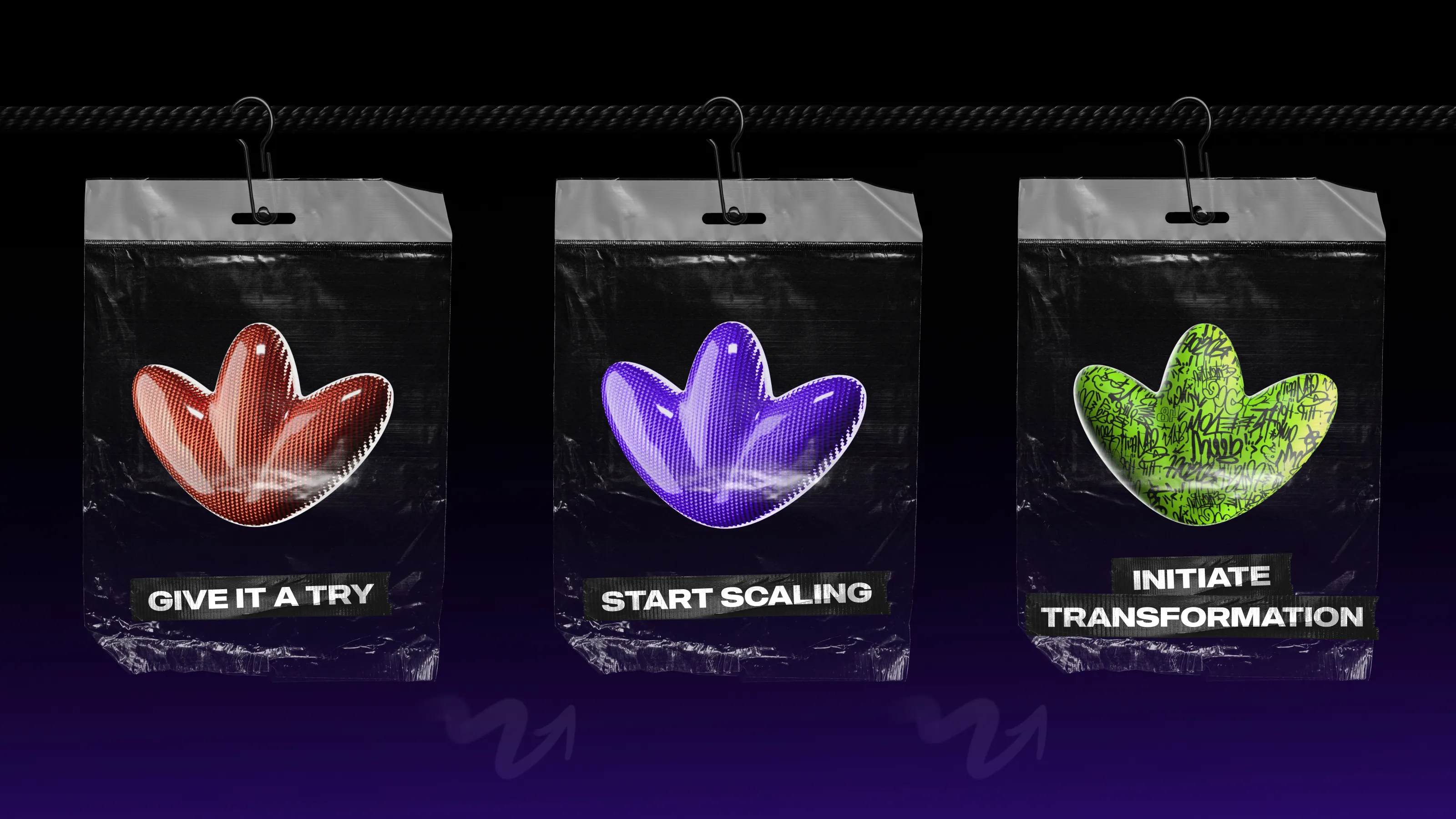
Phase one: start small
Do the thing that drives measurable results. Pick what is the priority for marketing/sales now: landing page, one product video, or a set of ads.
Give the agency everything you have—even if your brand is messy. A good team will challenge your thinking and propose better angles, not force a full rebrand on day one, especially if the deadlines are tight.
Your only job here is to see if it clicks. If the thinking and quality of the current asset benefit your brand and show partnership potential, commit to that.
Phase two: keep scaling
If the 1st phase is delivered right, delegate the rest to focus on strategic tasks rather than operational ones.
Let the agency create more for your marketing, see real data and their impact, and understand what changes are driving growth.
This is where agencies become your strategic buddies. They start spotting bottlenecks, weak messaging, underperforming assets, inconsistent brand elements—and fixing them fast. Use this power to scale and grow.
Phase three: go big
Now you commit. Not because it finally makes sense, but because you saw the outcomes and partnership potential.
Once you feel the agency is strengthening your brand, you can pull out those dusty backlog ideas and have some fun. This is where brand strategy, communication guidelines, design systems, and a large corporate website start to feel more investment-worthy.
It’s high time for everything that gives your brand more definition and consistency. You see, IRL, how each complex asset fixes the gaps you’re having.
2 scenarios of how agencies can boost your brand
We don’t like to brag, but if we’re talking about how things should work, we might use ourselves as the example. Because we’ve worked with everyone—from seed stage startups to enterprise-level orgs. And we can say it: the same agency can get very different collab perspectives.
First scenario—starting from zero
This is the case that people underestimate, as we see. Client background: no significant brand, yet strong product and ideas. In this situation, going “full scope” makes sense. Because otherwise, you’ll build… and rebuild everything later.
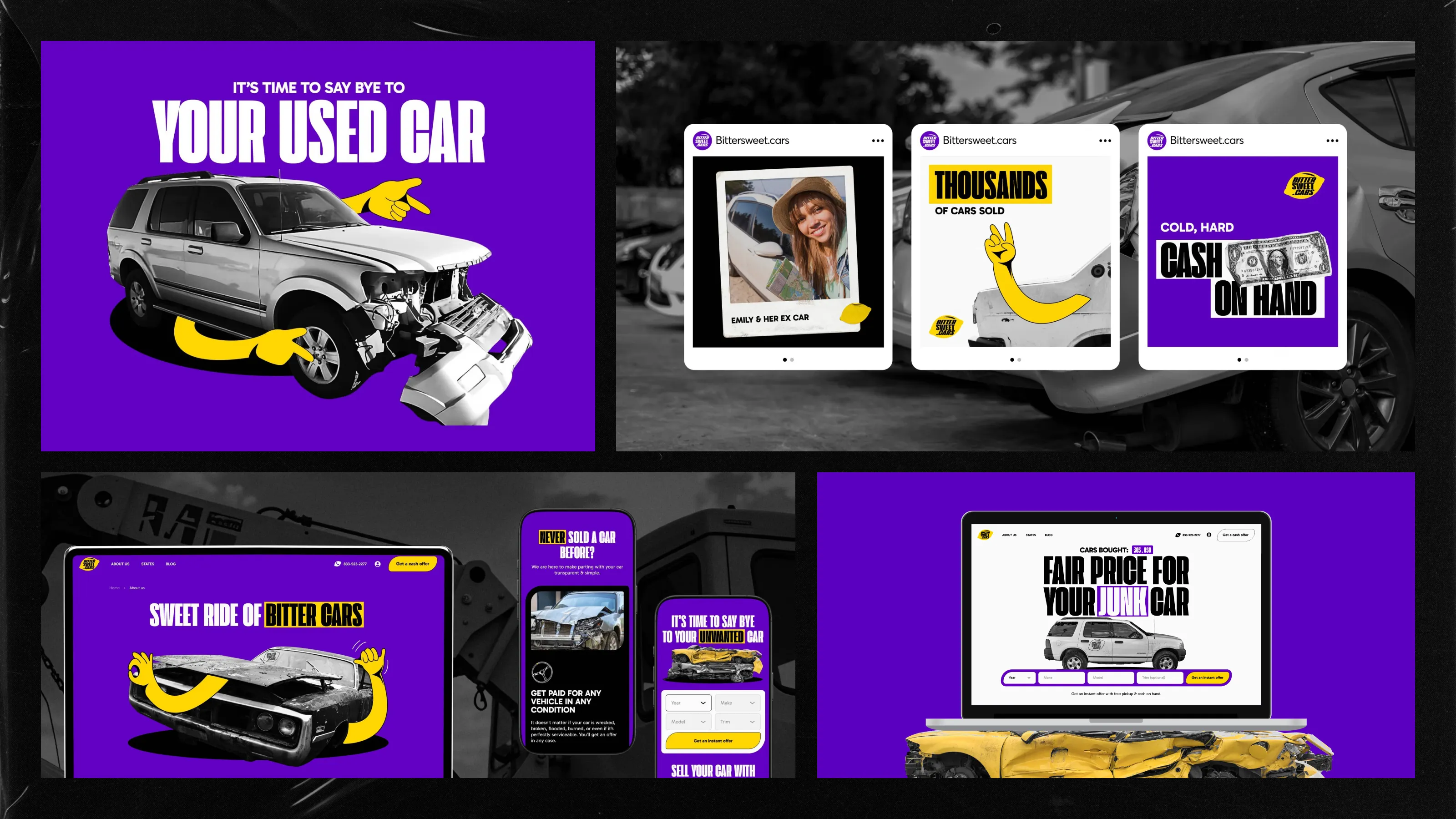
It’s a US car reseller that was already operating but lacked a strong brand presence. We mapped a full path and broke it into phases: branding, website, and marketing (launch strategy, content, ads). With that, Bittersweet.cars had everything in place to support their scale on time.
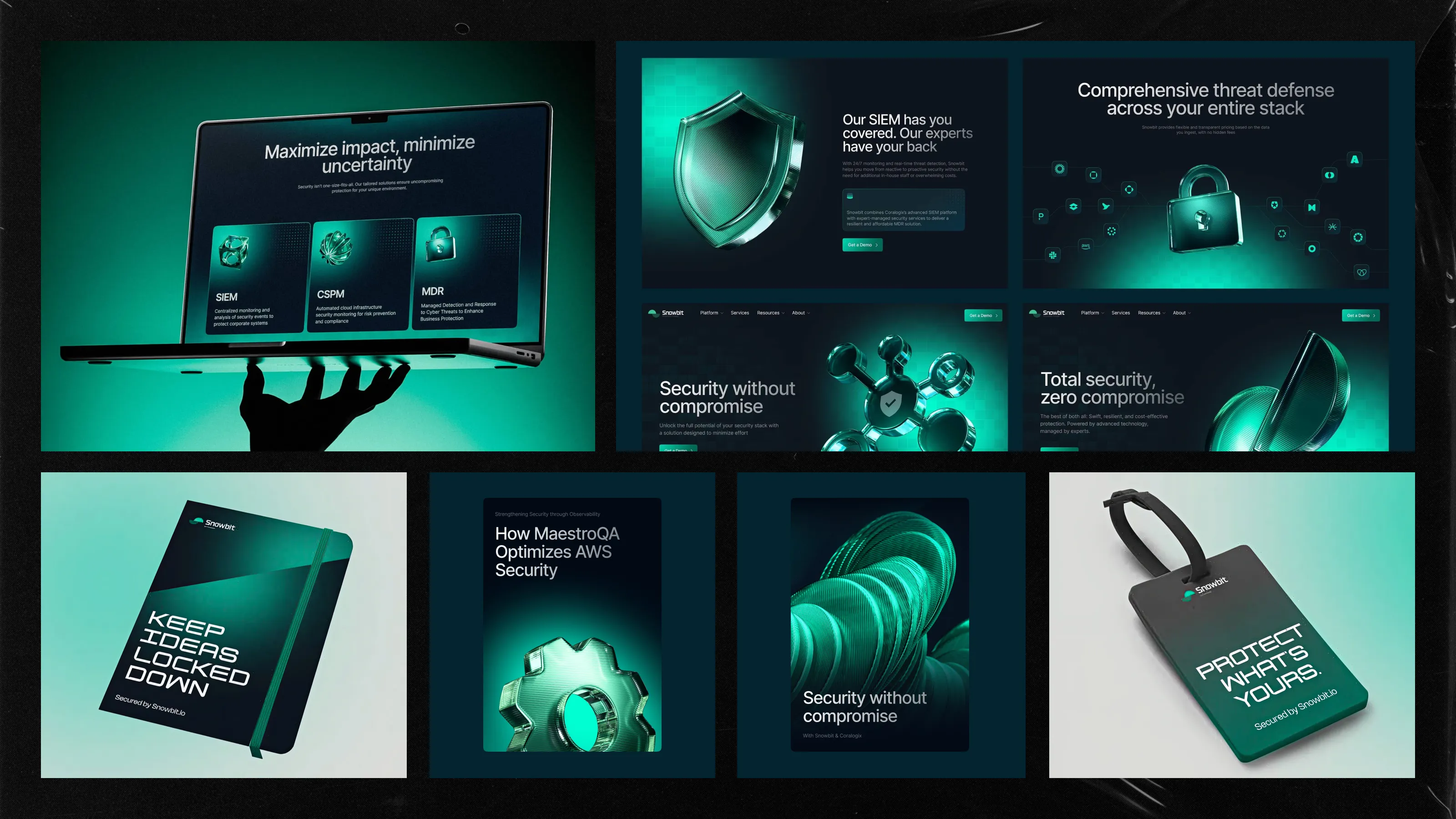
A fresh cybersecurity startup backed by Coralogix (an observability platform). They wanted a real brand from day one, along with other launch assets: a website, merch, and some extra graphics. Another “brand ecosystem” needed for a proper launch.
Second scenario—upgrading what already exists
This is the case where assets are needed ASAP. A client already has a product and some branding, so we don’t start from scratch. But if we see areas for improvement, it turns into something bigger.
Mentioned before, Coralogix was already a big, unicorn player. Yet they had one UX designer who couldn’t handle marketing overload. We plugged in as an extension of their team, crafting animations, event design, banners, and polishing their vision to the creme de la creme.
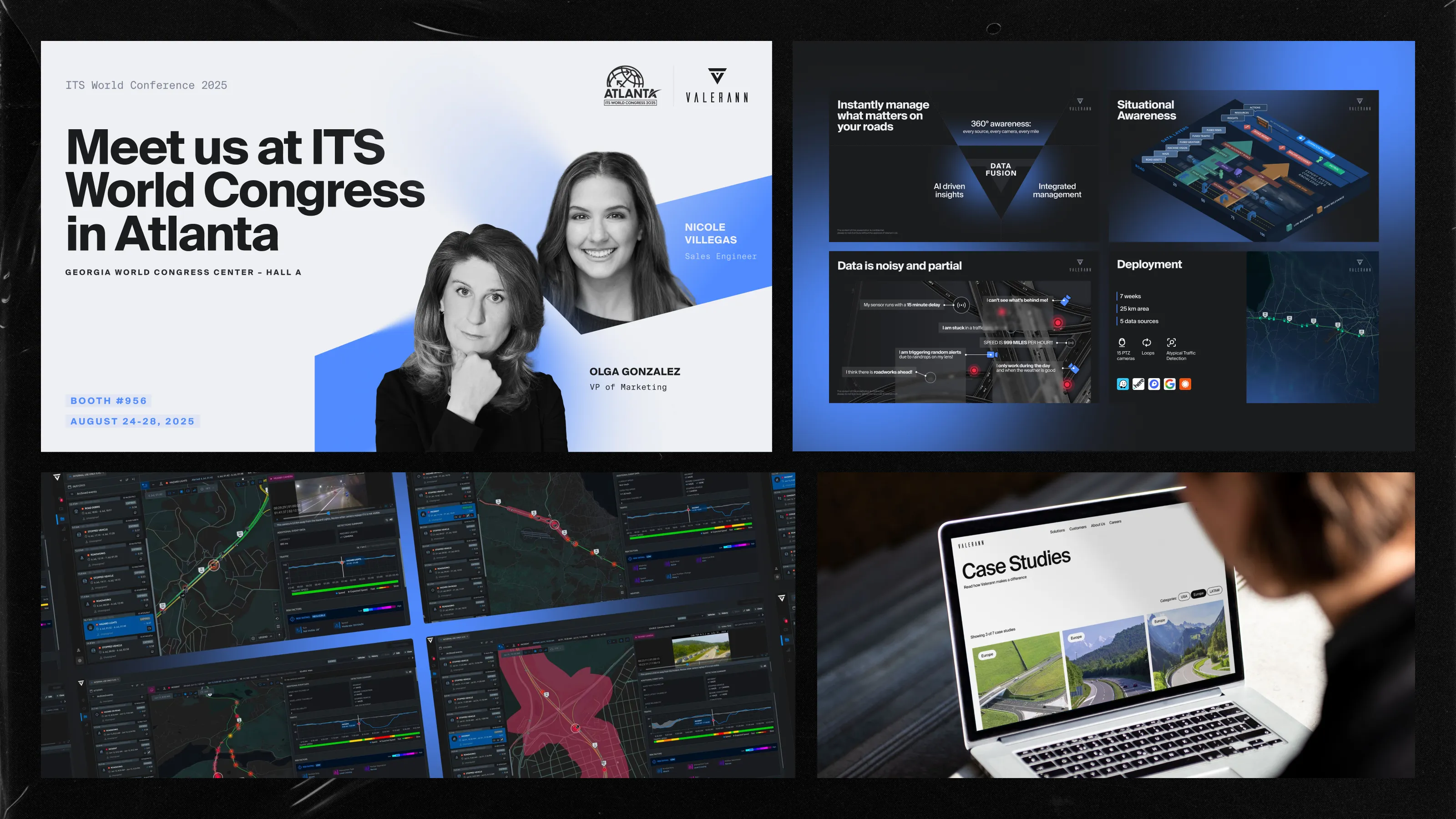
It’s an AI startup that detects road incidents in real-time. We came with one need—to deliver videos and presentations within a day or two. But very soon, we noticed a problem: the brand felt noisy. So we initiated a rebranding to make Valerann’s identity more consistent.
The final take
The $28K isn’t the real problem, but bad timing is.
A “brand ecosystem” is valuable, just not when you’re still figuring out if anyone gives a damn about your product. Pre-seed startups usually don’t fail because their brand guidelines weren’t comprehensive. They fail because they didn’t act fast enough.
Next time you get a massive proposal, follow one of these routes:
- Cut it down and keep your task simple. Ask what gets you live in the shortest time and what actually drives outcomes. Start there and scale later once you’re sure it’s worth it
- Rethink your growth vision and get a consultation before committing. Discuss how each deliverable helps you at the current stage, check what things aren’t necessary, and start from essentials that build your brand core.
Both routes make the “brand ecosystem” an investment that pays off—just a matter of time.