If you’ve been running campaigns for months (or years), tweaking creatives, testing platforms, throwing budgets at ads, and still getting the same mediocre results—it’s probably not “tricky algorithms.” Neither is bad luck—it might be your brand.
Keep scrolling to read what exactly makes marketing efforts fall flat and how to fix that.
“Why isn’t marketing working?” is the wrong question
We wish it was that easy, but marketing isn’t a “launch and play” situation. It’s a system—and systems don’t start with random ads. Strategy is the key.
The system, aka strategy, usually builds on this foundation:
- Research & competition analysis
- Audience segmentation and insights about motivations/needs/pain points
- Value proposition, differentiation, market positioning
- Channel choice and media planning
- Key messages and narratives distribution
If you skip all of that and jump straight into ads, you’re basically shooting in the dark with a machine gun. No matter the growth stage, launching campaigns or socials without understanding “why are we doing this?” and “what do we want to get?” is kinda useless.
With no foundation, marketing scales inconsistency. Fixing that later is pricey, trust us.
Brand weakness symptoms you might not recognize
When branding is undone, you don’t know what to communicate about, who to reach, or why certain channels don’t bring performance. In this case, marketing will slowly fall apart, draining your budget. Let that sink in—here are the signals you should pay attention to.

01 You can’t clearly explain what makes you different
If your answer sounds like “We provide the best solutions tailored to your needs,” you don’t have a positioning statement. You have a placeholder with buzzwords.
Just compare:
- If Grammarly positioned itself as “a paid proofreading tool” rather than as “an AI-powered communication partner and comprehensive productivity tool,” would you see its real value right away?
- If Monday.com were just “a task tracker” and not a “Work OS that simplifies complex workflows through a customizable and user-friendly platform,” would you still be interested in trying their plan?
And now we’re talking. No differentiation = no value = no reason to choose you.
02 You have traffic, but conversions remain low
It’s the case when marketing seems to be working: ads are seen, clicks are happening, but nobody is buying. Why? A classic positioning & messaging problem.
People don’t convert due to these reasons:
- They don’t trust you, meaning you don’t have social proof or a brand name that stands out.
- They don’t “get it,” meaning they don’t find your product better, more innovative, or economically beneficial than competitors.
- They don’t feel urgency, meaning you reached out to them at the wrong time (and you don’t know their motivations or behavioral patterns) or with the wrong offer.
03 Every marketing activity feels disconnected
Here we’re going again with brand consistency. If your ads look and sound one way, the website is another, and social media talks to a completely different audience… don’t be surprised that no funnels will ever work.
Every user goes through a journey: awareness → consideration → decision. If, along that journey, they see completely different messages or visuals, your brand never clicks with them.
At bottom, you can fix that by staying consistent with your CTA and intent. If your ad says “Book a demo,” don’t send users to a generic homepage without access to it. That’s friction.
Or fix it by repeating the same value across all touchpoints. Let’s say, your LinkedIn and PPC messaging shouldn’t feel like two different things. Imagine a SaaS startup says on socials: “We’re a strategic growth partner,” but in ads communicates: “Get leads fast with our tool.” How clear is what they’re doing?
04 You compete on price, not value
If the only way to win a customer is to be cheaper, you’re in a race to the bottom. You might reach out to the “audience with purchasing power,” but will they stay when you raise the price? Well, there’s always someone willing to go lower.
By the way, it works both ways. Relying on “we’re a premium product for premium customers” isn’t a long-term strategy either.
What actually works is a relatable brand that builds perceived value through clear differentiation, strong positioning, emotional connection, and consistent experience.
For example:
- Apple is not better because it’s premium, but desirable.
- Nike is not better because it’s more expensive, but functional and identity-driven.
Customers buy meanings, not just products—and we have to face it.
Why marketing efforts aren’t working—and how to fix that
Let’s translate common complaints into actual root problems. We spied on discussions among business owners and marketers on Threads, Reddit, and LinkedIn, so here are the issues that come up most often.
“We tested different creatives, but nothing brings leads”
The issue: if your positioning is unclear, even the best creative won’t save you. Ads can amplify a key message or image you want to be remembered by. But they can’t invent one—this is more about a specific offer.
The solution: start with the essentials and combine what you have to communicate into one system. Based on your established positioning, define up to 5 key messages that explain it—and then, give them a creative form that can be remembered as an offer.
For example, instead of adding the “All-in-one marketing solution” tagline on creatives, try something more specific, e.g., “Get 3x more qualified leads without hiring a bigger team.”
“We’re spending money, but see no ROI”
The issue: no funnel and tracking system. Spending money unintentionally is not marketing, more like expensive guessing. It can be one of two classic mistakes: you’re launching random creatives at random times, or you’re running massive campaigns all at once and burning resources.
The solution: go in structured iterations, not big bets. Prioritize all channels first, align your website with your offer, and create a few creative batches (e.g., 6–10 static creatives and 1–3 video variations). Then test, compare, and scale what’s working.
Set important metrics before that: CTR benchmarks, how many leads (MQL vs SQL) you need, appropriate cost per lead, etc. If you don’t define success, you can’t reach it—and you won’t know what pays off.
“We have a great product, but competitors win in creativity”
The issue: your brand doesn’t stand out. It could be weak positioning, generic visuals, lack of insight, and so on. Without research, you’ll be guessing.
The solution: rethink the brand from the core and back it up with expert power, whether in-house or from an agency partner.
And no, you don’t fix this by blindly copying competitors’ formats or making funny ads. You stand out by leaning into uncomfortable truths, speaking directly to real pain points, and breaking category patterns.
For example:
- Everyone in your industry uses safe black&white visuals → go bold and use unexpected vivid colors/graphics.
- Everyone promises success → talk about failure, risks, real struggles.
“We tried different platforms, but nothing works”
The issue: you’re showing up where your audience isn’t—or doesn’t care.
The solution: look at real data.
One way is to check your CRM:
- Where do your leads come from?
- What do they care about?
- How do they make decisions?
If you don’t have that, follow another way:
- Use statistics and platform behavior insights.
- Match your audience demographics with channels.
Middle and senior professionals will browse LinkedIn daily. Certain regions prefer specific messengers, e.g., Viber, WhatsApp, or Telegram. Channels aren’t really universal—context matters and determines all.
“We have a budget, but we don’t catch priorities”
The issue: if you don’t know where to start, you’re probably missing a funnel/Customer Journey Map.
The solution: map behavior and triggers for each stage.
- Awareness → where users discover the problem. Make them know you have a fitting solution.
- Consideration → where they compare solutions. Use it to stand out among competitors.
- Conversion → where they act. Suggest a simple offer without being overwhelming or pushy.
- Retention → where they stay. Build warm contacts and suggest personal offers to drive loyalty.
And then, connect them to channels you have, e.g., website, ads, blog, social, reviews, email, etc.
All issues come down to branding
Branding is often misunderstood, leading to the idea that it’s only about visuals. So, when a hypothetical startup already has a logo, a few colors, and two fonts, some people think that’s enough to launch full-scale communications. But no one builds a house on a lousy foundation.
Branding is a system made of:
- Brand strategy that defines your place in the market, who you’re for, what you stand for, why you matter, and what you communicate. This is your differentiation.
- Verbal identity that includes the name, taglines, and tone of voice. It sets your brand personality and emotional tone: how bold (or conservative) you want to sound.
- Visual identity that expresses emotions through colors, typography, graphics, and motion. People do judge by the cover—it makes you memorable.
In simple terms:
Marketing tells people about you—branding gives them a reason to care.
The hidden reason marketing fails: maybe your product isn’t wanted
We’re sorry to bring this up, but are you sure your product stands out—and people actually need it?
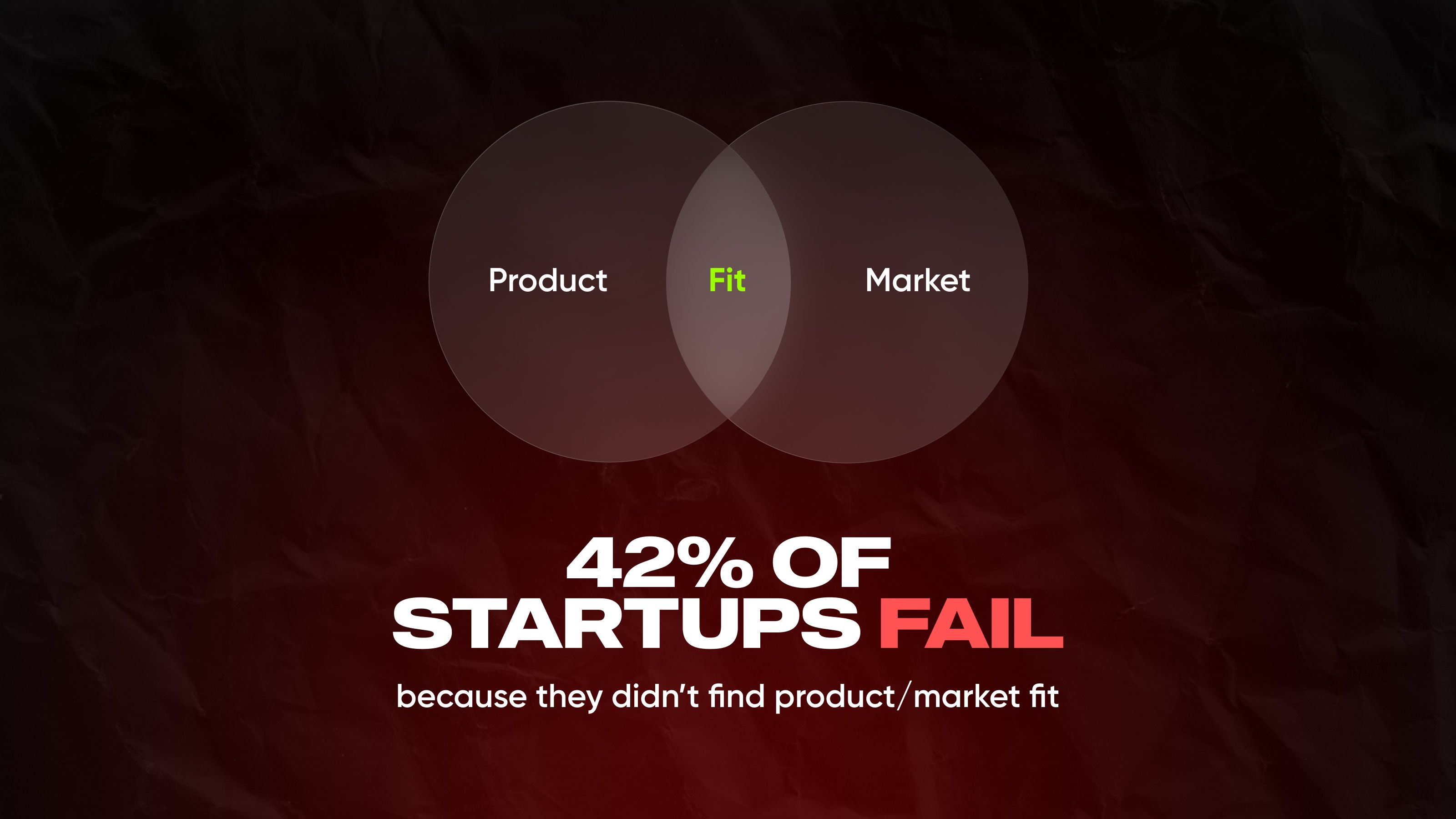
Product-market fit comes before marketing. Even the best promo in the world can’t fix a product nobody needs, a saturated market with no differentiation, or an irrelevant offer.
The #1 reason startups fail is a lack of market need—43% of them quit because no one cares about their solution (according to the CB Insights research). The great idea that came to your mind isn’t equal (yet) to a product loved by millions. To achieve that, you have to be more flexible, conducting user research & interviews all the time and adding in-demand features.
Because the market today is crowded. It’s not 2010. People aren’t surprised by AI assistants—they already think “innovative” features are the bare minimum.
The market is attention-starved as well. People need more than another option—they seek an emotional resonance that usually stands out.
Say, you’re building another payment tool. Instead of promoting another “Fast and secure payments,” try hitting on real pain points, e.g., “With our tool, you’ll stop losing international clients because your payment system breaks at checkout.”
Your roadmap for marketing improvements
If something isn’t working, don’t just start producing more ads. Step back and start from the basics, answering the main question: “Does my brand give people a reason to choose it?”
If the symptoms above sound familiar, follow this path.
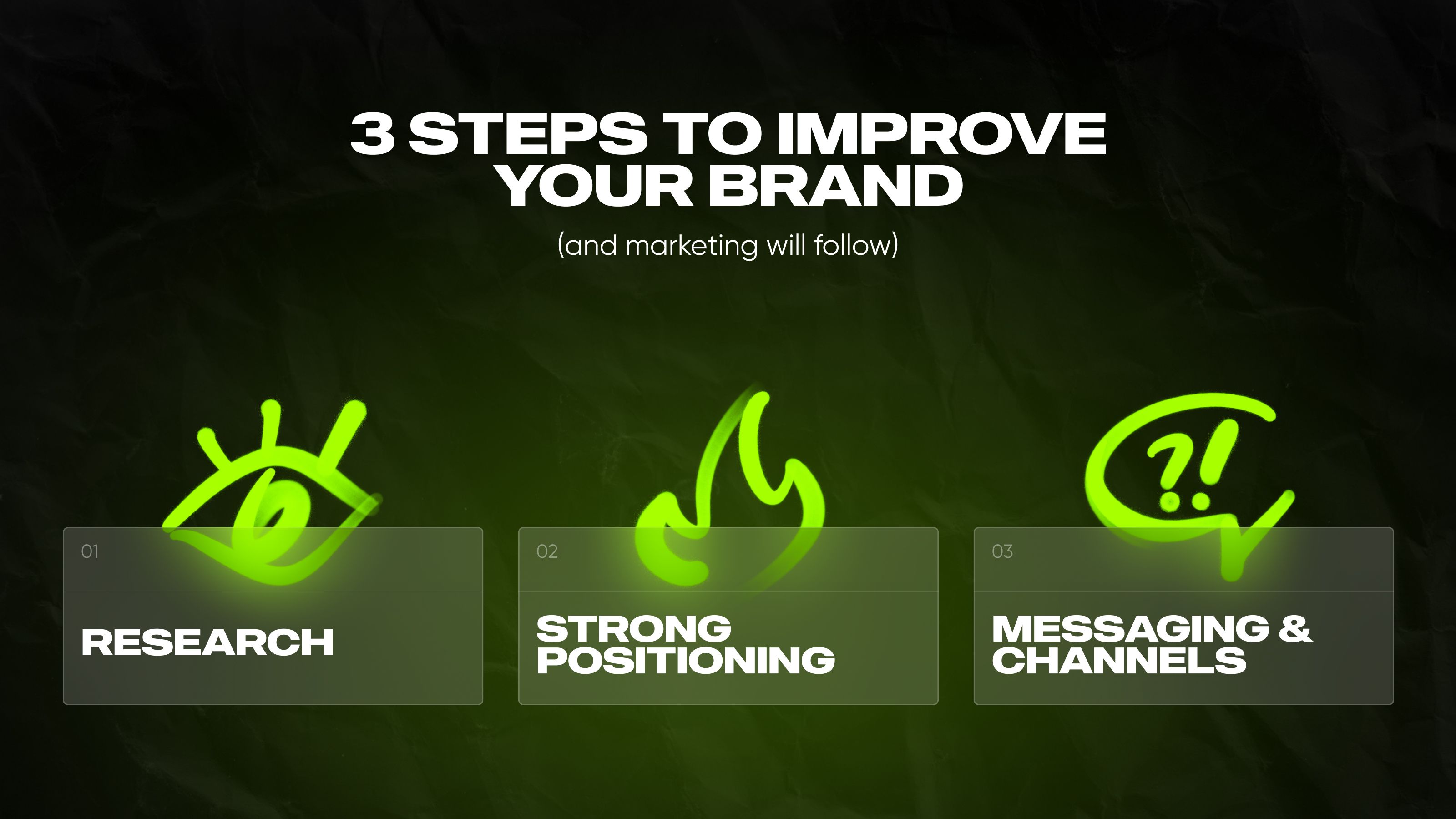
First things first, do the research. Talk to users and uncover their behavior. Run at least a few interviews with a real client/someone who matches the ICP to understand true pain points. It’ll help you communicate not about what you think is right, but what they actually feel is going on.
Analyze competitors, too. At least check their ads on Meta Ads Library to review their messaging and study how they attract attention through visuals. Are they eye-catching and memorable? Does their offer sound better?
Second, define your positioning. Find the gap between what people need and what competitors don’t offer. If you add an emotional benefit or a feature that no one has, you win.
The last thing, match messages with channels. Choose where our audience actually pays attention, and don’t do TikTok just because trendy videos get many views.
Then—and only then—scale. Marketing works best when you build it on something solid.
Written by

Qream co-founder | Design and product direction
Leads Qream's creative and product direction, connecting brand strategy, experience design, and business goals. Reviews content where design strategy, UX/UI, customer experience, and brand execution are central.