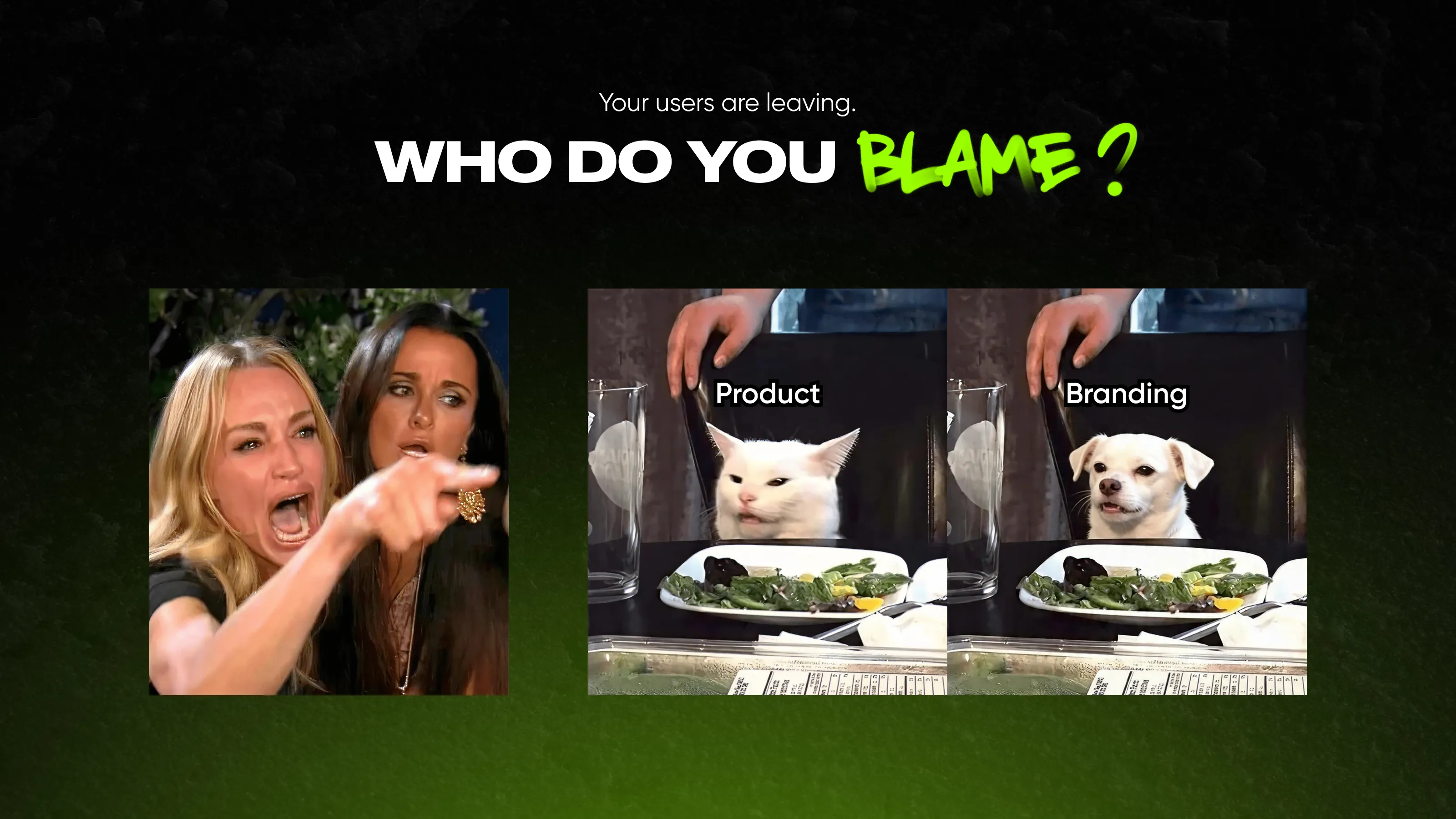
There’re recurring debates on X every few months: can bad branding actually be the reason you’re losing customers? Half the replies say it’s a product problem. The other half says it’s UI. Both sides are actually missing something.
If your users churn fast, you’re dealing with something more fundamental: people never actually understood what your product was supposed to do for them. Let’s go through, step by step, why the brand is key to a business’s ups and downs.
Is it a product problem or a branding problem?
Our call: let’s ground this in a real scenario we saw on Reddit.
Imagine a typical SaaS—a project management tool for construction companies. As with any product, it’s not simple and has lots of workflows, industry-specific logic, etc. But users act weird: they sign up, click around for a day or two, and disappear. Exit surveys say the same thing: “I couldn’t figure out how to do what I needed.”
So the team invests in guidance: a 7-email onboarding sequence, tooltips and tours, and tutorial videos. But nothing barely moves. So what exactly are they trying to fix?
Two patterns showed up in this situation:
- You’re solving the wrong problem. Users aren’t trying to learn to use your complex tool–they just want to complete a very specific job. When the product experience doesn’t map directly to that job, additional tutorials don’t reduce friction.
- You’re overexplaining and creating tension. When product teams sense confusion, they tend to add more guidance. But it just increases cognitive load, and no user wants to be involved in that.
At first sight, it looks like a UX or onboarding issue. More content = more complexity = less desire to continue. But if we dig down, we’ll see the roots of this issue.
In this case, users aren’t saying that the product failed. They shared that they didn’t get if they could solve their needs. That points to a breakdown in how the product is framed and understood, not just how it functions.
We can frame it like this:
- If users understand what they need to do but can’t execute it, you are dealing with a product problem—bad UX, technical features issue, etc.
- If users don’t understand why they should try harder in the first place, you are dealing with a branding problem—value misunderstanding, broken expectations, etc.
Let’s also clarify what “branding” means in this context. Qream treats it as more than visual aesthetics—branding the system that shapes how people interpret your product before and during use. It defines the mental model they bring into the experience and the visual identity that creates clarity and reliability. And when this model is incomplete, churn might happen.
How branding becomes the reason for churn
When branding is weak or misaligned, users form the wrong expectations about the product. With the wrong expectations, they take the wrong actions. When those actions don’t lead to value, they disengage.
At Qream, we see these 4 patterns the most when discovering tech brands:
01 Expectation mismatch, aka wrong positioning
If the user says, “This isn’t what I signed up for,” the promise made in acquisition channels doesn’t align with the actual product experience.
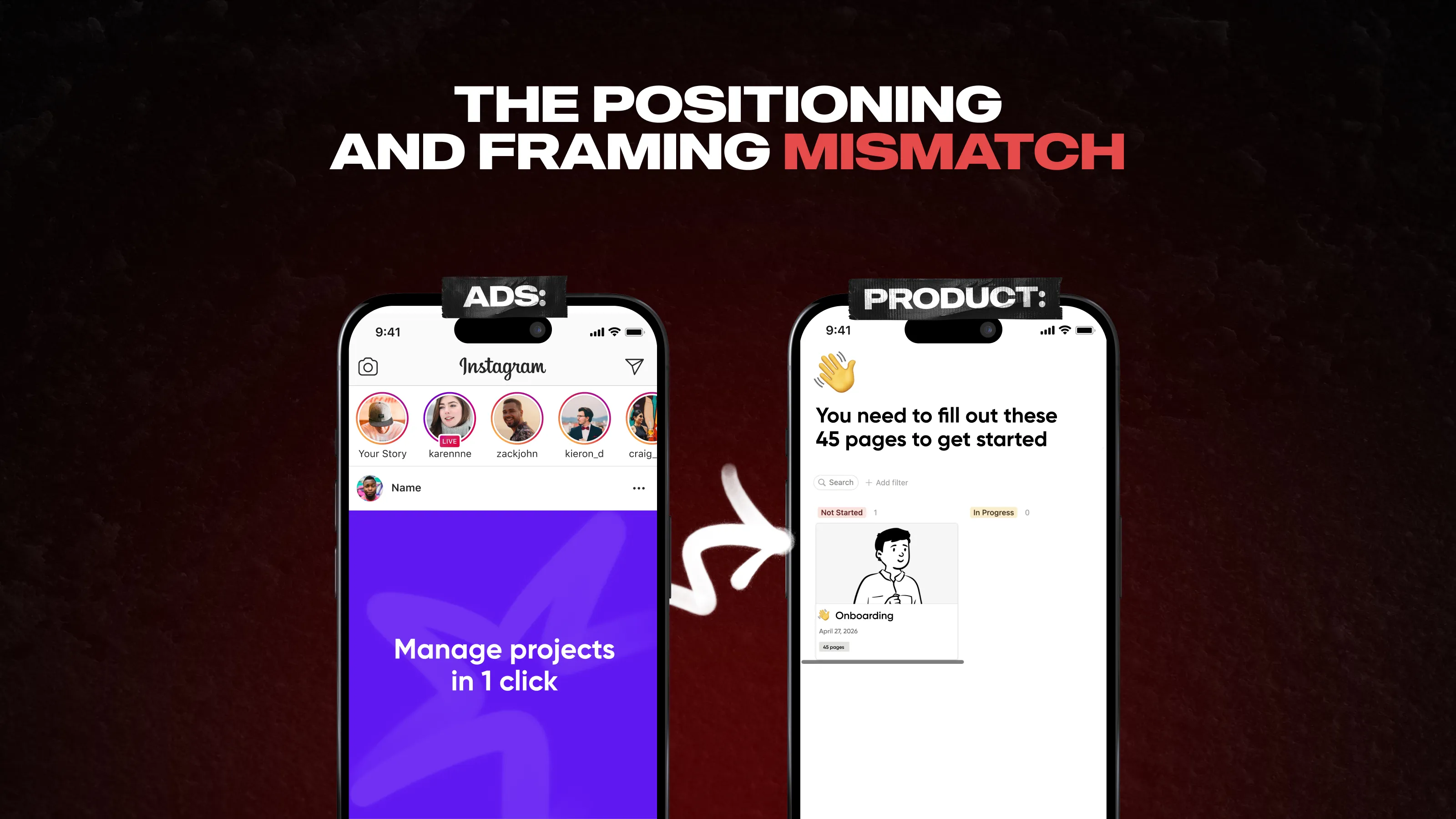
Even small differences in emphasis can lead users to approach the product with the wrong goal in mind. For example, a tool positioned as a way to “simplify project workflows in 1 click” may require significant upfront configuration. Users who expect immediate simplicity get stuck in complexity instead, and many of them drop off before reaching any progress.
02 Cognitive overload
It usually happens in an attempt to be flexible and powerful. “More promises mean more value.” “Flashy visuals will attract users, what do you mean it overcomplicates UX?” Bruh, if the brand core lets teams follow this logic, it’s doomed.
Products also like to show off with multiple workflows, options, and entry points. From an internal perspective, this reflects the team’s capability. From a user perspective, it creates overload. Time-to-value increases, and the likelihood of drop-off rises accordingly.
03 Trust deficit
This is less about functionality and more about perception. Inconsistent UI, unclear messaging, or a lack of visual hierarchy can signal that the product is not fully thought through.
In B2B contexts, especially in fast-moving tech industries, this matters. If the brand doesn’t feel reliable, users are less willing to invest the effort to learn it. Without that initiative, they never reach the point where product gains become clear.
04 Value uncertainty
Back to the construction example. Users land and can’t answer a question: “What’s the first thing I should do to get value?”
They may see many features, but none of them clearly connect to their need. In the construction example, each user may have a slightly different use case. And that, folks, is your secret power.
Use different scenarios to present how your product solves customers’ problems. Tailor your comms, tailor your product—make people step closer to feel the value.
Where the user journey breaks—and breaks the branding
Teams often analyze churn at the end of the user lifecycle, looking at retention and other data. However, the critical twist happens much earlier, when users form their initial understanding of the product.
A typical user journey includes several stages: discovery, evaluation, signup, initial use, and ongoing engagement. Branding plays a role at each stage, but its most important function is to create continuity between them.
When branding is effective, the user moves through these stages with a consistent mental model. The expectation set during discovery is reinforced during evaluation and confirmed during initial use. The first actions they take in the product align with that expectation and lead to a quick win.
If this model isn’t clean, the journey collapses:
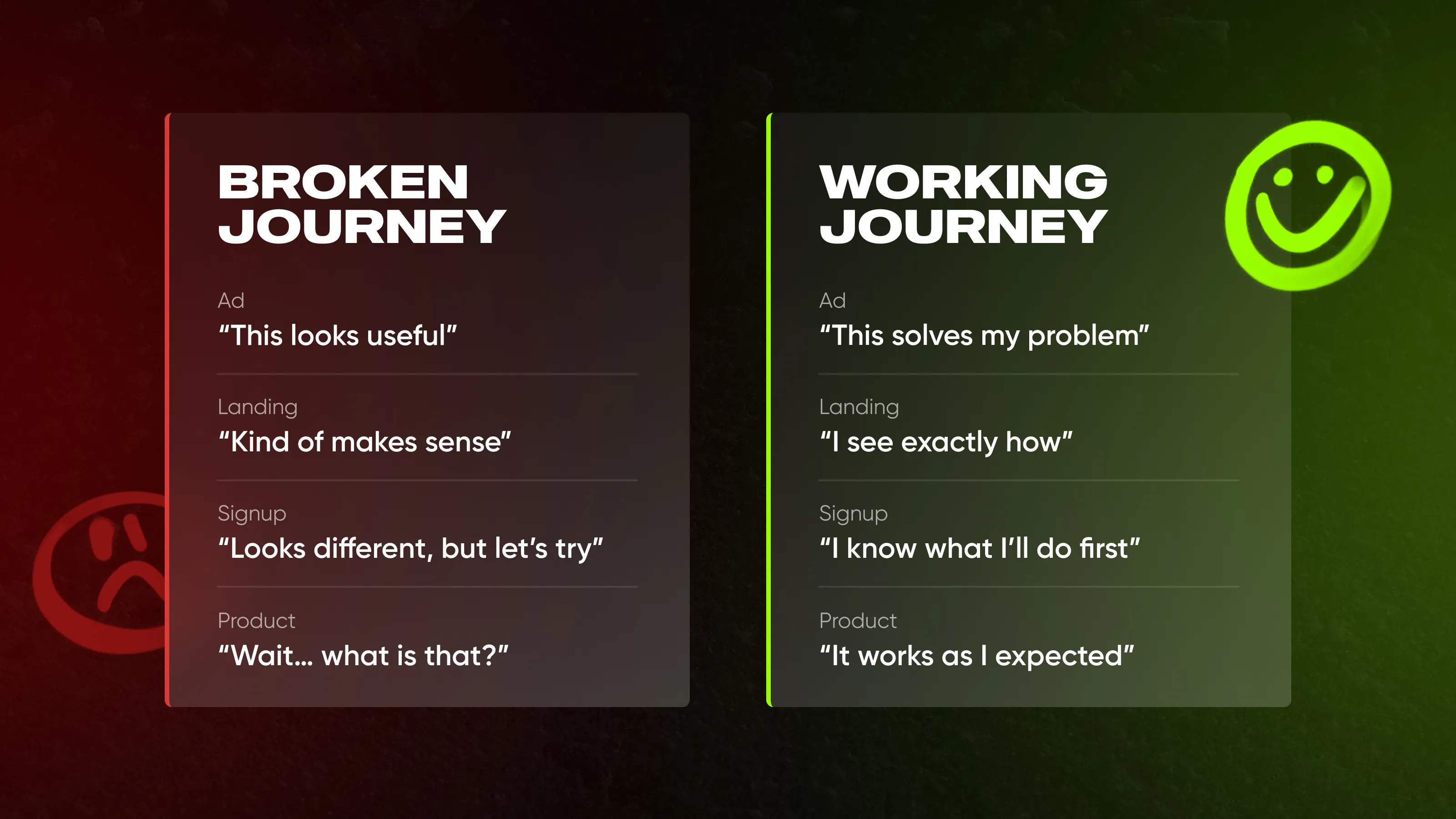
When branding is weak, the user enters the product with one understanding, only to encounter a different reality. At that point, they have to reconstruct their mental model. That requires effort, and most people will drop off unless the perceived reward is high enough.
This is also the reason why onboarding fails. Teams attempt to explain the product after the user has already formed an incorrect understanding of it. By that stage, you don’t want to educate from scratch, but to guide users toward value within an existing framework.
Explaining why weak branding is the problem to the board (in their language)
Your board isn’t thinking about “emotional bond” or anything else that comes to branding. They need numbers—and if the data is persuasive, the actions will be taken.
What you don’t want to do here is evaluate only the results. Metrics such as churn, retention, customer acquisition cost, or revenue growth don’t show the reason why. Of course, you can frame branding as a driver of efficiency and connect it directly to these metrics. But we suggest going big brain.
Here are data sources that prove your branding is the missing part.
Exit surveys, NPS comments, support tickets, and social listening
Pay attention to what people complain about. If there is a product problem, you’ll see consistency: “Missing feature X,” “Integration with Y doesn’t work,” “Too expensive for what it does.”
But when it’s a branding problem, feedback looks different: “Not what I expected,” “Enjoy Competitor X more,” “Don’t want to keep trying.” These insights signal why your brand isn’t chosen.
Product usage data
When a product is the problem, users usually let you know that by complaining to the support. But when branding and expectation mismatch are the problem, users don’t even get that far—they just ignore you.
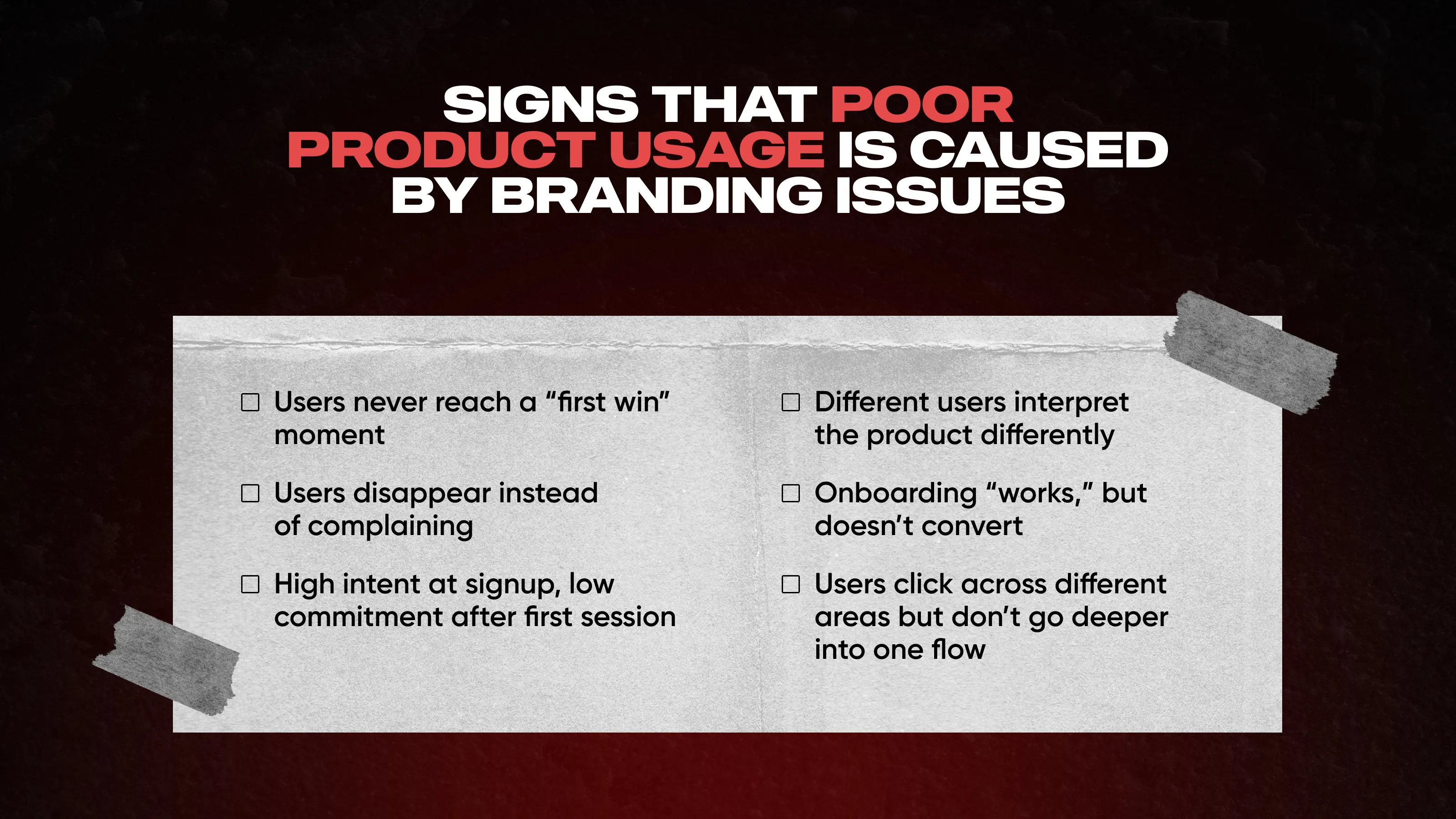
You’ll see low onboarding completion rates, short sessions early on, and users “poking around” without committing to a workflow. It might not be a usability issue, but a missing mental model. Users didn’t see what this product is for them or what success looks like.
From a business perspective, this is a lost conversion. You already paid to acquire these users, but they never got convinced that it’s worth the effort to continue. No amount of onboarding fixes that. If there’s no clarity, no pull, or no reason to push through friction—that’s a branding issue.
Engagement data (email opening, CTR, unsubscribes, etc.)
When branding is weak, you often see declining email open and click rates, rising unsubscribe rates, and decreasing responsiveness to updates or new features. This happens because the user never fully “bought into” the product.
When any content you send (newsletters, product updates, or promo) is ignored, it signals a decrease in brand interest. No other way around—users just don’t feel the brand is remarkable or worth checking out.
Segmentation analysis
Segmentation usually tells you who is churning. But it can also reveal a branding problem if you dive deeper into who’s coming from where—and with what motivation.
If it’s a product issue, patterns are clean: enterprise leaves for missing features, SMB leaves for price. Transparent cause for each segment.
But when branding is off, it gets messy. Some segments perform fine, others churn fast, and different acquisition channels behave inconsistently. That’s the signal—you’re attracting the wrong users, and your positioning isn’t strong enough to anchor a shared understanding of what the product is and why it matters.
Time-to-value
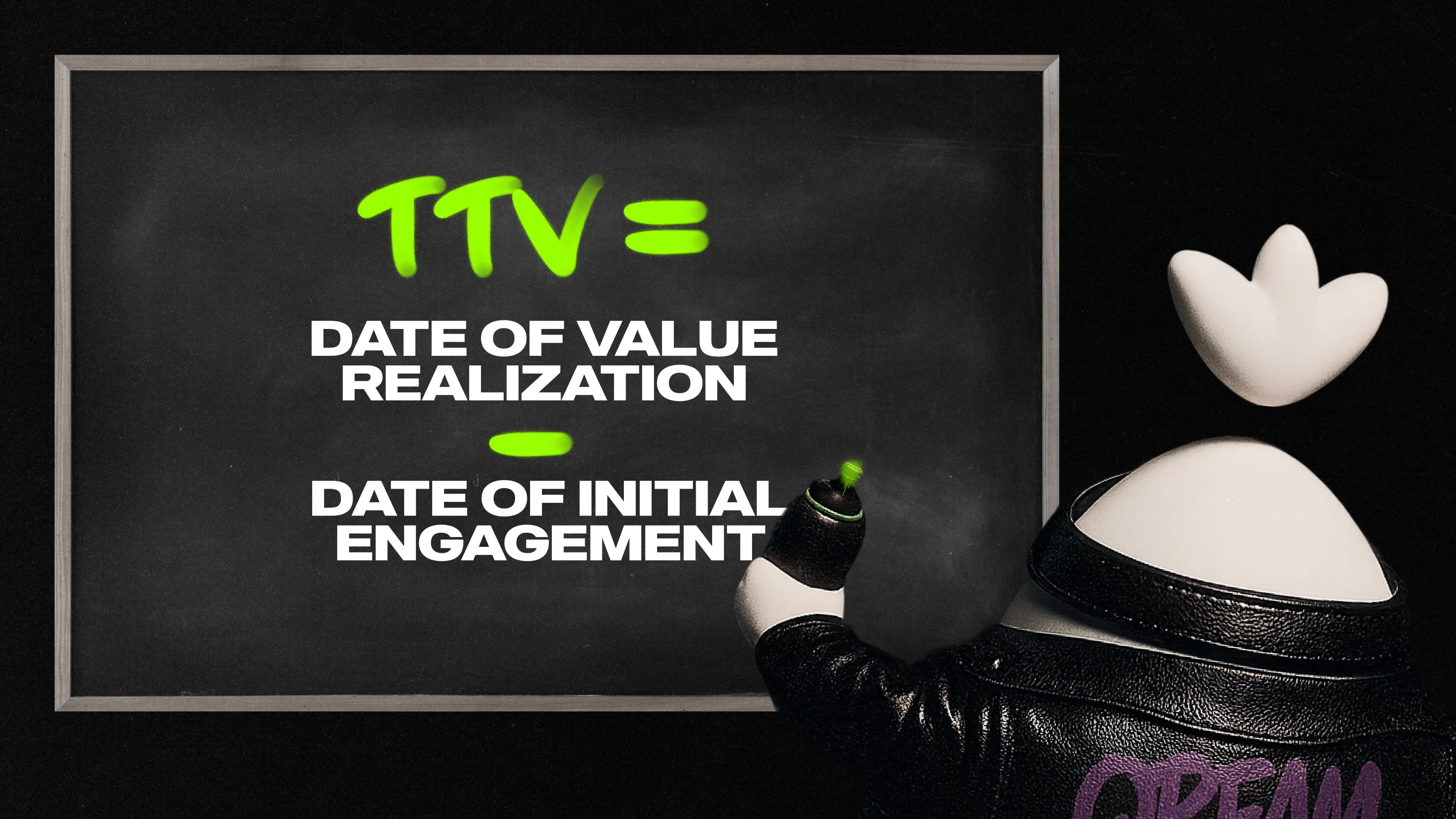
Finally, look at how long it takes users to reach their first meaningful outcome. If the product itself is complex, a longer TTV can be expected, but it’s usually consistent (and the churn isn’t a big plot twist coming from nowhere).
When branding is the issue, TTV becomes unpredictable: some users grasp it quickly, others never do, and support has to “translate” the product for users.
This inconsistency is the signal. If value depends on someone explaining the product, your branding isn’t doing its job.
Self-diagnostic: does your branding show red flags?
Most teams try to debug churn by looking at behavior inside the product. Branding problems show up earlier—at the level of interpretation. So instead of asking what users do, start by asking how they get it.
01 Do different users describe your product in completely different ways?
If your ads say the product is “a simple tool to track projects,” and a user sees it as “a complex system to manage operations,” you have a positioning problem. Users may use different words from you, but they have to share the same core idea.
02 Do users come in with expectations you never intended to set?
Look at what users try to do first and what they’re disappointed by. If you hear things like “I thought it’d be simpler” or “I expected it to work differently,” that’s expectation drift. And it doesn’t start inside the product—it starts in how the product is framed before usage: ads, landing pages, category positioning, and the story users absorb before they even sign up.
03 Do users trust what they see before they understand it?
Visual identity isn’t about aesthetics—it forms early trust. If the product feels outdated, templated, or inconsistent, users don’t immediately see “bad design,” but they sense uncertainty.
04 Are you attracting users who are technically a fit, but mentally misaligned?
This is when, on paper, your ICP is correct, but in practice, users don’t behave the way you expect. They don’t follow the intended path and get stuck in different places. That usually means the issue is framing: you bring in the right people, but they arrive with the wrong mental model of what the product is and how it fits into their workflow.
Final thought: churn doesn’t start in the product
When churn goes up, the default reaction is to look inside the product—onboarding, UX, missing features. Sometimes that’s right, but often, the issue starts much earlier.
By the time a user enters your product, they’ve already formed a belief about what it is, who it’s for, and what success looks like. That belief comes from positioning, messaging, look, and framing—not onboarding. If that mental model is off, the product doesn’t solve the problems people face.
That’s why branding matters here—as the system that shapes interpretation before usage. It defines who you attract, what they expect, and whether they recognize themselves in your product story.
So when you see churn, don’t only ask what broke inside the product. Ask what users thought they were signing up for. If that expectation is misaligned, no amount of onboarding will fully fix it.
Written by

Qream co-founder | Business growth and strategy
Leads Qream's business development and commercial strategy, bringing experience across sales, customer support, and complex digital projects. Reviews topics around project scoping, agency engagement, strategic partnerships, and growth.