Most cybersecurity websites look as if they were designed by engineers for engineers, and it’s immediately obvious. That’s exactly why cybersecurity website design often fails to convert enterprise buyers.
Here’s the sad and unpleasant truth: your website isn’t so much losing to competitors as it is losing to the confusion that throws the customer off track. If an enterprise client can’t figure out in a few seconds exactly what you do, who you do it for, and why they can trust you, they’ll simply close the tab. There’s no second chance.
Why most cybersecurity websites fail enterprise buyers
Poor conversion rates are often the result of ineffective cybersecurity website design. However, there are other important factors that companies often overlook:
Visual clichés that signal, “Hey, we’re just like everyone else”
Imagine a CISO or security lead opening a website, seeing a dark background, a padlock, and neon lines—and within three seconds thinking, “This is just another generic vendor.” Such visuals say nothing about the product, the environment, or the complexity of the solutions.
As a result, the website doesn’t set the company apart; instead, it puts it on the same level as dozens of others. Without clear signals about “who this is for and what exactly it solves,” the user simply closes the tab and moves on, because they’ve already seen a million similar visuals.
Messages that are overloaded with features and lack clarity for the customer
An enterprise buyer scans a website looking for the answer: “Does this solve my problem or not?” When they see a list of 20 features without any context, it just looks like white noise.
For example, “AI-powered threat detection, real-time analytics, scalable architecture” sounds impressive, you’ll agree, but it doesn’t answer the questions: Where does it work? What does it protect against? What are the results?
Without this, the user can’t quickly “try on” the product for their situation and simply moves on.
Missing or weak trust signals
A CISO won’t “dig deep” to find evidence; they expect to see it right away. If the first screen doesn’t feature familiar logos, mentions of compliance (SOC 2, ISO 27001), or specific results, a sense of risk arises, along with the question, “Is this risk worth taking?”
In practice, it looks like this: opened the site, didn’t understand who they’ve worked with, didn’t see any numbers or case studies, closed it.
Without quick and recognizable trust signals, the company looks “unverified,” even if the product is strong.
Lack of context regarding pricing or qualifications
Enterprise buyers don’t expect to see exact prices on the website, but they need at least a rough idea. Without it, they can’t tell whether the solution is intended for large or small companies.
Without any indication of scale (type of clients, company size, implementation complexity), users won’t be able to assess “whether this is even relevant to us.” As a result, either relevant leads are filtered out, or irrelevant ones come in—which is also a problem.
What enterprise buyers actually look for
Enterprise buyers evaluate your website in the first 10 seconds, often before involving sales. This is where branding becomes critical.
This means your site is being judged not as marketing, but as a decision-making tool. In those first seconds, buyers are subconsciously trying to answer a few critical questions:
Can I trust this company with my data?
Trust is assessed instantly based on visible indicators. Buyers look for SOC 2 or ISO 27001 badges at the top of the page, recognizable client logos, mentions of compliance in the header or at the beginning of the text, as well as clear statements regarding data processing or infrastructure. If these elements are missing or buried deep within the site’s structure, it amounts to losing a customer.
Do they understand my compliance requirements?
Corporate buyers expect compliance with the standards they already use. This means clearly referencing standards such as GDPR, HIPAA, SOC 2, and ISO 27001, as well as providing dedicated pages, integrations, or use cases that demonstrate how your product fits into compliance-driven organizations.
Is this a serious, scalable company?
Trust is built through the website’s appearance and structure. Buyers pay attention to the quality of the design, the detail of case studies with actual figures, the availability of information about the team or management, as well as examples of clients of a similar scale. If the website looks generic or superficial, it immediately raises doubts, even if the product itself is strong.
The anatomy of a cybersecurity website that converts
The difference between an average and high-performing enterprise cybersecurity website is structural not only visual.
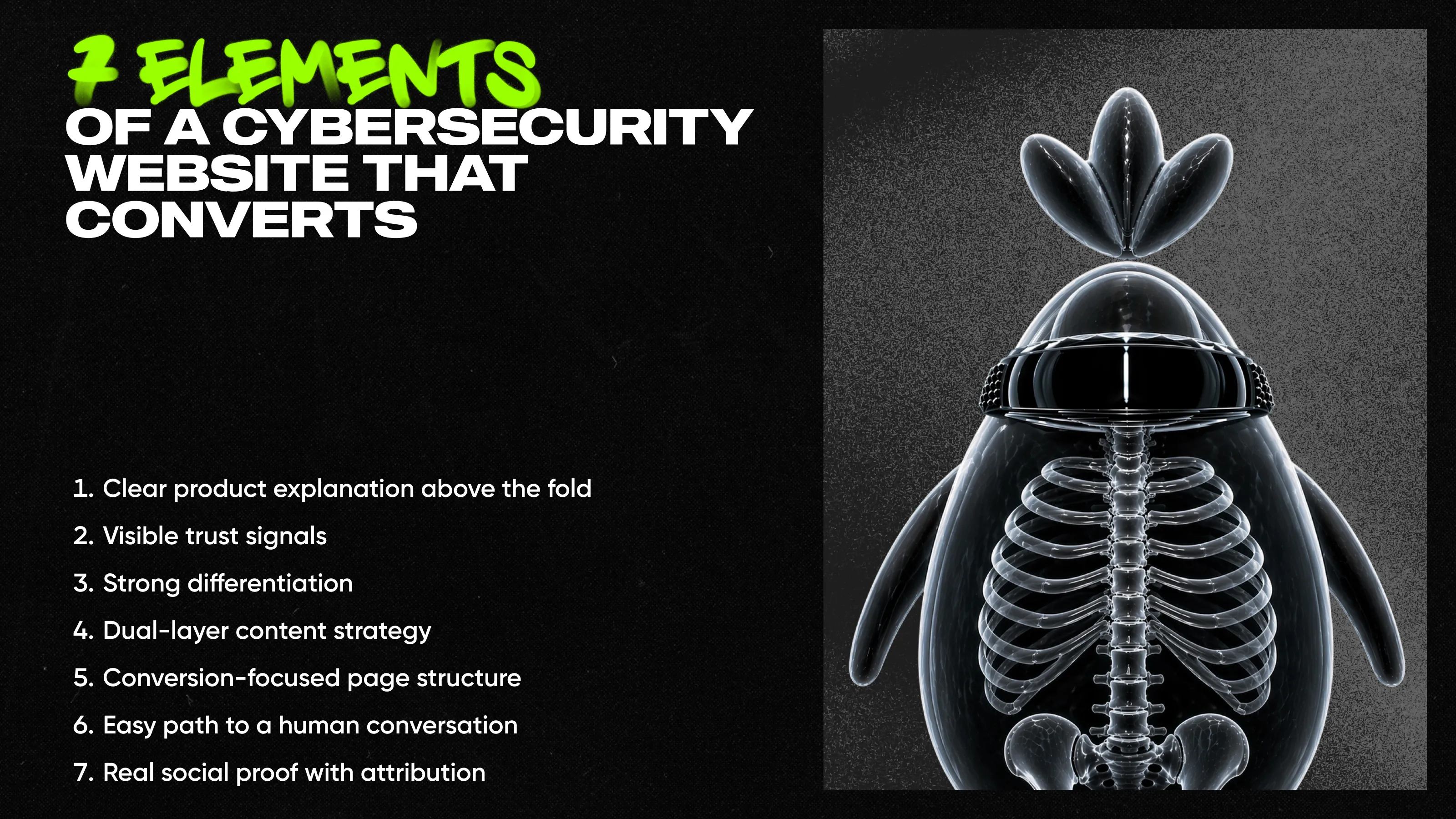
Seven elements of a cybersecurity website that converts:
1. Clear product explanation above the fold
Visitors should understand what the product is, who it is for, and what problem it solves within seconds without decoding technical jargon. A strong hero section gives an immediate “this is for me” signal.
2. Visible trust signals
According to Stanford Web Credibility Research, users primarily judge a company’s credibility based on its website’s visual design and trust signals.
Certificates, compliance badges, client logos, and information about partnerships should be displayed at the top of the page to reduce the risk of losing a customer. In the field of cybersecurity, trust is a prerequisite for attracting customers, not just the final step before closing a deal.
3. Strong differentiation
The website should clearly explain exactly how the solution differs from competitors' offerings, rather than simply listing its features. Without clear differentiation, even the strongest products will lose out to more innovative competitors.
4. Dual-layer content strategy
A high-performing site serves both technical and business audiences by offering layered content. It should provide quick, high-level explanations alongside deeper technical insights for those who need detail.
5. Conversion-focused page structure
Every section should intentionally guide the user toward action, building understanding and trust step by step. The page should function as a funnel, not just a presentation of features.
6. Easy path to a human conversation
Enterprise buyers often want to talk before they commit. Clear, low-friction paths to “Talk to an expert” or “Book a demo” are essential for conversion.
7. Real social proof with attribution
General testimonials aren’t credible. The most effective cybersecurity websites cite the names of real companies, specific job titles, and concrete results. Citing the source (who said it, from which company, and with what result) transforms social proof from a simple decoration into a trust-building factor.
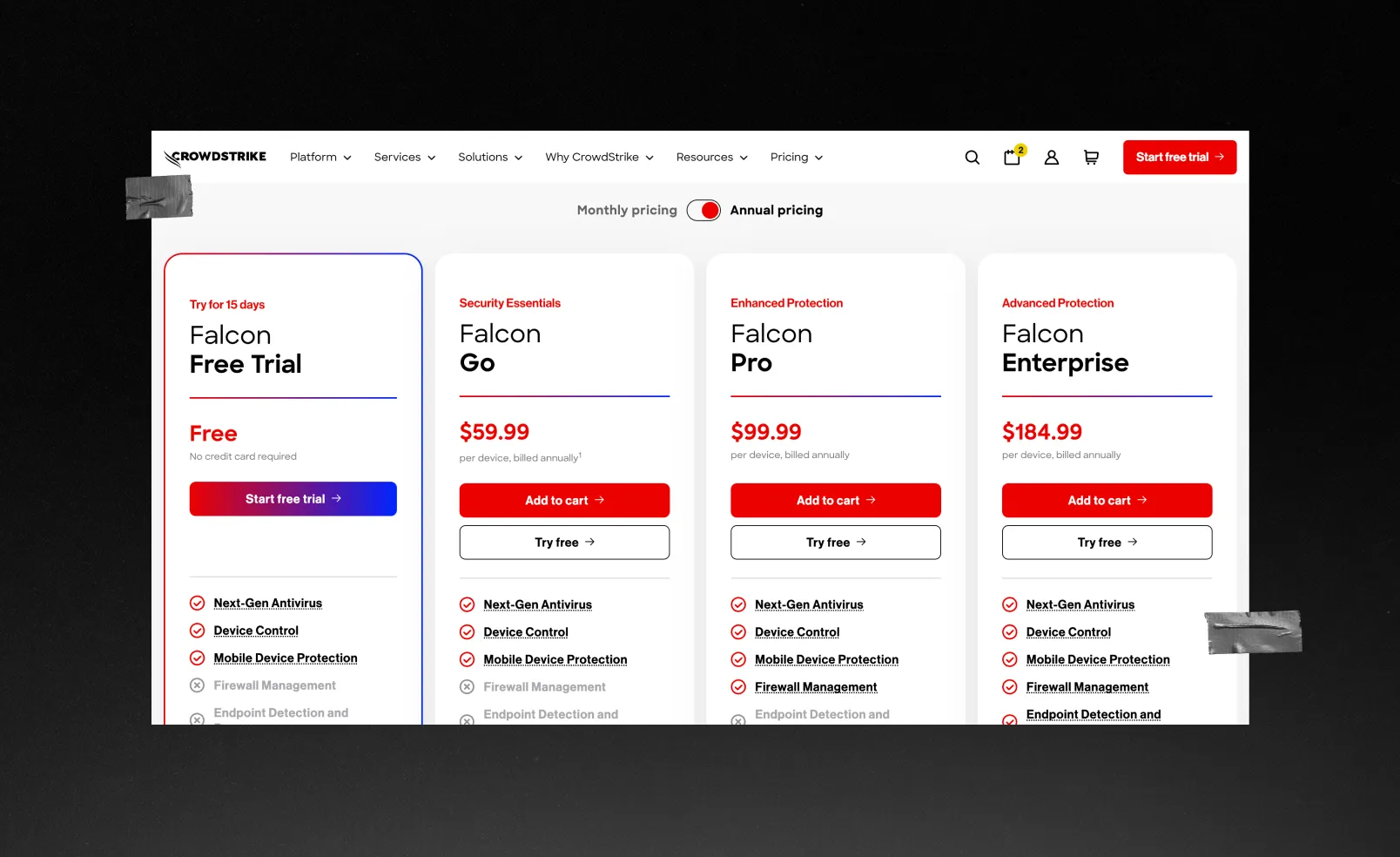
The hierarchy is built around a platform rather than a specific task
CrowdStrike immediately promotes the idea of the Falcon platform—not a single product, but an ecosystem. This works for mature enterprise buyers and those already seeking platform consolidation. But it creates a problem: a new user doesn’t immediately understand which use case is relevant to them.
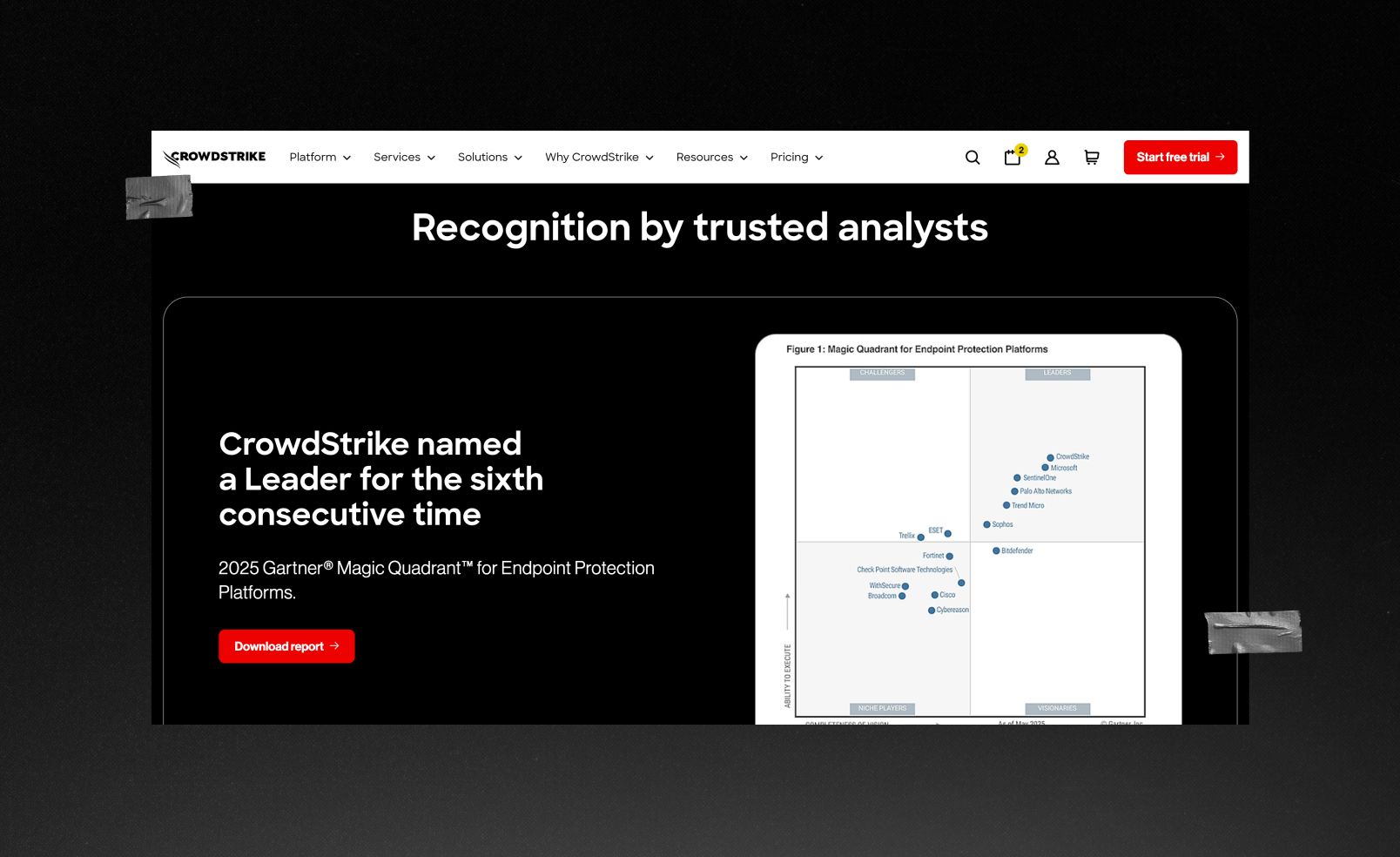
They leverage their authority very effectively, even before explaining the product
CrowdStrike openly and actively showcases: major clients, awards, and leadership (Gartner, reports, etc.) The website builds trust before the user begins to understand the product, which reduces the risk of losing them at the outset. But the product “gets lost” behind the marketing. CrowdStrike takes longer to guide the customer to the core product. There are many messages about the platform and many proof points, but little immediate “visualization.”
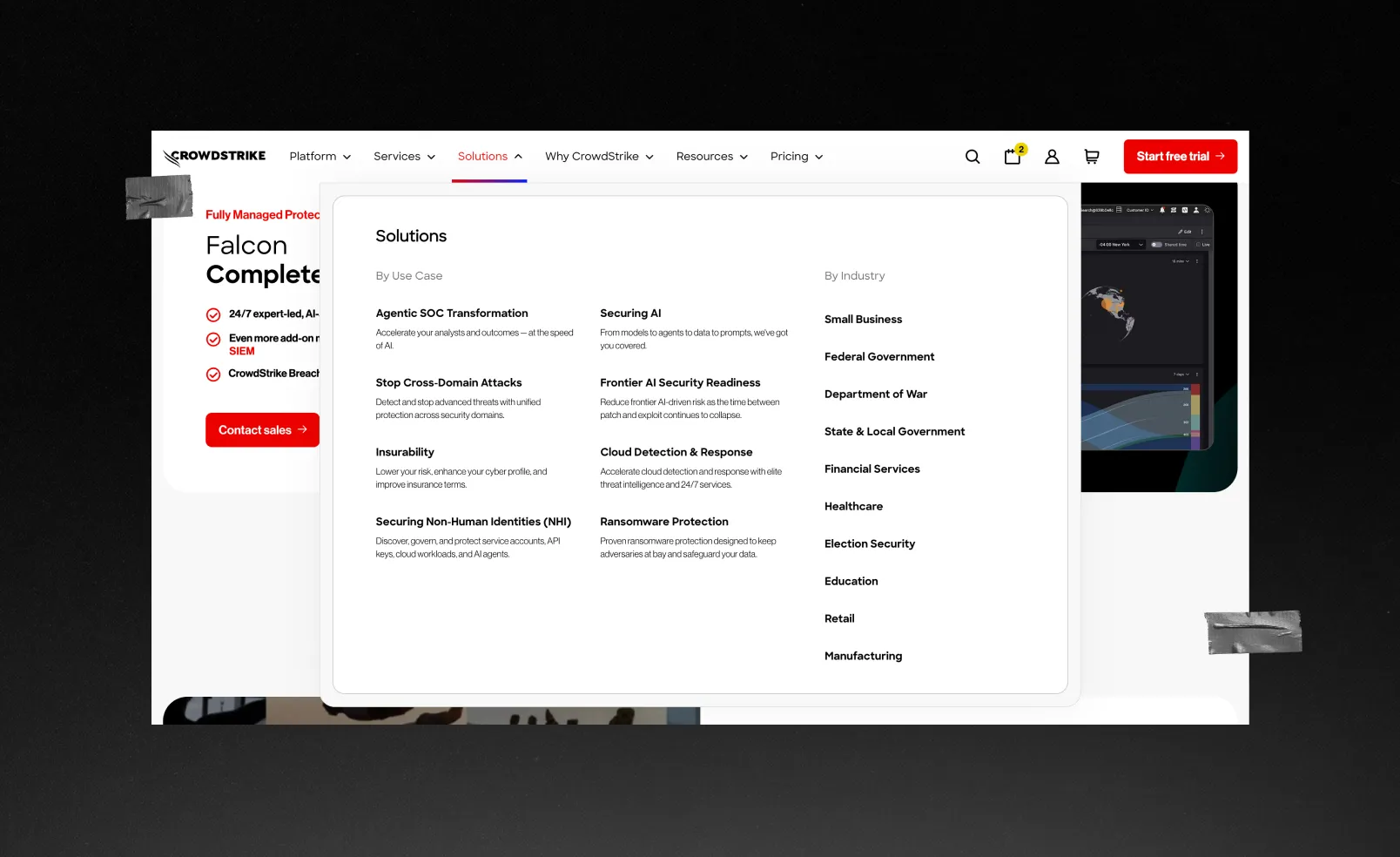
Strong structure, but complex navigation
CrowdStrike has a very complex structure: products, industries, use cases, resources. This is good for depth and credibility, but in reality, users often don’t know where to click, jump between pages, and lose context. In other words, the site offers many paths but doesn’t suggest which one is right for you.
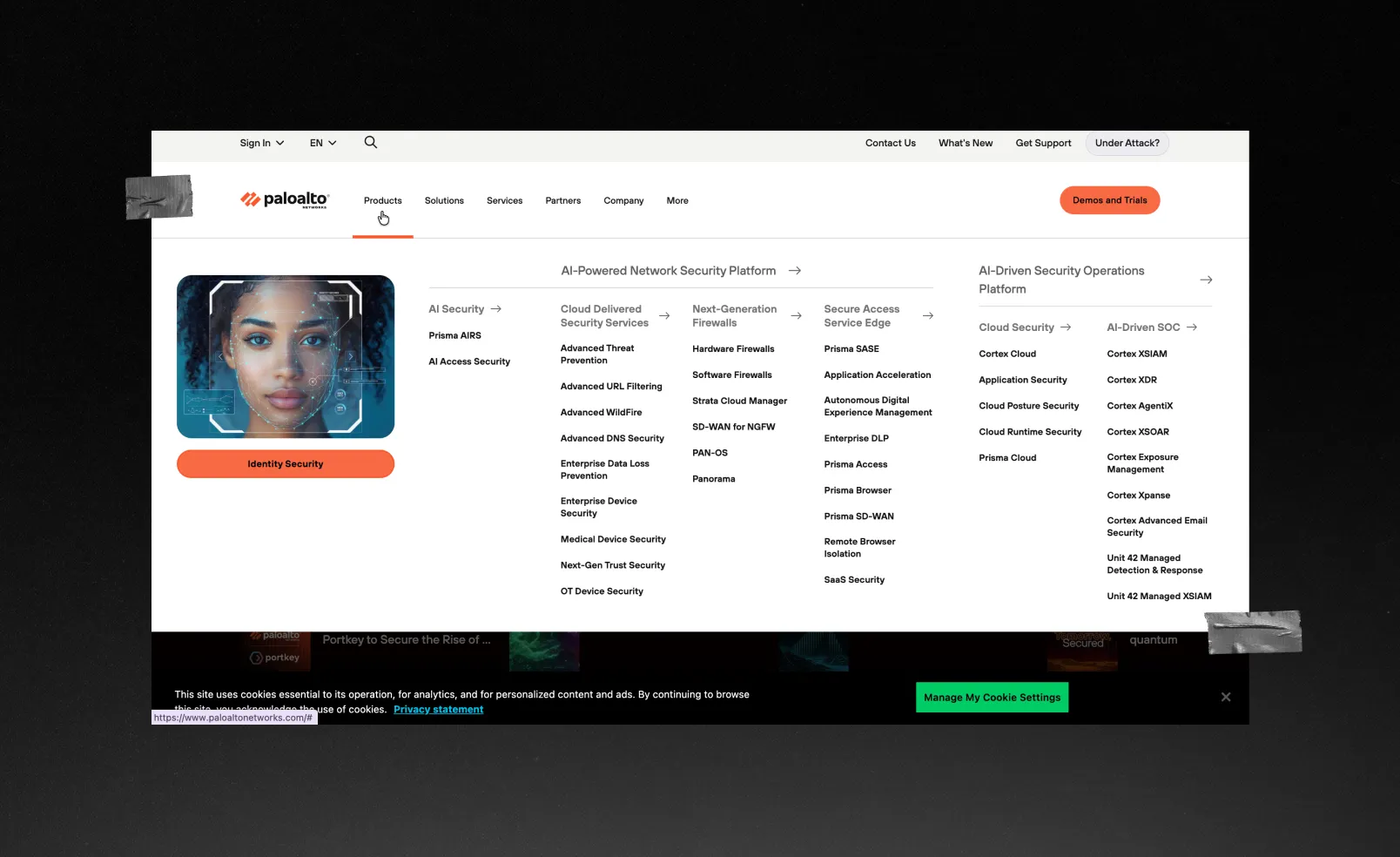
Complex navigation
Users struggle to find their entry point. The sheer number of sections, products, and scenarios creates a situation where users are forced to decide for themselves where to go next—and so they often just leave.
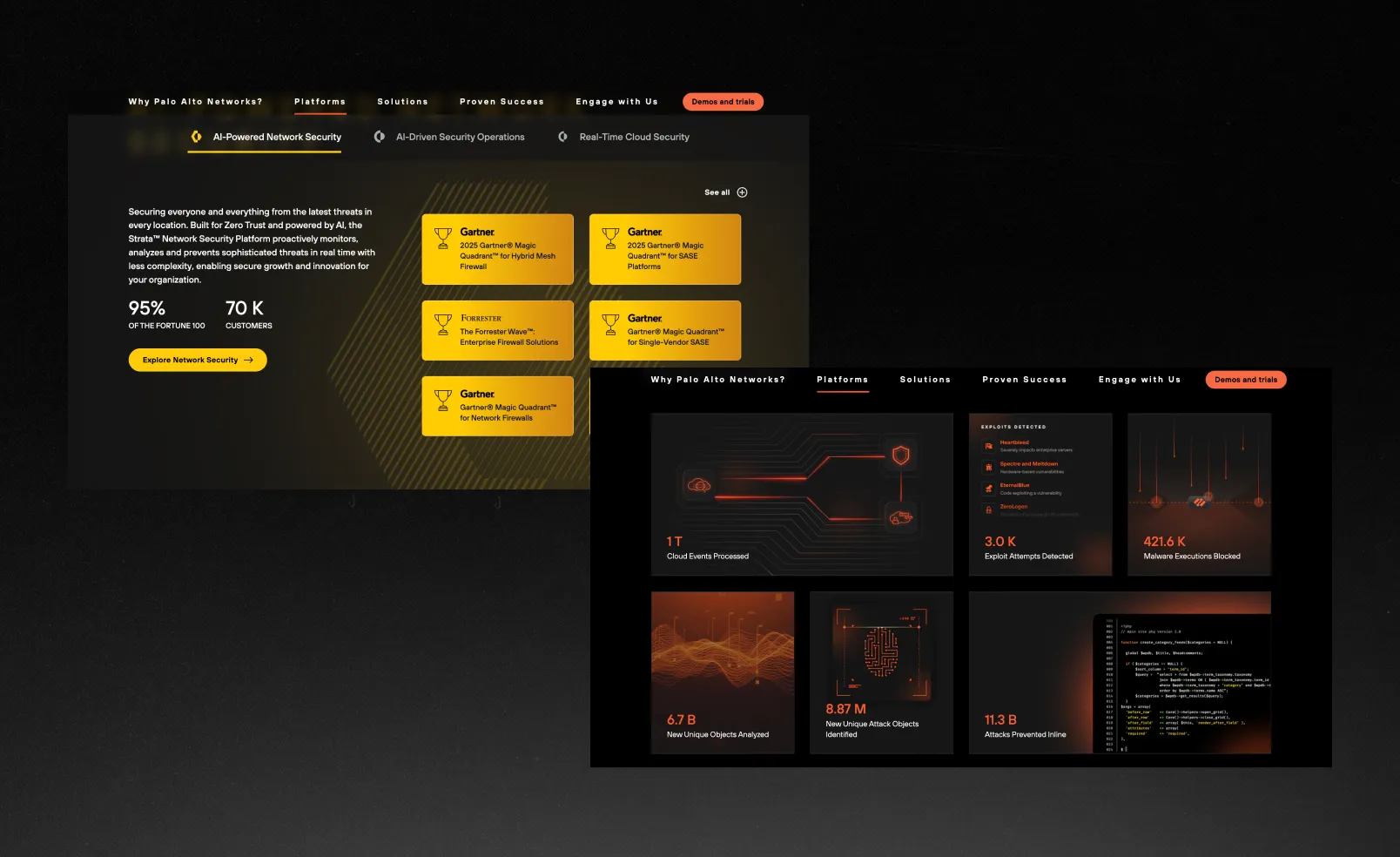
Strong trust aspects
Brand trust is built through systematic social proof: customer testimonials, case studies, analytics, industry reports, and mentions of market leadership all work together to consistently reinforce the brand’s reliability and credibility.
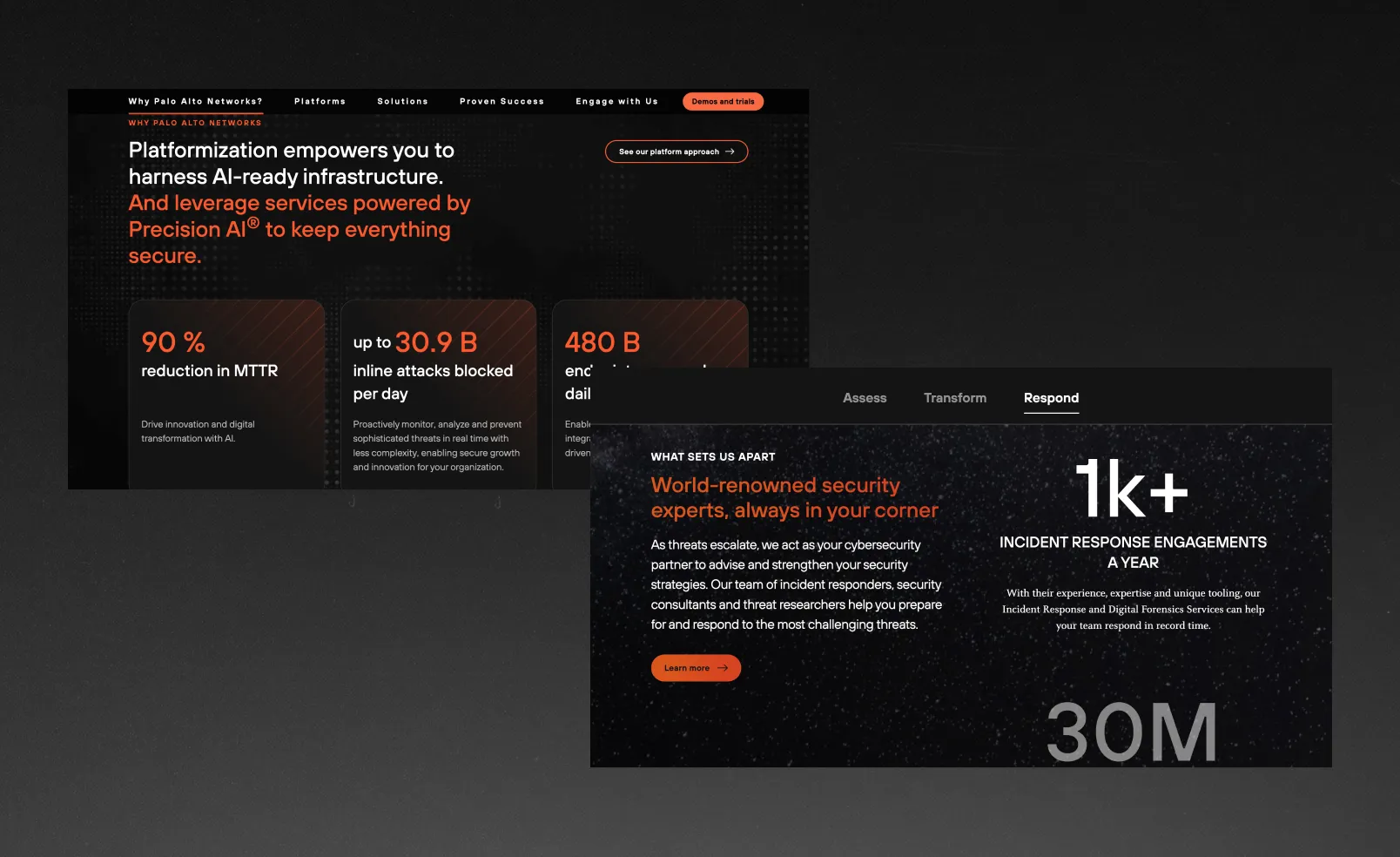
Content depth is high, but hierarchy is weak
There is a lot of information, and it is valuable, but it isn't prioritized: key messages get lost among less important ones, making it harder for users to quickly get the full picture.
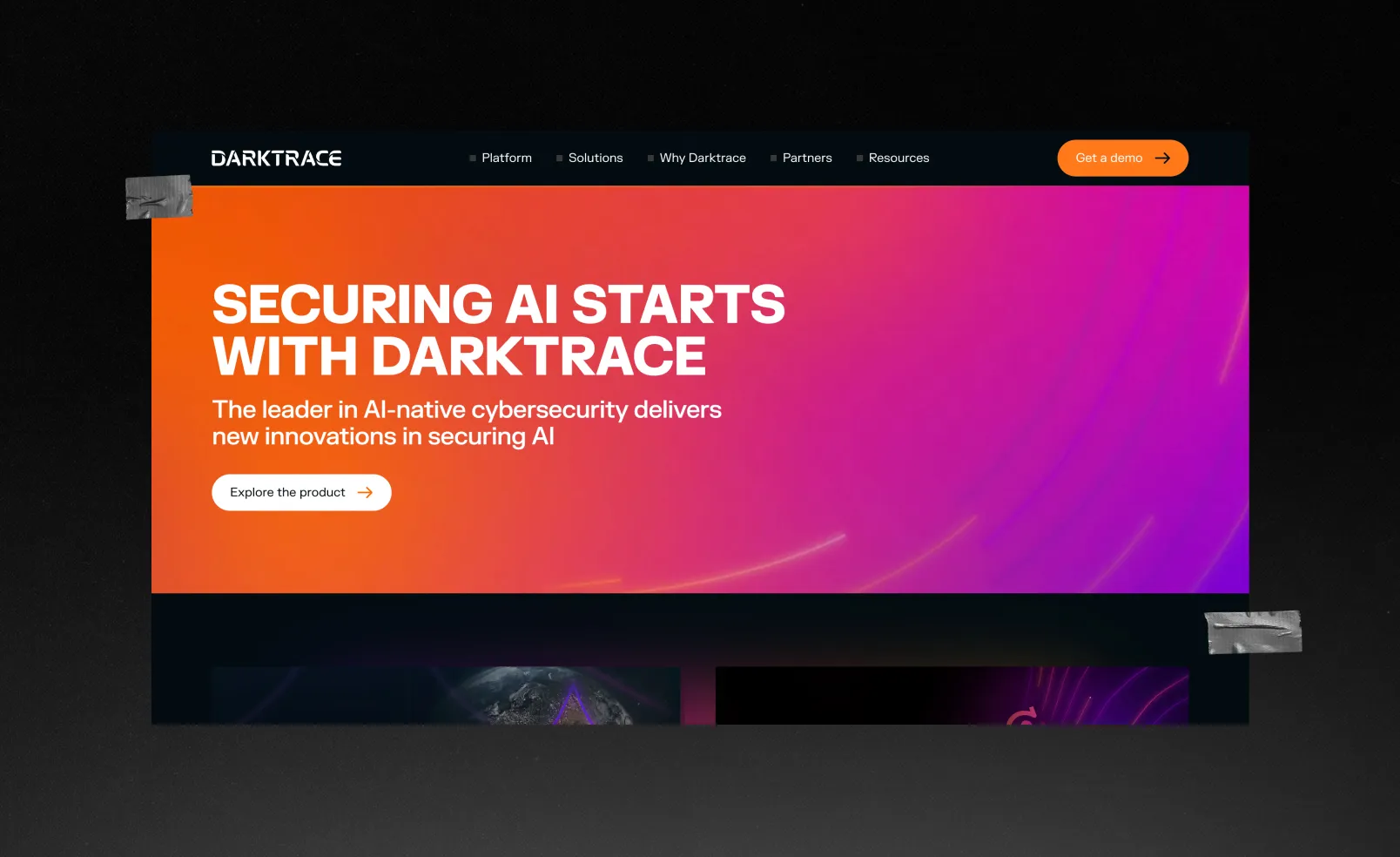
Autonomy Through AI
Darktrace builds its platform around self-learning AI that detects and responds to threats on its own. This creates the feeling that “the system is working for you.” What could be better than making life easier?
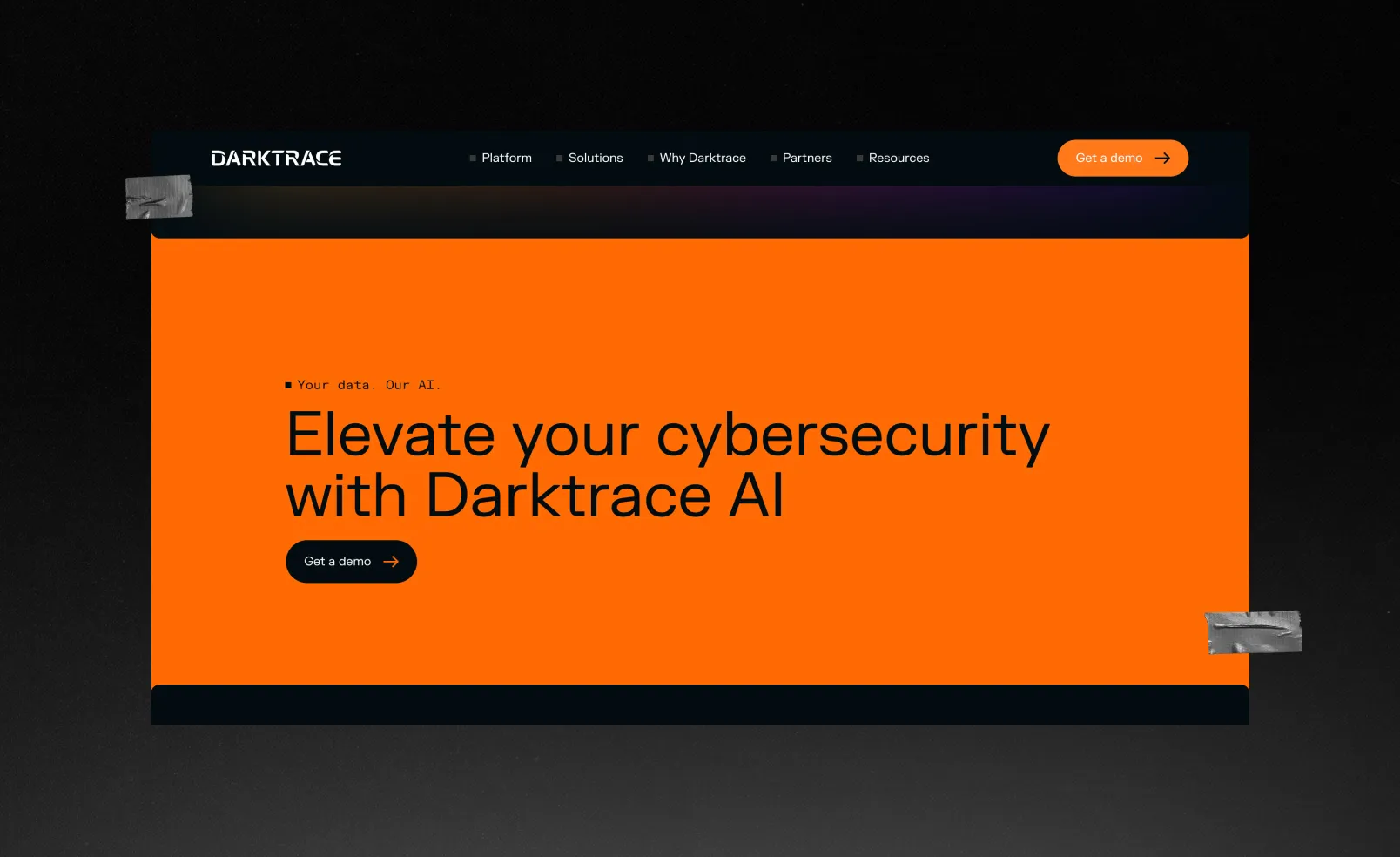
The line between automation and control is blurred
For more experienced users, the question arises: “How much of this is managed and controlled?” The website seems to sell the product well through automation, but does a poor job of explaining exactly how it’s controlled.
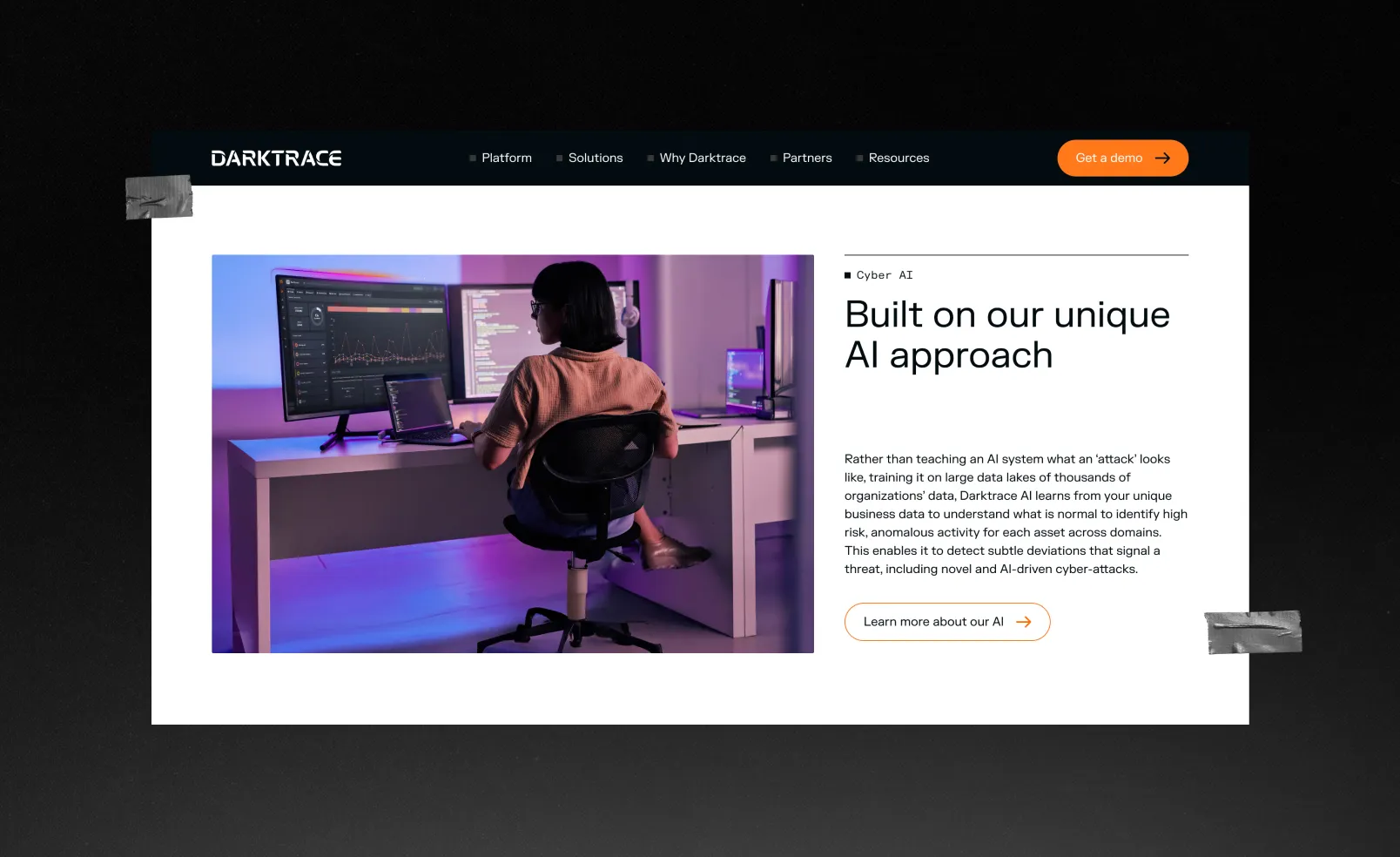
The perception that technological complexity equals premium value
The visuals and AI narrative create the impression of a high-end product. This reinforces expertise and trust, in addition to real awards and case studies.
Common mistakes that kill conversion
Even strong products fail due to execution mistakes.
Generic stock visuals
Stock images might not seem harmful at first glance, but in the field of cybersecurity, they often convey the exact opposite of what you’re trying to achieve. When a buyer sees abstract shields, evil hackers in masks, or overly polished stock photos that don’t really fit the overall flow, it certainly doesn’t inspire trust. Admit it, monotony is off-putting. It’s like an endless, dull conveyor belt.
The Qream team has repeatedly observed that corporate buyers tend to react to these things as “oh, here we go again… another website just like the rest.” Without real products, interfaces, or technical visualizations, a website isn’t memorable and certainly doesn’t convey a sense of expertise.
Single CTA:
A single CTA (such as “Request a Demo”) seems fine, but it only works for a small portion of the audience that’s already ready to engage. In reality, most users are still in the research phase and aren’t ready to interact with sales right away.
According to Qream’s observations, such websites lose a significant portion of their traffic simply because they don’t offer “softer” next steps—such as watching a demo, reviewing documentation, or checking out case studies. As a result, the user leaves, even if the product is a good fit for them.
Unclear positioning
If it isn’t clear within the first few seconds what the product does and who it’s for, the user won’t bother to look any further. Corporate buyers don’t read every detail; they’re like an X-ray machine that scans and makes decisions right then and there.
A website that uses vague phrases (“advanced protection,” “next-gen platform”) without specifying the context—such as the environment, types of threats, or the outcome—is the quickest way to kill conversion. Without this, the product simply looks abstract and fails to address the customer’s real pain points.
Lack of price benchmarks
The lack of any pricing context creates uncertainty, which deters enterprise buyers in any case. They don’t expect exact figures, but it’s important for them to at least roughly understand the price range and the scale of companies the service is intended for.
Qream’s team observes a recurring pattern: if a user can’t quickly assess whether “this is within our budget or not,” they simply choose a page where that information is provided. As a result, the company loses both relevant leads and, on top of that, time spent on irrelevant inquiries.
How to audit your own cybersecurity website
Use this checklist to evaluate your site:
1. Can users understand your product in 5 seconds?
Show your website in incognito to someone outside your bubble and give them five seconds. Then ask what you do. If the answer isn’t clear—your hero isn’t working. Rewrite it.
2. Are trust signals visible above the fold?
Check: Are the compliance badges, client logos, or case studies visible without scrolling? If not, move them up.
3. Do you show real customer names and results?
“We’re trusted by Fortune 500 companies” not enough. List specific companies, job titles, and results.
4. Are there multiple CTAs?
Don’t rely on a single “Book a demo” at the top. Make sure users see clear next steps throughout the page, different entry points for different levels of intent.
5. Is your messaging clear to non-technical users?
Simplify your messaging. Show your website to someone non-technical and ask what you do. If they stumble, hesitate, or start guessing—you’ve made it too complicated.
6. Do you differentiate from competitors?
Open your website and a few of your competitors’. If you can’t tell the difference—you are all coming off the same factory line. Fix it.
7. Is compliance easy to find?
Are you sure you can find SOC 2 / ISO 27001 in just two clicks? If so, move on.
8. Do you provide pricing context?
You don’t need exact pricing, but your site should clearly signal whether you’re targeting startups or enterprise.
Your cybersecurity brand should command trust before the first call
Let’s talk about redesign issues
Developing a cybersecurity website typically costs between $15,000 and $60,000, depending on the complexity and scope of the work. Simpler projects include basic pages, while enterprise-level projects involve in-depth branding, custom design, and a well-thought-out UX structure. The price is also influenced by the amount of content, integrations, and the need for technical visualizations (such as diagrams or demo flows). The more there is to visualize, demonstrate, and explain, the higher the budget.
An effective website should clearly explain exactly what the product does and who it’s for, without vague phrases or “marketing fluff.” Essential elements include trust signals (compliance, clients, case studies), concrete results, and a clear product description. It’s also important to demonstrate how it works through an interface, diagrams, or use cases. And, of course, provide the user with a simple next step: watch a demo, access the documentation, or contact you without any unnecessary complications.
A good landing page doesn’t try to cover everything at once; instead, it focuses on one specific task. It would be a bad idea to say “we provide cybersecurity” instead of “we protect against ransomware on AWS.”
It quickly identifies the problem, presents the solution, and backs it up with evidence in the form of statistics, case studies, or recognizable logos. It’s important that the user doesn’t get lost in a sea of information: one clear message, one main CTA, and a minimum of distracting elements. The simpler the path, the higher the conversion rate.
The best websites aren’t just about looking “high-tech.” Their main goal is to help users understand the product in a matter of seconds. They clearly articulate the value proposition, present real-world evidence (case studies, statistics, client testimonials), and don’t overwhelm users with unnecessary clutter. Such websites are also well-structured: it’s easy to find the information you need and quickly move on to the next step. And most importantly, they don’t copy competitors but have their own unique identity.
Improving conversion rates starts with small, simple steps: make your messages clear and specific. Next, add stronger trust signals: real customers, statistics, and compliance with standards. It’s also important to remove unnecessary roadblocks: simplify navigation, shorten forms, and make the CTA as obvious as possible.
Written by

Qream co-founder | Business growth and strategy
Leads Qream's business development and commercial strategy, bringing experience across sales, customer support, and complex digital projects. Reviews topics around project scoping, agency engagement, strategic partnerships, and growth.