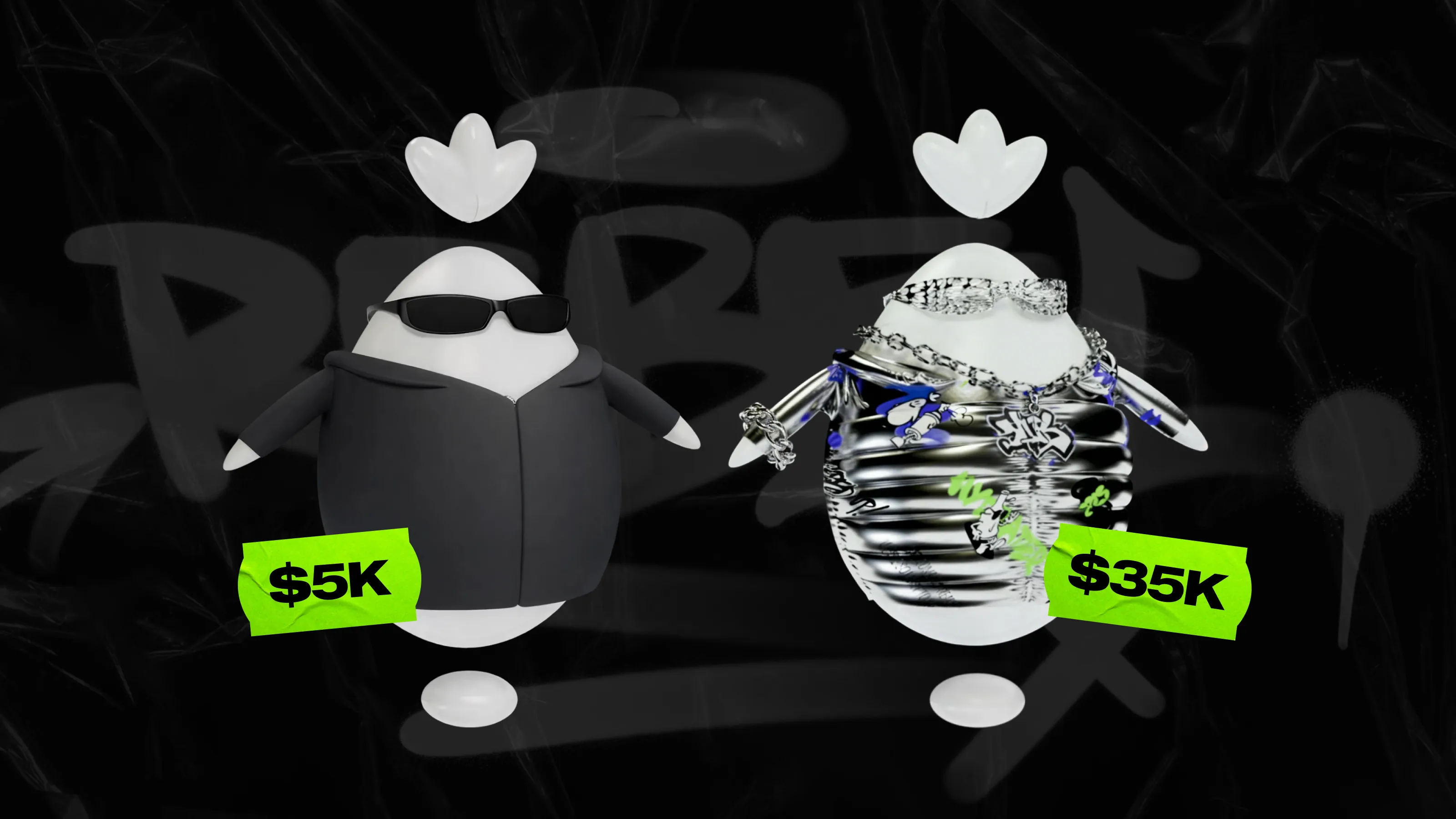
You decided to rebrand or launch a new website. You wrote a brief, sent it to ten agencies, and got back ten proposals. Some quoted $5K. Others quoted $35K. For what looked like the exact same list of deliverables.
And now you're wondering: what the hell are those other guys charging for—a pet-friendly office with free cookies? But it is the same proposal only at first sight. And you're not looking at different prices, you're looking at different products. In fact, even the list of deliverables isn't the same, even though it sounds very similar.
Before you pick the cheapest agency, let’s go deeper.
What "deliverables" actually mean (and why most people get it wrong)
From a business owner's perspective, deliverables are simple: you order a website—you get a designed website in Figma. You order branding—you get a brand book. Done. But that framing leaves out everything that makes the difference between just nice visuals and design that works for years.
Deliverables also include the depth of thinking, the range of assets, the quality of execution, and the decisions made (or skipped) along the way. Two proposals can say "logo + color palette + typography" and mean completely different things.
Branding: what you're really buying at different price points
The baseline—what most agencies will deliver—typically includes a logo, a font, a color palette, and mockups: a business card, a pen, and a folder. That's it. You get a brand that looks fine on handouts and falls apart everywhere else.
What higher-end agencies bring to the table:
- Custom illustration systems and 3D/2D icon sets—so that no other brand is exactly like you
- Art direction for photography—so your brand doesn't look generic on Instagram
- Motion guidelines—so the brand stays consistent across video, reels, and digital activations
- A workshop for your in-house team—so they actually know how to use everything they've been handed
The biggest current shift is that motion branding is no longer optional for brands operating across digital channels. If your brand only exists as static assets, it's already behind. A Wyzowl video marketing statistic shows that 89% of people would like to see more online videos from brands.
At Qream, motion guidelines are a core part of every brand. For Soscale—our Scandinavian client—we created a detailed system that allows their team to produce consistent animations.
Website: design can mean ten different things
At the lower end, you might get a set of screens—sometimes templated, sometimes semi-custom—with no system behind them. It looks complete until you need to build a new page six months later and realize there's no UI kit.
At the higher end, you get:
- A full component library and design system—so new pages can be built consistently without involving the agency again.
- Templated layouts for recurring page types (service pages, product pages, landing pages)—so new pages for new products can be launched without involving a designer.
- A CMS setup that lets your team update content, rearrange sections, and add new material without a developer.
- A handoff workshop so your team actually knows what to do.
One of the most important parts of building a website is keeping the designer involved through development—especially when another team is handling the implementation. It’s the only way to make sure animations behave as intended, interactions feel intuitive, and details aren’t lost along the way—down to making sure black is truly #000, not #003. It ensures the live product reflects the original vision—and it’s something most agencies include as part of their process, even when development happens on the client’s side.
Social proof: why going cheap can be a gamble
Any agency can write "10 years of experience" in a proposal. The question is how to verify it before you're already three weeks into a project that's going sideways.
A few signals that are hard to fake:
Verified reviews on third-party platforms. Clutch, for example, contacts clients directly to confirm the project happened and the feedback is real. A strong track record there isn't something you can manufacture overnight—it's built case by case, client by client. An agency with 30 verified reviews and consistent scores has something a newer team simply can't replicate yet
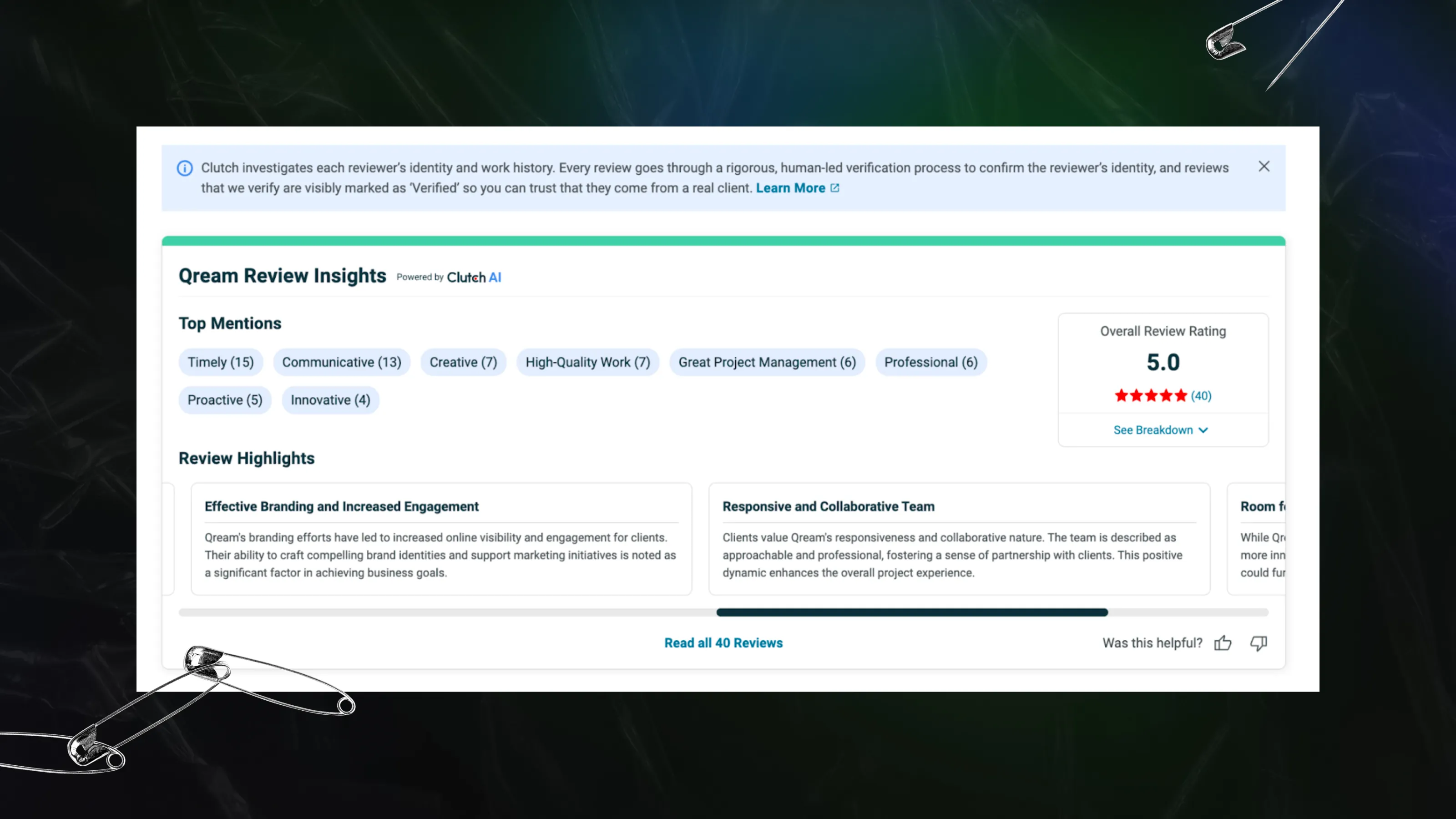
The reviews on Clutch are organized by categories, making it easy for clients to quickly see if the company meets their key criteria.
Referrals from past clients. Not a testimonial box on the website—those are curated. The real signal is whether people recommend the agency unprompted. If a founder in your network says "we worked with them, here's their contact," that's a stronger indicator of quality than any award badge on a homepage.
A newer agency with a thin portfolio almost always charges less. They don't yet have the track record to justify a higher number. The risk isn't that they're bad. Some of the sharpest work comes from younger teams. The risk is uncertainty—you don't know what you're getting until you're already in the middle of it. Established agencies charge more, partly because they've already made the expensive mistakes (usually on someone else's project). Their price includes the accumulated cost of learning what not to do.
Team: juniors execute, seniors think
A senior team costs more. That's not news. The real question is: does it matter for your project?
It matters if you want:
- Fresh thinking, not recycled solutions
- A team that understands your category well enough to challenge your assumptions
- Faster execution and fewer edit rounds
- Decisions that come with reasoning
- Someone who will push back on a bad brief instead of just executing it
It also matters what's under the same roof. An agency that has brand designers, 3D artists, motion designers, copywriters, strategists, and marketers working together produces work differently than one that outsources half the scope after signing the contract.
Process: vendor vs. partner
It’s impossible to tell from the proposal alone whether the agency will become your partner or simply act as your design arm. But it might be the most important differentiator of all.
Some agencies will take your brief and execute it. If the brief is wrong, the output will be wrong too.
Other agencies treat the project as a business problem rather than a design task. They'll question assumptions in the brief. They'll tell you if what you're asking for won't solve the actual problem. They'll connect design decisions to your market positioning, your growth goals, and your go-to-market strategy.
That kind of engagement requires more from both sides. And yes—it costs more. But it's also why some brands come out of a redesign with a stronger market position, and others just come out with a new logo.
Post-project support: what happens after the handoff
Lower-cost engagements often end at delivery. You’ve paid for the work done, and you’ve received the final files. But this isn’t usually the end of the process. Your in-house team needs to learn how to work with the new branding or website.
Higher-end agencies stay involved. That might look like:
- Helping QA the developed site to make sure it looks IRL the way it did in Figma \
- Training sessions so your team can work independently with the brand system
At first glance, this might not seem particularly important. But it significantly increases the brand’s chances of maintaining consistency across all platforms and reduces the time marketers need to spend figuring out a new CMS.
Our client didn’t have a designer on the team, so we built a Figma library that allows them to create simple branded collages in just a few clicks.
So, what are you actually paying for at $35K?
Still wondering if you're being overcharged? You're not. You're just not comparing what you think you're comparing.
The cheap agency executes. The expensive one thinks. One delivers a logo. The other delivers a reason your brand doesn't look like every other company in your category. One sends you a Figma file. The other sends you a system your team can actually operate without calling them every time you need a new page.
The $30K gap is real. But it's not in the price—it's in what happens after the handoff. Cheap design has a way of becoming very expensive around month 18 (sometimes even month 6), when you're back to square one with a brand that never quite worked and a website nobody converts on.
Pay once for the right thing. Or pay twice for the wrong one. Your call.
Written by

Qream co-founder | Design and product direction
Leads Qream's creative and product direction, connecting brand strategy, experience design, and business goals. Reviews content where design strategy, UX/UI, customer experience, and brand execution are central.