You’ve got product launches stacked, paid campaigns running nonstop, and a sales team screaming for decks. Meanwhile, your in-house designer is stuck revising last week’s ads (again). Growth doesn’t slow down—but your creative pipeline just did.
Before your in-house designers hit capacity, pay attention to these warning signs that your design setup is holding your company back.
Read the signs and evaluate what’s up with your team
01 Inconsistent branding across channels
Your website might look polished, but your social media posts feel like a different company. Your blog has one vibe, your ads another. No matter how many assets you produce, the pieces don’t add up to a complete puzzle.
This isn’t about aesthetics only—it affects performance. Having a consistent brand means more trust, stronger loyalty, and less blown budget.
Look at the numbers yourself: 68% of orgs that keep the brand consistent notice a revenue growth from 10% to 20% (Source: Brand Consistency Report by Marq). Flip the coin, and inconsistency decreases your revenue by the same amount of money.
How to spot inconsistency creeping in:
- Ads, social posts, and landing pages use different color palettes and images.
- Typography shifts depending on who designed the asset—and every time, it’s different in terms of sizing, accents, and colors.
- Icon styles don’t match—some are flat, others are skeuomorphic, creating a messy visual language.
- Presentation decks look nothing like your brand guidelines (and sales teams quietly make their own templates).
- Motion graphics, video overlays, and 3D assets feel like they belong to entirely different companies.
02 Iteration loops are eating time
If minor edits routinely turn into multiple rounds of revisions, it’s a sign your designer is juggling too many hats.
Complex campaigns—like multi-format launches combining video, motion, and static content—require deep brand understanding to avoid back-and-forth loops. When that understanding isn’t there, every stakeholder brings a different “fix,” and the asset bounces between revisions like a ping-pong ball.
Just imagine: 64% of creative teams waste 5–10 hours weekly to edit content due to comments and requests (Source: Brand Consistency Report by Marq). That’s almost a full workday lost every week—on rework instead of real progress.
One iteration or one delayed management/stakeholder approval = one day out of the deadline. Multiply that across channels, campaigns, and teams—and suddenly launches slip, budgets stretch, and growth slows.

03 Your team is exhausted, but output is stagnant
Your designer is doing heroic work, but the team is constantly in firefighting mode. They’re fixing yesterday’s campaigns while yesterday’s deadlines slip. Over time, it leads to design team burnout, bottlenecks, and costly mistakes, obviously.
This is usually the case of a turning point in a company’s growth—right after a funding round, a new product launch, or a push into new markets. Suddenly, the demand for creative triples: sales decks, launch videos, landing pages, paid campaigns, and event collateral. The in-house team is still the same size, but the workload is no longer manageable.
We see it often with mid-size tech companies: after Series B, marketing requests double, and every new campaign needs fresh creative. Without scalable support, the internal team spends most of its time patching urgent tasks instead of building brand value.
That’s when it’s time to rethink your setup. A creative partner fills the gaps, brings in specialized skills you can’t afford to hire full-time, and frees your core team to focus on strategy and long-term brand consistency instead of daily survival.
04 Missing specialized skills
In-house teams excel at core design tasks, but complex campaigns often demand specialized skills: 3D, motion, graphic, creative strategy, UI, etc.
Imagine you’re launching a new product and need a comprehensive campaign. That requires a team of 5 (at least): copywriter, graphic designer, motion designer, 3D designer, and UX/UI designer.
Now let’s talk numbers. For one “extra skilled” specialist, you’ll need $5–8K/month on average. For the whole team, it’s at least $30,000—seniors will be worth more, tho. (And we’re not talking hiring time, HR costs, tools, etc.)
That’s when a creative partner should join the game: one month with external specialists will cost at least half as much as scaling design team.
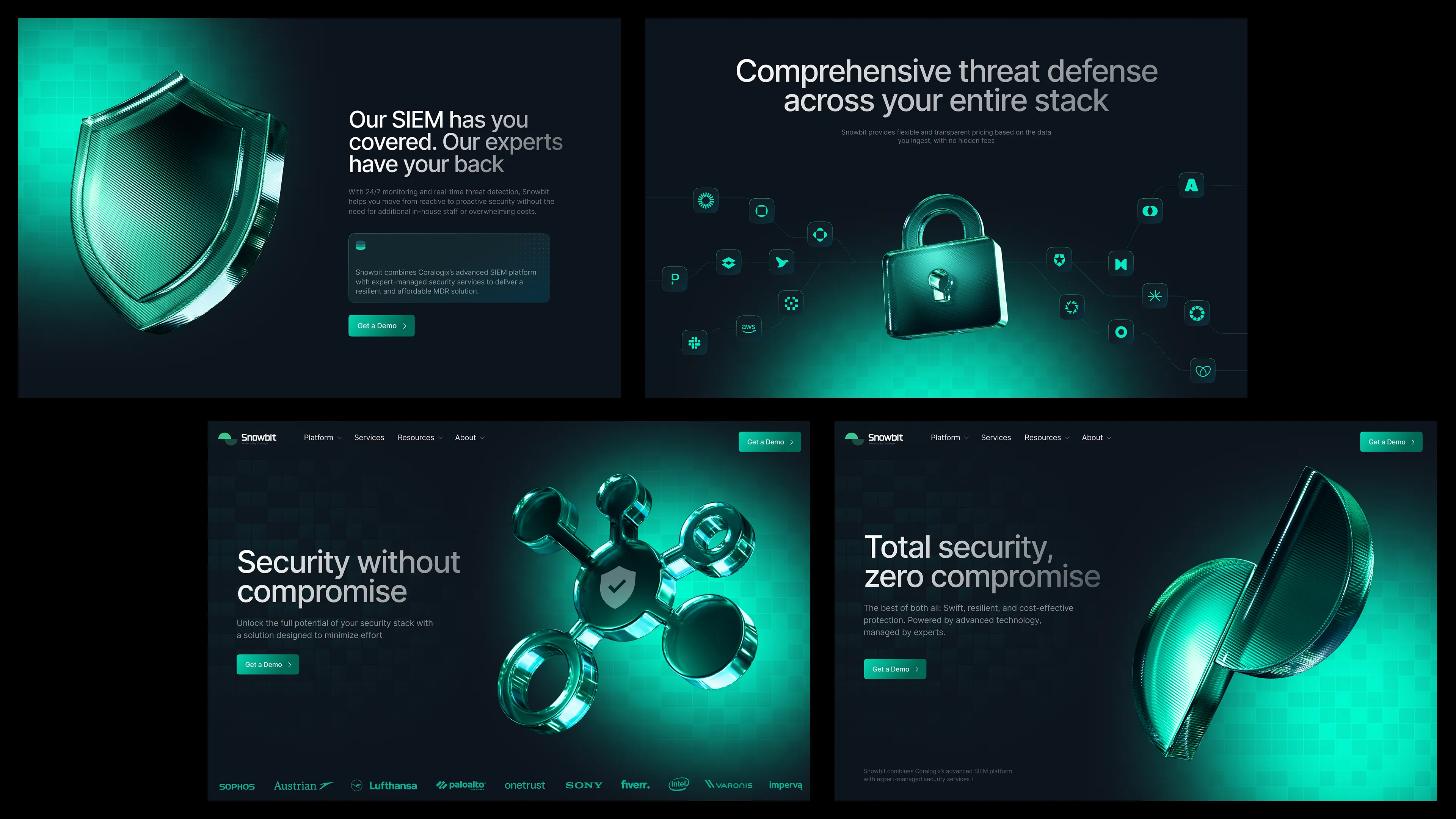
The same happened when Coralogix was preparing to launch their cybersecurity sub-brand Snowbit. Instead of stretching their in-house team or building a new design squad from scratch, they plugged into our external expertise that covered everything—from branding and merch to website and blog banners. The sub-brand launched fast and fully polished, without derailing the core team.
05 Speed is slowing your growth
When in-house capacity limits how quickly campaigns can launch, you lose momentum. Big ideas shouldn’t wait. If launching campaigns, updating websites, or producing video content feels like being stuck in slo-mo, it’s not just frustrating—it costs you potential.
Any testing, situational marketing, changing brand identity or positioning, or seasonal campaign launches shouldn’t be avoided just because “It doesn’t seem to fit our design pipeline.”
To stay ahead of the curve, brands need flexibility and the ability to react quickly—and sometimes, this is beyond the reach of in-house teams, which often rely on long-term task planning.
Take our case for Viber for Business, for example. A few years ago, they shifted their strategy toward rapid B2B growth. That pivot multiplied their creative demand almost x10—what used to be 10 assets per month quickly became 100.
The in-house team couldn’t manage the volume and diversity of content: static ads, motion design, presentations, landing pages, videos, 3D. With scalable creative support, they turned what could’ve been a bottleneck into an engine for speed: campaigns shipped in days, not months, while brand consistency stayed unharmed.
Don’t let a design bottleneck kill your moment to shine
These signs don’t mean your in-house designer isn’t talented—they show design capacity issues and that growth demands more than one team can handle. The solution isn’t just hiring more people; it’s building a creative ecosystem that can scale.
Keep these 3 things in mind when the signs hit your team:
- Audit your creative pipeline
Map out every recurring design request (ads, decks, social, product launches) and see where the real bottlenecks happen. Is it revisions? Missing formats? Uncertainty in the brand guidelines? Last-minute fire drills? You can’t fix what you don’t measure. - Protect your in-house team
Let them focus on performance, keeping all marketing needs fulfilled. Delegate campaign concepts, rebranding, or seasonal stuff to the external partner—that will balance your capacity. - Add flexible capacity before the crisis
If you’re about to scale campaigns (such as new markets or product launches), plan your creative capacity ahead of time. Waiting until deadlines slip usually costs more, both in money and lost momentum.
And remember: a scalable creative ecosystem matters. At this point, a strategic creative partner can make the difference. They integrate seamlessly with your team, deliver faster across formats, and ensure your brand stays consistent—without overloading your internal designers.
Written by

Qream co-founder | Design and product direction
Leads Qream's creative and product direction, connecting brand strategy, experience design, and business goals. Reviews content where design strategy, UX/UI, customer experience, and brand execution are central.