It’s 11 p.m. An engineer at a global manufacturer is sitting at his laptop, searching for a component for a new project. Shhh… You’re observing the quiet part of the buying journey, the part that most industrial companies still systematically underestimate.
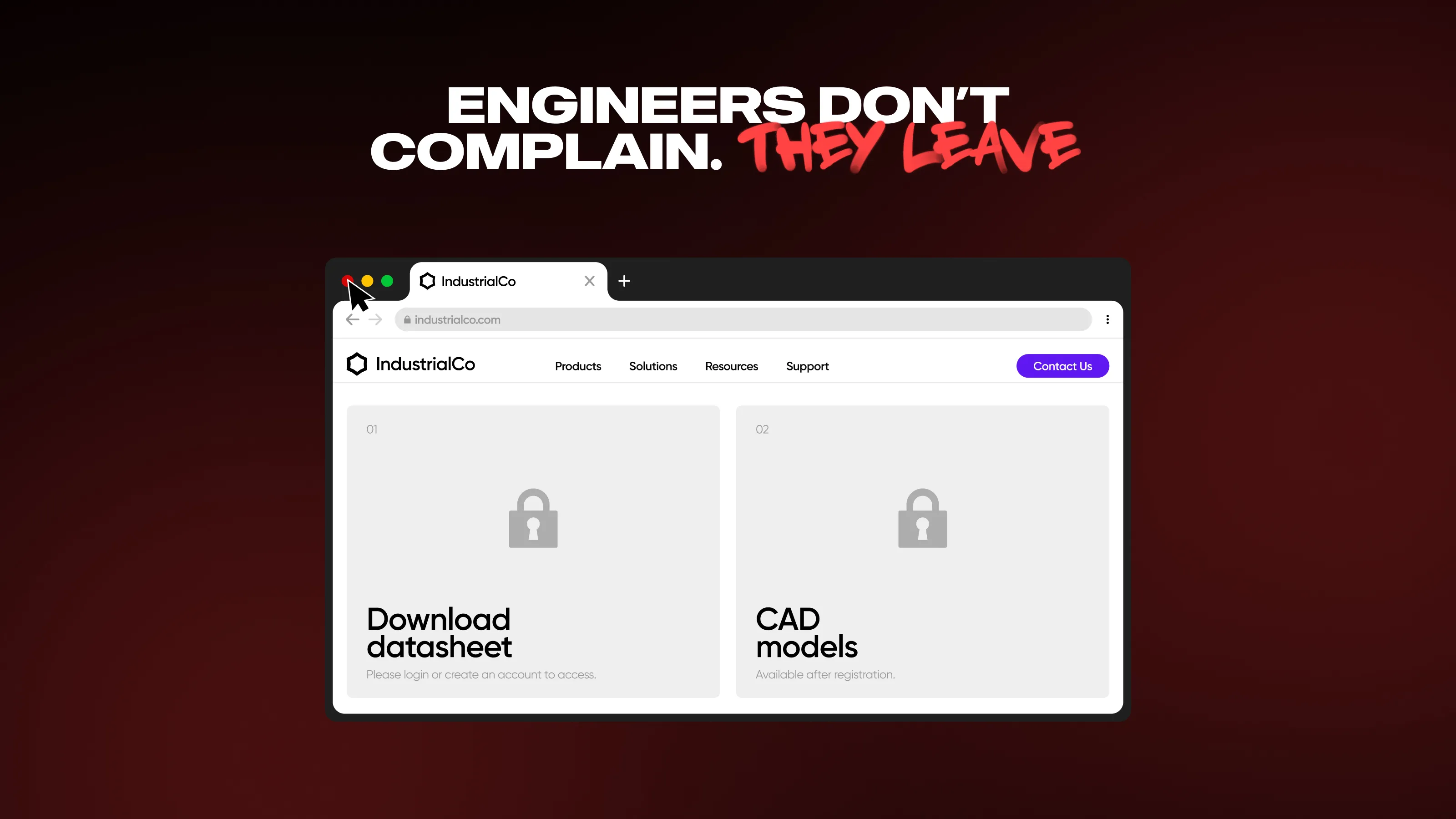
He opens this untrodden website of a potential supplier. The last thing he needs is a super-cool brand manifesto or a flashy hero banner. He needs a datasheet. He needs a CAD file. He needs technical confirmation that this company can actually deliver what it promises. But instead, he lands on a website that moves at a snail’s pace with navigation tangled in a knot, where technical documentation is buried somewhere on the hundredth menu level, and the PDF he eventually finds was last updated in the Stone Age.
Think he won't close the tab? Of course he'll close the tab. Open a competitor's website.
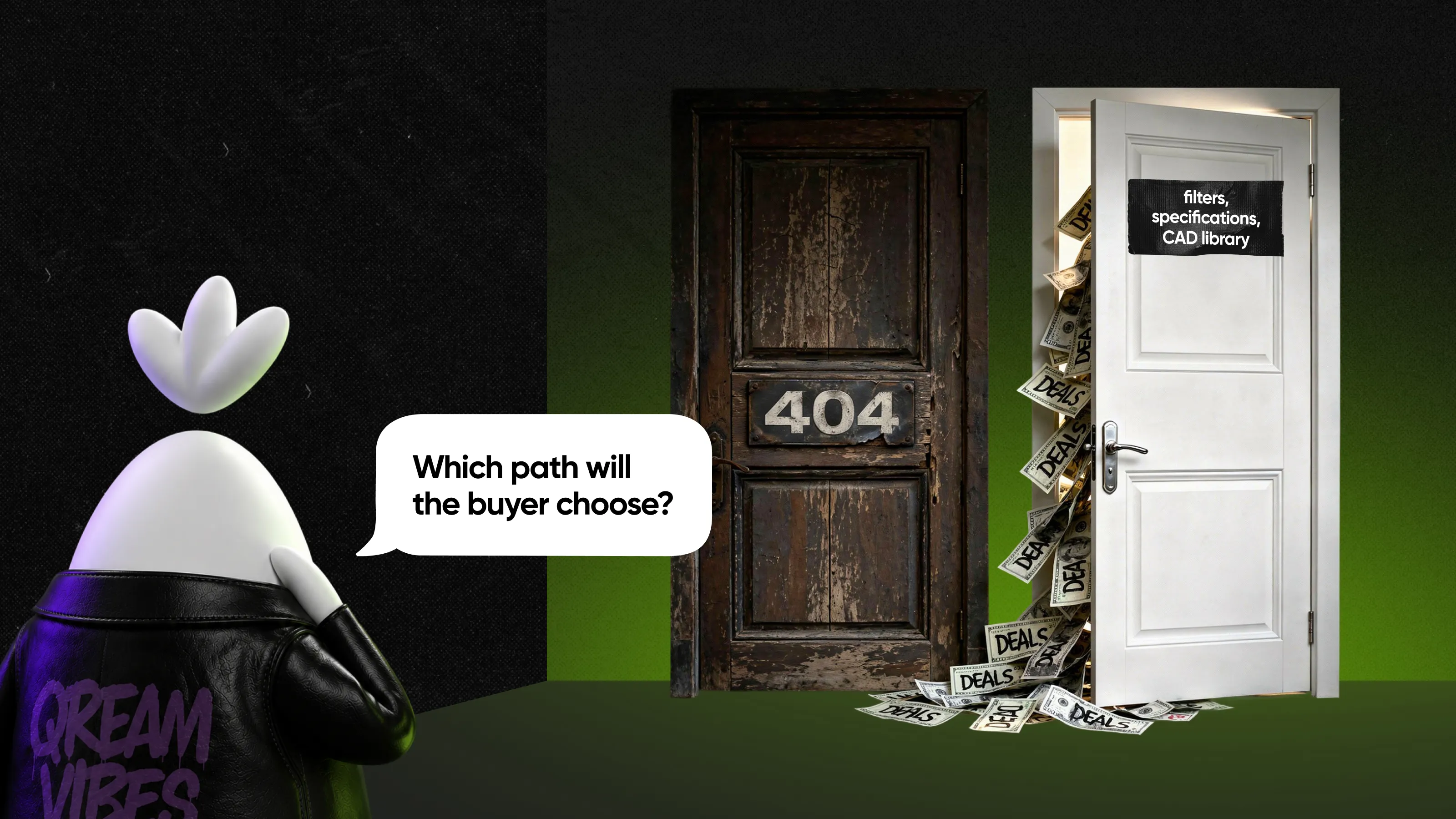
Everything there is in the best traditions: filters, specifications, a CAD library, and a clear structure. Within a few minutes, he’s already adding this brand to his shortlist and is even willing to pay more, because he’s just saved a ton of time, nerves, and a few extra hours of work.
And you know what’s most interesting? The first company will never know that it just lost out. That’s exactly how industrial B2B brands are losing contracts in 2026. Right on their own websites.
The paradox of current B2B?
And that’s the main paradox of modern industrial marketing: companies invest millions in operational excellence, precision engineering, and supply chain resilience, yet their digital facade remains stuck in 2012. They create the products of the future and sell them through the interfaces of the past. It’s a bit of a mess, don’t you think?
Back in the day, a website was really just an “online brochure” that a customer would visit only after talking to sales. But times are changing, folks.
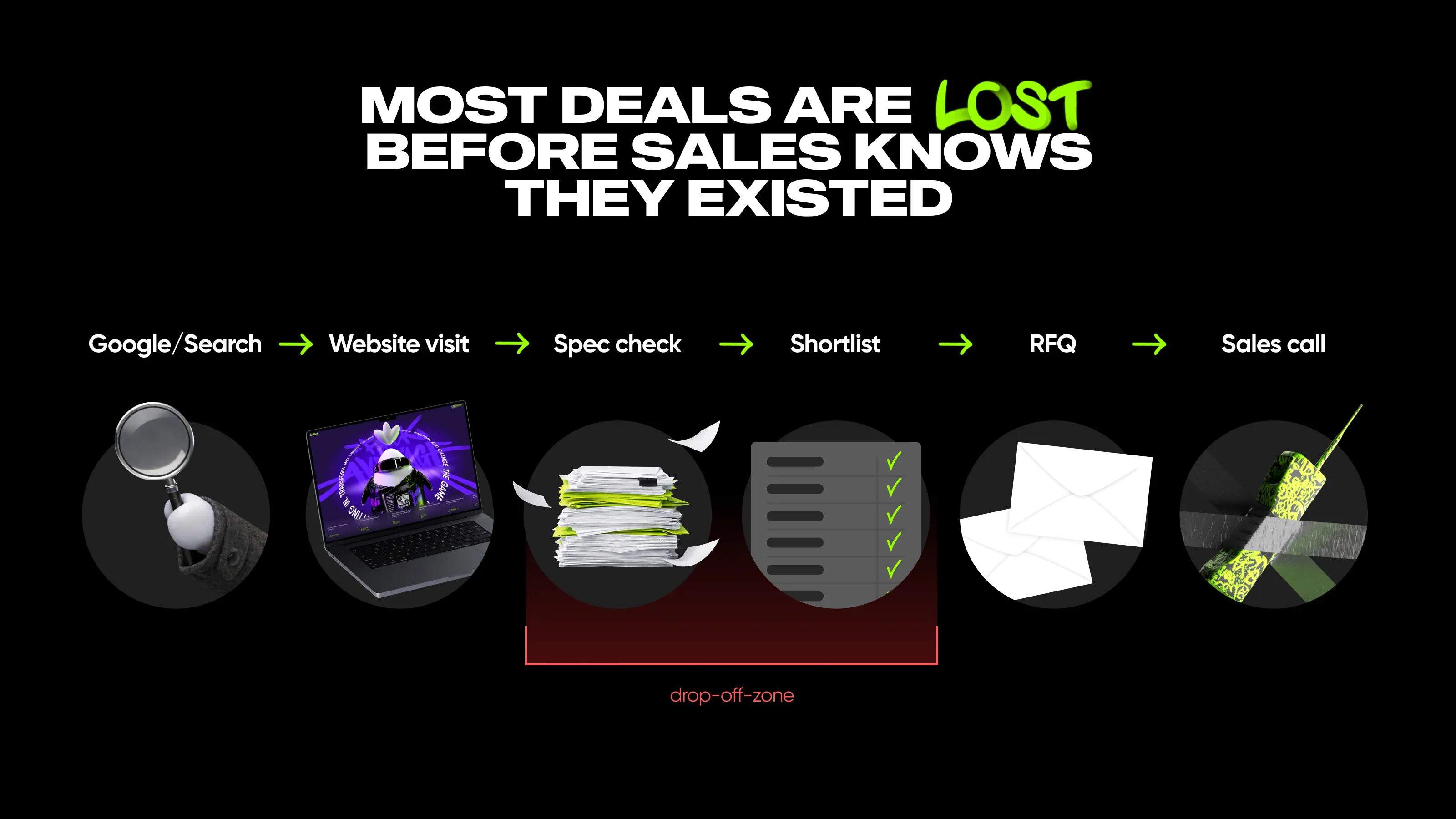
Now the website comes first in the sales process. It shapes the first impression, passes the initial check, helps make it onto the shortlist—or quietly kills the deal before anyone even clicks “Contact us.” And often, companies don’t give this much thought.
And the data proves the same. Back in 2021, McKinsey & Company reported that 97% of B2B buyers were ready to make digital self-service purchases exceeding $50,000. For many industrial companies, that figure sounded like science fiction at the time and seemed completely unrealistic. And now it’s 2026, and this is no longer a forecast but the norm. Buyers have grown accustomed to conducting research, making comparisons, and creating shortlists without the seller’s involvement.
That is precisely why most industrial websites fail—not because they are “old”, but because they are built around old sales logic.
The invisible cost of poor documentation UX
Industrial companies often think of technical documentation as nothing more than a box to tick. But for an engineer, this is the real product. It’s through the datasheet that they assess your maturity, through the CAD model, how easy you are to work with, and through the speed at which they can find the information they need, how much friction you’ll create down the line.
"As someone who builds prototypes with many parts from online retailers, sometimes I need to do the unfathomable and stray from mcmaster to find what I need. But I often find myself just blindly visiting various websites and scrolling down to the datasheets of countless products before I find what I'm looking for." — Engineer, r/AskEngineers, Jan 2024
So much for busting that myth, folks. Is the decision made strictly based on technical specs and price? Spoiler alert: nope. It’s now as clear as day: if your website makes an engineer jump through hoops, they’ll simply choose another brand.
"One of the most frustrating parts of being a designer is not having access to reference CAD models i can't tell you how many times i've wanted to integrate a real world component like a sensor, valve, switch, actuator, etc and there's no 3d file maybe a 2D datasheet from 2008 7 out of 10 times, i end up wasting hours modeling it myself or just not starting the project i've literally paid more for parts from industrial suppliers just because they offered a clean model i could drop into my assembly." — @Xaraphim on X, Apr 2025
That, folks, is modern-day industrial shortlisting. No drama, no conflicts, no mumbo jumbo. Just closing the tab and shoving your website into a drawer in a matter of seconds.
The biggest problem is that most industrial companies simply don’t see it. No red light goes off, and no alarm sounds to warn, “Attention: we’ve just lost a customer.” It doesn’t show up in the CRM. The sales team doesn’t get a signal saying, “We’ve just lost an opportunity because of poor UX.” But that’s exactly what happens every day.
The silent procurement filter
The buyer who never called isn't a buyer you lost. It's a buyer who already had their answer— sitting in row 23 of someone's chaos spreadsheet, filtered out because your website didn't look “professional enough.”
Today, many industrial companies don’t even guess that they are losing the game before the first call from sales. Why? Because procurement teams have long been filtering suppliers on their own—quietly, quickly, and without warning. This is where your website comes into play. And, heaven forbid, it’ll look like it’s stuck in the 2000s. According to the Forrester 2023 Global Buyers' Journey Survey: nearly 90% of business buyers had their purchase process stalled in 2023. So, the buying process is an obstacle course where you can be eliminated at any stage, so the website has to pass the test at first glance.
Procurement teams are no longer limited to price and specs. The search is for the least obvious risks. Does the company look stable? Are certifications easy to find? Are the sustainability claims convincing? And most importantly—is there a sense that: “these people will definitely still be in the market five years from now.”
Here, many industrial companies crash and burn. If you think an out-of-date website is just a minor issue, let us disappoint you…These days, an out-of-date website is a huge red flag that screams that working with you is a big risk. So you get a quick glance and are quietly crossed off the list.
So what does that procurement officer actually say?
“Now I'm spending entire days googling random companies, trying to figure out if their websites look ‘professional enough.’ My Excel sheet is chaos — 40+ potential suppliers…” — r/procurement, '3 weeks to find suppliers outside China' (Jun 2025)
That’s right, “professional enough.” Not “perfect,” not “innovative,” but simply convincing enough to move forward. And if your website doesn’t give that feel, you’ve already failed.
This is especially critical in industrial B2B, where the stakes are twice as high. When it comes to deals worth $200K, $500K, or $5M+, procurement teams’ level of caution increases proportionally. According to the Forrester 2024 report, on average, 13 people are involved in a B2B buying decision, and 89% of purchases involve at least two departments. This means your website is no longer evaluated by a single person—it’s evaluated by an entire system. And this system is even better at filtering out risks. So, sticking with an outdated website isn’t worth the trouble.
The trade show stockholm syndrome
$25,000 per trade show. Three shows a year. $75K annually that exists because the website is decoration. The CFO calls it cost of doing business. The auditor called it Stockholm Syndrome. Either way it's a brand maturity gap, paid in installments.
Yep, trade shows really matter in the industry. That’s a fact, and there’s no getting around it. Major deals are still made there, long-term relationships are built there, and “showing your face” really does work there, too. The problem isn’t with trade shows themselves; it arises when the trade show budget becomes a way to compensate for a lack of digital strength.
The company spends $25,000 on a single event. Three events a year. $75,000 annually. And it explains this by saying, “It’s just the cost of doing business.” That sounds a bit naive. Isn't that so?
"The owner told me, "That's just the cost of doing business. You have to show face." Is this Stockholm Syndrome?" — P&L auditor, r/manufacturing (Dec 2025)
Harsh, but true. Because if your website isn’t generating demand, someone has to do it manually. The sales team, trade show booths, channel partners, cold calls, endless RFQ follow-ups. The costs don’t disappear; they just shift to another line item on the P&L. As a result, the company spends years funding a parallel compensation system and calls it “traditional industrial marketing.”
And this raises the question: “Do we need a new website?” But that’s actually the wrong question. The right question is: “How much is it already costing us not to have one?”. And these questions can be answered in ten minutes.
4 quick tests to find out if your website is already costing you deals
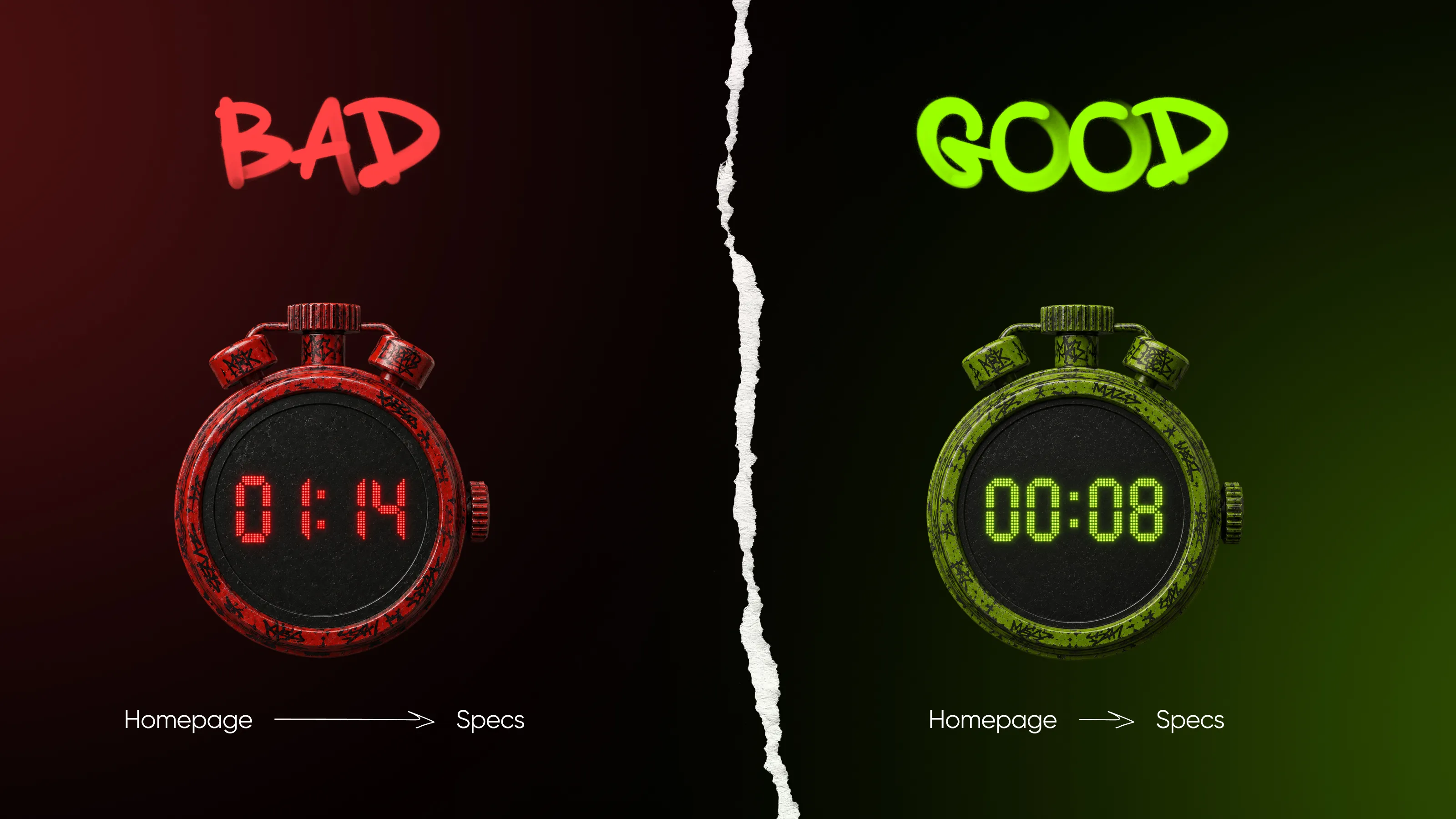
The spec-sheet test:
Track the time. How many seconds does it take a user to get from the home page to the specifications for your flagship product?
More than 60 seconds? Houston, you have a problem.
Well…It's hardly a good UX when you have to cross the Misty Mountains just to get to your product specifications.
The five-second segmentation test:
5…4…3…2…1…Stop! And in that time, each of them—the engineer, the procurement manager, and the distributor—needs to figure out where to click next.
One quick question: “Will they actually figure out where to go next?”
If the answer is “nope,” the problem obviously isn’t with the user. The problem is that your website is trying to speak to everyone at once and in the same way, which means it’s not speaking to anyone.
The peer test:
Print out your homepage. Show it to your main competitor. Did they see you as a fly among elephants, or as an equal opponent?
If the answer is the first one, your website is already sending a signal to the market that you are smaller, less stable, or less mature than you actually are.
The trade-show test:
Just imagine: tomorrow you’re cutting your whole trade show budget.
How will your pipeline cope? Is he holding up bravely?
If the answer is “It crashed and failed with a bang,” let me tell you the unpleasant truth…
Your website is just a pretty decorative plant on the windowsill—it’s pleasing to the eye, but serves no other purpose.
The gap quietly killing your pipeline
So these issues aren’t so much about website redesign as they are about brand maturity.
Industrial buyers have grown up. They do their own research and make quick, tough decisions with zero tolerance for friction.
Today, your brand needs to be the sum of all the digital signals you send to the market, not just a logo and pretty decorations.
Based on this logic, Qream worked on a project for Triol Corporation. The key objective wasn’t simply to create something colorful and attractive. The goal was to make nine product lines and hundreds of technical specifications easily accessible with just two clicks.
And that’s exactly what works. Not in the sense of the cliché “more leads” or “greater brand awareness”—that’s far too surface-level. The real result looks different: your brand makes it onto shortlists more often, engineers are more likely to include your products in specifications, procurement sees you as a lower-risk option, and your reliance on expensive trade shows gradually decreases. And, as a bonus, you’re building a stronger brand not only for buyers but also for the talent market.
So, in 2026, industrial companies are losing out every single day in that silent part of the buyer’s journey where no one calls, complains, or explains why. They just close the tab and leave, while you’re still scratching your head, thinking it’s because of a weak product.
No, folks. The problem is that your brand simply can’t keep up with your customers. And that’s the gap that’s quietly eating away at your pipeline.
Industrial buyers have already changed. The question is whether your website has. If not, you’re single-handedly killing the deal and we need to talk about it.
Written by

Qream co-founder | Business growth and strategy
Leads Qream's business development and commercial strategy, bringing experience across sales, customer support, and complex digital projects. Reviews topics around project scoping, agency engagement, strategic partnerships, and growth.