TL; DR
By 2026, the best fintech websites will have moved beyond the “gradient + floating card + blurry slogans” phase. That’s no longer enough. Today, strong fintech brands succeed through clear positioning, compelling product storytelling, and design that transforms complex financial products into something intuitive and easy to understand.
The best of them do one really important thing: they explain complex stuff quickly while still looking premium. No chaos, no clutter. In 2026, a good fintech is defined by the trust placed in it, which is built at every step: through restrained motion, modular storytelling, authentic product UI, and typography. Because in fintech, the real currency isn’t measured in money. Only trust works.
The good old problem: in fintech, companies have been inspiring each other for so long that they didn’t even notice how they all started to look like they came off a conveyor belt.
Go to one website and you’ll see 3D figures, flying bank cards, and slogans about the safest and coolest banking in the world. And then go to another fintech site, and guess what? It’s exactly the same there. And you know, this isn’t even so much a design problem as it is a major business problem. In a matter of seconds, a user decides whether they’re ready to trust you with their money, data, or investments. An investor forms an opinion about the company’s maturity in those same seconds. The best fintech websites of 2026 have already figured this out and broken the mold.
For this list, we evaluated companies across several criteria:
- Design quality (modern,visually clear, and structured)
- Clarity of positioning within the first screen
- Trust-building design patterns
- Conversion architecture and CTA hierarchy
- Differentiation (distinction of the site from others)
10 Fintech website examples setting the standard
Here, we’ve put together a cheat sheet of fintech website design examples. If your site feels generic, studying modern fintech website inspiration is one of the fastest ways to rethink your approach.
1. Stripe
What works:
Stay simple, and people will be drawn to you
Stripe uses a winning strategy: despite the complex payment ecosystem, the company builds its website around simple and intuitive sections—Payments, Billing, Connect, Radar. Instead of technical jargon, users are shown the practical value of each tool: accepting online payments, managing subscriptions, launching marketplaces, or protecting against fraud. This approach makes the platform much more accessible, even for people without a technical background.
Segmentation: clarity's best friend
Stripe builds its website to remain accessible to different types of audiences—developers, young startups, and large corporations, all at the same time.
The platform doesn’t try to speak to everyone in the same voice, and that’s exactly why it works. Developers are immediately directed to in-depth API documentation, startups see simple product explanations and quick setup guides, and large companies see enterprise solutions with case studies from global brands. Each audience gets its own path, its own language, and its own context—without chaos or cluttered pages.
What could be better:
Unbeatable jungle
Stripe is a fairly large ecosystem that can often seem like an unbeatable jungle to new users. On top of that, the system is constantly evolving and growing. You walk in and think, “It feels like I’ve been lost in a massive hypermarket.” Where should I start—with “Payments” or “Elements”? And how are they even related? This is a common problem with fintech sites that can be overwhelming.
Takeaway:
Stripe wins by making a highly complex product feel simple and approachable, but as its ecosystem grows, maintaining that clarity becomes its biggest design challenge.
2. Mercury
What works:
Beauty lies in simplicity
“Beauty lies in simplicity”—that’s perfectly defines Mercury. Instead of cluttered screens, complicated explanations, and boring fintech jargon, Mercury offers maximum space, a simple structure, and messages that can be read in just a few seconds. The site literally guides the user forward without unnecessary cognitive overload. Plus, the strong visual style and recognizable branding further create the feeling of a next-generation product that stands out noticeably against the backdrop of typical fintech services.
Speed-First Onboarding
Mercury constantly highlights one simple yet critically important idea: you can start using the product right now. All communication on the website is built around speed, at the level of short messages and CTAs.
Users aren’t pressured to spend time analyzing or going through a complicated onboarding process; instead, they’re gently nudged toward taking action from the very first seconds. For startups and early-stage companies, speed is a decisive factor.
What could be better:
When simplicity starts to hide importance
Mercury sometimes simplifies the user experience to the point where, at a certain stage, the site begins to seem too lightweight for serious companies. Experienced finance teams want to see the depth of the product and the details, beyond messages about a quick start: how the infrastructure works, what technical limitations exist, how security is built, and how scalable the integrations are. But instead of answers, the site sometimes leaves a feeling of something being left unsaid. For startups, this works perfectly. For enterprise clients, however, it can raise doubts about the complexity and maturity of the solution itself.
Takeaway:
Mercury wins by turning fintech complexity into effortless clarity and momentum, but its obsession with simplicity can sometimes make the product feel lighter than it actually is.
3. RetireUS
What works:
Focus on the essentials
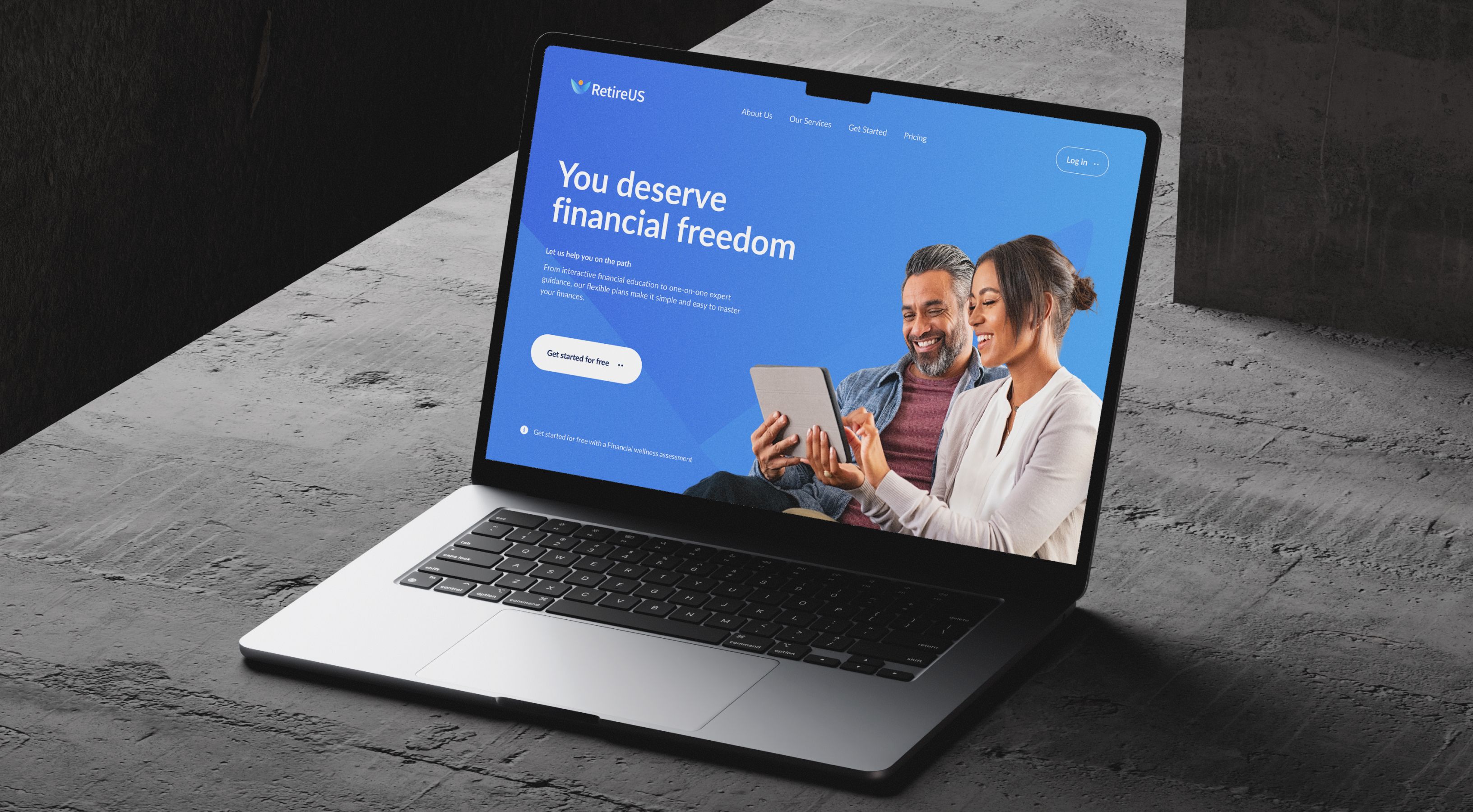
Retire US has a huge advantage—it gets straight to the point: you’ll understand exactly how to retire and what you need to do to make it happen. All communication is centered on the user’s real pain points: how much money to save and how to plan the process.
That’s why the product isn’t perceived as just another investment service, but as a clear action plan that removes uncertainty and gives a sense of control.
Trust is built where competence is evident
The website consistently builds a sense of expertise through educational materials, explanations of strategies, real-life financial scenarios, and clear guides that help users navigate their own future. As a result, the platform is perceived as a financial advisor guiding you through complex decisions. This is critically important for financial technology, as people entrust the service with their long-term savings and need to feel a sense of competence, stability, and support.
What could be better:
Light CTAs
The CTAs on the site aren’t pushy, they’re more like pasta with a mild pepper sauce. This fits well with the site’s overall tone of voice and the theme of long-term planning, but there’s a catch: in the early stages, users might simply lack the push to take the next step. As a result, the site builds trust, but sometimes takes too long to “accelerate” to conversion and loses the necessary tonus.
Takeaway:
By making retirement feel less intimidating and more actionable, RetireUS builds strong trust, but its soft conversion approach can slow users down when it’s time to act.
4. Ramp
What works:
Winning architecture
The website’s architecture is built as an enterprise sales funnel. The user flow is really well thought out: first, a big promise; then a quick product demo; followed by a trust layer (logos, statistics, social proof); then use cases, deeper product details, and handling objections; and only after that, deeper conversion points. It’s a winning approach.
The design discipline
Does Ramp have a disciplined design? Qream would call it like that. No visual chaos, no unnecessary embellishments—just clean whitespace, strong typography, and complete control over the user’s attention. And that’s exactly why the site looks appealing: not because it’s full of “wow” effects, but because everything feels perfectly balanced down to the last detail.
What could be better:
Speed or quality?
Sometimes the focus is too heavily on speed, which causes the brand’s emotional appeal to get a little lost. You quickly realize that Ramp is effective. But you have much less of an understanding of why Ramp specifically, beyond “we help you save money.” It’s a powerful sales machine, but its brand identity is a bit weaker.
Takeaway:
Ramp proves that disciplined design and a perfectly structured sales flow can make complexity feel effortless, though its obsession with efficiency sometimes leaves too little room for emotional brand connection.
Want your fintech website on this list?
What works:
A large-scale player
The first thing that really gives Brex an advantage is the strong sense of scale it achieves through its architecture-first approach. They sell the idea of a comprehensive financial ecosystem. Right from the first screen, you see not just a single product, but a large platform: cards, travel, banking, treasury, accounting, AI. This is important because the user immediately understands: this isn’t a point solution, but a major player that can potentially handle many tasks at once. For an enterprise audience, this is a powerful signal.
Sewn-in trust
Does Brex inspire trust? It’s crucial to note that it’s not just about showcasing figures like “4,250 hours saved” or “99% policy compliance”, it’s rather about how these metrics are integrated. It’s not a separate “social proof block” tucked away somewhere at the bottom. Trust is literally woven into the user journey: every key product claim is followed by proof. This is sound enterprise logic: the Brex website doesn’t need to ask you to “trust it”,it proves it naturally, all the time.
What could be better:
Do you see the personality?
According to Qream's view, the website is super polished and enterprise-ready, but if you remove the logo, parts of this experience could easily be found at other major fintech companies. It speaks the language of “efficiency, control, and scale”, and rightly so, but that’s also the language of nearly all mature fintech brands. Because of this, Brex wins on trust, but doesn’t always stand out for its distinct character.
Takeaway:
Brex proves that great fintech design can sell scale and trust at the same time, the next step is making the brand feel as memorable as the platform.
6. Adyen
What works:
Say no to financial puzzles
While most fintech companies start throwing around terms like “issuing,” “acquiring,” or “embedded finance,” Adyen takes the opposite approach: it offers a clear and powerful framework: “One platform for payments, data, and financial products.” They don’t force users to piece together a puzzle from dozens of confusing options. The ideal scenario for the user.
The key is balance
Everything is well balanced. The financial infrastructure behaves exactly as expected: in a restrained manner, without any flashy animations or gradients. There is minimal visual clutter, and everything conveys a sense of stability and reliability.
What could be better:
First, differentiation
Yes, there is a product distinction, but if you look specifically at the language used, it’s very functional: reliable, scalable, unified, global. These are the right words, but almost the entire enterprise fintech sector uses them. As a result, Adyen doesn’t always stand out through its brand voice.
Takeaway:
Its biggest strength is disciplined clarity; its biggest opportunity is turning that clarity into a more memorable brand voice.
7. Robinhood
What works:
Glowing Robin
Have you seen this brand character? One thing is certain: Robinhood is super easy to recognize. Everything has been thought through down to the smallest detail: tone of voice, illustrations, motion, the green accent, and a mobile-first approach. All of this underscores a single idea: that “finance should feel friendly.” And while most fintech companies sound the same, Robinhood shines.
Strong Structure
Robinhood has a strong structure designed to help new users get started. Each section helps ease the fear of investing. The website gradually teaches users financial literacy through interactive models and visual sequences.
What could be better:
Oversimplification
Simplicity sometimes crosses the line into oversimplification. Qream has observed this tendency among fintech companies with complex products. This is an old problem for Robinhood too: the desire to make investing “simple” is so strong that some of the risks and complexities seem to be hidden. Because of this, the platform has often been criticized for “gamifying” finance, where the user experience is too user-friendly and lightweight for such a serious product. For a beginner, this is a plus. For trust, it’s sometimes a minus.
Takeaway:
Robinhood wins by turning investing into something approachable, friendly, and easy to start, but in making finance feel this simple, it sometimes risks softening the seriousness and depth the product actually requires.
8. Lemonade
What works:
Bold decisions
Insurance company websites have traditionally been considered among the least engaging digital resources in the financial sector. Lemonade has changed that. Their website transforms insurance into an interactive and visually modern experience. The user experience minimizes bureaucratic procedures thanks to streamlined workflows, concise text, and intuitive interactions. Lemonade is nothing like a traditional insurance company. While all insurance companies have been stuck in blue color palettes and stock photos of smiling families for decades, Lemonade came out in pink and won this battle right away. And this is an example of the best fintech website design that has truly managed to stand out.
Modern experience
They start off by saying: “Forget everything you know about insurance.” And that’s pretty cool, because instead of yet another dry product description, they’re immediately selling a new, modern experience. You instantly get what their promise is all about: faster, simpler, and much more people-friendly.
What could be better:
Product in the background
The brand is so dominant that the product sometimes takes a back seat. After a few screens, you get a clear sense that Lemonade is “fresh, digital, friendly.” But it’s a little harder to see exactly why their insurance product architecture is better. In other words, the brand sells itself more effectively than the insurance moat does.
Takeaway:
Great fintech website examples reduce psychological friction as much as operational friction.
9. Column
What works:
Trust signals
Trust signals are at every turn. And that makes sense if you’re a bank that wants people to entrust you with billions. Column does this very effectively: $2 trillion+ in annual transaction volume, 99.999% uptime, the No. 1 issuer of real-time payments in the U.S., plus a separate security layer and a clear emphasis on the fact that they are a federally chartered bank.
Balance in audience
Fintech companies typically lean heavily toward either a developer audience or a sales-driven enterprise. At Column, there is a balance: developers quickly notice the documentation and API-first mindset, while enterprise buyers simultaneously see the scale, compliance, and banking license. As a result, the website doesn’t force one audience to follow the path of the other.
What could be better:
Where is the human touch?
The website is very technical and, as a result, feels almost emotionally sterile. It works perfectly for a CTO or a fintech operator. But if you’re a less tech-savvy buyer, the site might come across as cold. There’s almost no humanity, no stories, and no emotional connection to the brand. You respect Column, but you don’t necessarily feel a personal connection to it.
Takeaway:
By building a platform-level sense of trust and carefully balancing developer and enterprise needs, Column creates a highly credible fintech experience, but its technical precision comes at the cost of emotional warmth and brand connection.
10. Blackalgo
What works:
Striking vibe
Blackalgo has a very clear vision of the vibe they want to create: dark mode, plenty of black space, metallic gradients, and premium motion. The site looks high-end, modern, and “exclusive.” Compared to other fintech sites, it stands out as quite distinctive and striking.
Easy way
For a product that could potentially seem very complex (AI + crypto + automated trading), the Blackalgo website is surprisingly clear and easy to understand. It takes a step-by-step approach: first, a bold promise; then, a simple explanation; next, building trust; and finally, a deeper look at the product’s logic. Rather than overwhelming the user, it guides them through the process.
What could be better:
The world’s best AI
The website sometimes seems to “overpromise.” Phrases like “The world’s best AI”, “unmatched intelligence”, and “consistent performance” sound loud. For part of the crypto audience, this might work. But for a more mature or skeptical buyer, it raises the question: “Okay, but where’s the proof?” And that’s where the risk lies.
Takeaway:
Blackalgo stands out through a strong, premium crypto aesthetic and a surprisingly structured way of simplifying a complex AI trading product, but its heavy reliance on bold, absolute claims can sometimes shift attention from clarity to skepticism.
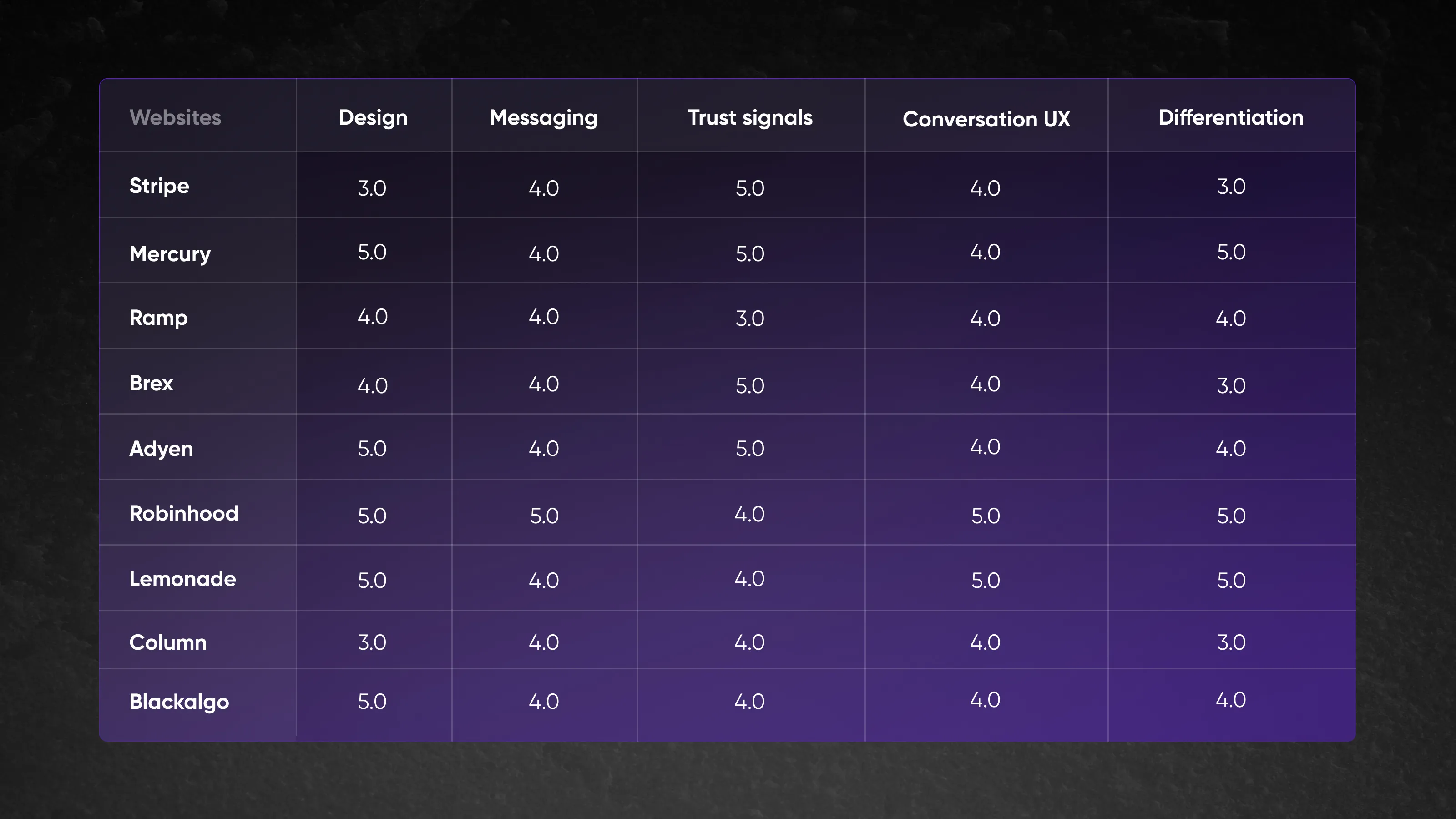
Here are the ratings from our team:
Best fintech website design patterns in 2026
The most effective fintech website design examples share several emerging patterns.
1. They simplify complex concepts without compromising their essence
All of these products are complex: payments, banking infrastructure, investing, and AI trading. But effective websites don’t overwhelm users with unnecessary, technical financial jargon. Instead, they present a straightforward approach, occasionally explaining specific details.
2. They don’t try to tell you everything at once
Weak fintech websites often try to “dump” the entire product on the user within the first 30 seconds: all the features, all the use cases, all the integrations. That won’t work. First, they spark interest; then they explain; then they convince. In other words, they guide you through the site’s pages rather than overwhelming you.
3. They build trust from the very first sentence on the hero
Client logos, uptime, compliance, licenses, ratings, and security claims, all of these appear as high up on the page as possible. They don’t ask you to trust them; rather, they show you why you should trust them within the first 10 seconds.
4. The design reflects the company’s maturity.
Adyen and Column look like infrastructure. Robinhood and Lemonade look like consumer brands. Blackalgo looks like a luxury crypto product. In other words, good fintech design isn’t “pretty in itself”, it reflects who the company really is.
5. Every site has a clear differentiation hook.
Strong fintech sites always have one standout personal opinion. You’ll quickly see what sets one site apart from another. If not, it’s game over for that fintech site.
Let’s make your fintech brand shine the brightest

A strong fintech website should make complex financial products feel clear, trustworthy, and easy to understand. Start with sharp positioning and product-led storytelling: explain the value first, then gradually introduce the complexity. Use trust signals as highly as possible: compliance, client logos, case studies, security messaging, and make sure the design reflects your company’s maturity, whether you’re a bold startup or an enterprise infrastructure platform.
A good fintech website combines trust, clarity, and usability. Users need to understand the product quickly while also feeling confident about security, reliability, and operational maturity. The best fintech websites simplify complexity without oversimplifying the product itself.
Many fintech companies rely on the same startup design trends and messaging frameworks, which leads to visual sameness. Stronger brands differentiate through strategic positioning, clearer storytelling, and more distinctive design systems.
A fintech website should include a clear product explanation, visible trust signals, and tailored journeys for different audiences like end users, enterprise buyers, or investors. Strong fintech sites also use real product UI, demos, and use cases to make abstract financial tools feel tangible. Most importantly, every page should reduce uncertainty and reinforce one message: your money, data, or infrastructure are safe here.
The era of flashy gradients is gradually coming to the end. Trust is taking center stage. The strongest fintech websites are focusing on subtle motion, realistic product UIs, modular storytelling, and clean typography to make complex financial products seem less intimidating.
Another major trend is product-first design. The site no longer hides the product behind fancy words: it shows it right away and guides the user step by step through the experience. The main goal? Simple: to reduce anxiety, clear up doubts, and turn attention into trust more quickly.
Written by

10 years in UI/UX | Awwwards, FWA and Webby jury
Leads strategic visual direction and acts as a senior design authority across major project milestones. Reviews content on UX/UI, design systems, user-centred experiences, and conversion-focused design.