TL; DR
Choosing a branding agency comes down to seven things: portfolio relevance, strategic depth, process transparency, who actually does the work, pricing clarity, working chemistry, and post-launch support. Skip the gloss—ask hard questions on all seven. European marketing leaders named branding the number one priority for 2026, citing its power to drive distinctiveness and competitive differentiation (McKinsey & Company, November 2025). Here's how to get it right.
Almost every agency has a beautiful website, a polished deck, and a list of past clients that sounds impressive. They all claim to be strategic, collaborative, and results-driven. It’s really hard to predict which agency will deliver successful results until the work actually begins and the results become clear.
The problem isn't that there is a lack of options. There are plenty of them. It's a lack of useful criteria. Knowing how to choose a branding agency, and what to actually look for—makes all the difference. Most guides tell you to check portfolios and trust your gut. But that's not enough for a $30K-$100K+ investment that will define how your company shows up in the market for years.
That's exactly why it's hard: every agency craves attention as instinctively as sunflowers turn toward the sun. Agencies are evaluated on their best projects, their most experienced experts, and their most polished pitches, but none of that tells you what working with them for five months would actually be like.
Qream is a brand transformation agency for tech companies. Here's what we'd want you to ask us—and any agency you're considering. This isn't a pitch. It's a framework for evaluating any agency, including us. Because we want you to know how to make an informed choice, even if that means you don't choose us.
Your product is complex. Not every agency is built for that
Your buyers are tech-savvy, skeptical people who are tired of suppliers who don’t speak their language. An agency that has succeeded in retail or lifestyle brands has a different perspective, and that perspective will show in your results—even if they claim to be flexible and adapt their approach to suit your needs.
Fintech companies operate where one wrong brand signal kills trust before a demo. Cybersecurity companies fight for credibility in a visually generic category—and the wrong agency will make you look like everyone else.
Here's how to make sure that doesn't happen.
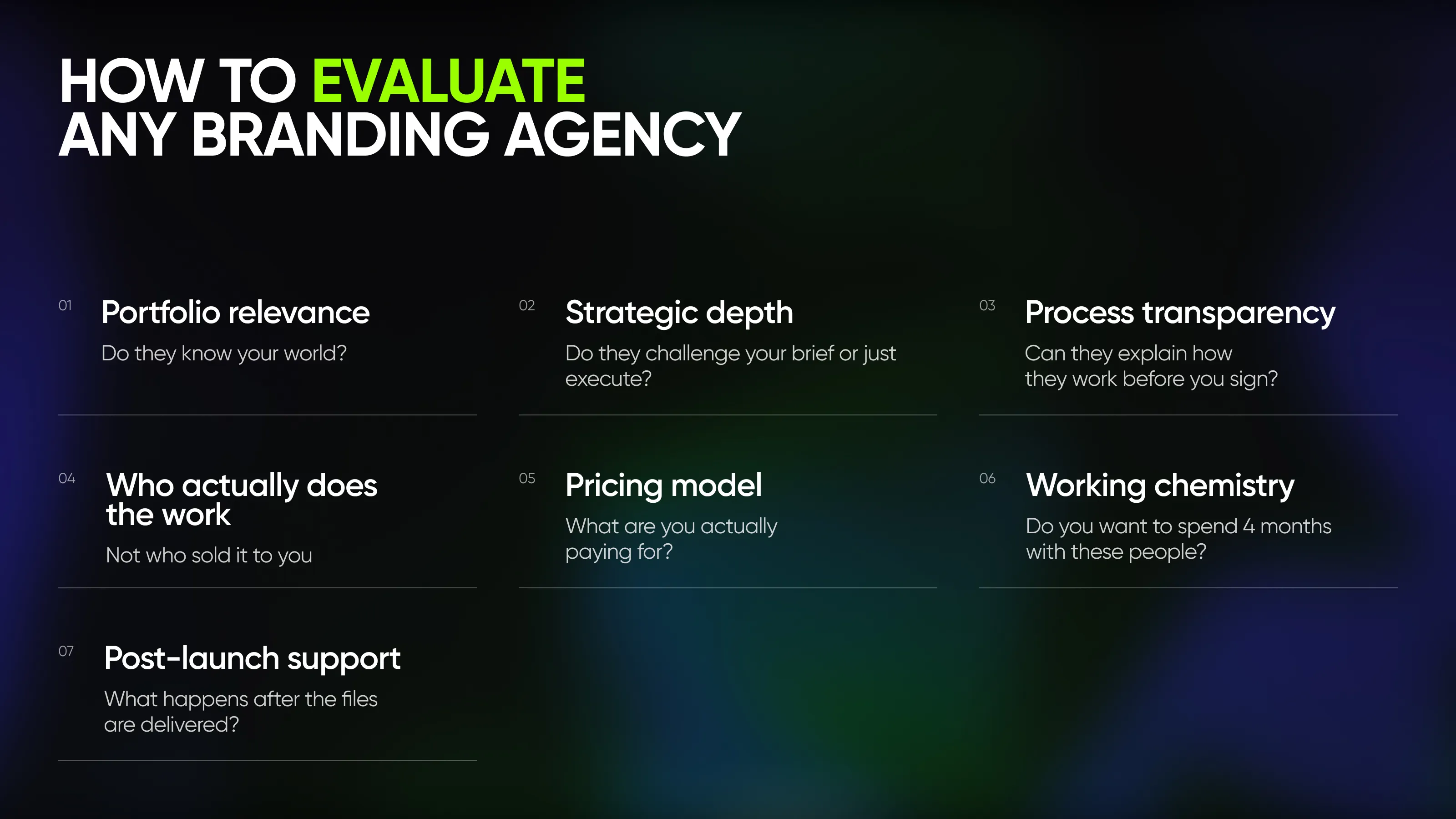
The 7-point agency audit: how to evaluate a design agency
01. Portfolio relevance—do they actually know your world?
The first of these branding agency selection criteria starts with a portfolio—but not in the way most people think. Look at an agency's portfolio and ask one question: does this work live in a world your buyers would recognize? You don't need an exact industry match, but their portfolio should be closely aligned with what your business actually needs. Look for evidence they understand trust-sensitive markets, where credibility is the prerequisite, not a nice-to-have.
A strong tech portfolio means more than familiarity—it means the agency has already solved problems similar to yours and built instincts around them. That's what lets them bring a genuinely fresh perspective instead of guessing.
Ask any agency: what industries do you know well enough to push back on the brief?
02. Strategic depth—do they challenge your brief or just execute it?
The fastest way to tell a strategic agency from an execution shop: watch what happens in the first meeting. Are they asking about your competitive position, your sales cycle, what objections your buyers raise? Or are they asking about your favorite colors and three brands you admire?
According to Harvard Business Review (2024), the most effective way to approach complex problems is through the E5 problem-framing method: Expand, Examine, Empathize, Elevate, and Envision. Execution agencies take your brief and make it look good. Strategic agencies challenge your brief.
Lurkit came to Qream asking for content support. The real problem was a brand that had to speak two completely different languages at once—studios chasing reach, creators chasing partnerships, without losing coherence. The result was a full brand transformation, not a content plan.
Look for agencies that explain the thinking behind their creative decisions—not just what they made, but why that specific approach, for that specific business moment.
03. Process transparency—can they explain how they work before you sign?
A clear process isn’t just a nice bonus: it's a signal of maturity. Any serious agency should walk you through their approach in 30 minutes: how they run discovery, handle feedback rounds, what happens if the first creative direction misses.
"We're flexible and collaborative" is not a process: it's a way of avoiding the question. Push for specifics: how many revision rounds are included? Who runs the strategy sessions? What does week three look like?
04. Who actually does the work—not who sold it to you
This is the gap between what gets promised and what gets delivered. In many agencies, the senior strategist and creative director appear for the pitch, kickoff, and final presentation. Between those moments, junior staff is doing the actual work.
Ask directly: who will be the day-to-day lead on my project, and can I meet them before we sign? If the answer is evasive, take note. Also ask about capacity.
You're not just buying deliverables—you're buying access to thinking and iteration. The clearest signal: does the day-to-day lead ask smart questions about your business in the intro call?
05. Pricing model and scope clarity—what are you actually paying for?
Branding costs range from $5K freelancer work to $200K+ agency engagements. That spread reflects scope, team size, and strategic depth. The problem isn't the range: it's agencies quoting a number without explaining what's inside it.
Before signing the contract, make sure you have the following answers: what's included in the price for website design? What's the revision policy? What happens if scope expands mid-project?
Price is an important factor, but every situation calls for its own solution, and you don't necessarily need the most expensive option. Full brand transformation for tech companies typically runs $25K–$80K+—and that range exists for a reason. For a $5K logo refresh, a skilled freelancer is often the smarter call. Matching the scope to the right type of partner is how you get value at any budget.
06. Working chemistry—do you actually want to spend 4 months with these people?
Brand projects are long. They involve feedback that feels personal and moments where client and agency have to disagree constructively and keep going. Get this wrong and the work suffers regardless of how talented the team is.
Chemistry isn't about liking the agency. It's about whether their communication style and decision-making pace are compatible with yours.
Pay attention to pre-signature interactions. Are they responsive? Do they listen, or do they perform listening? Are they genuinely interested in your problem—or in closing the deal? By month two of communication, chemistry is either working or it isn't.
07. Post-launch support—what happens after the files are delivered?
This is the criterion most evaluation guides skip, and where projects quietly fall apart.
A brand system without instructions on how to use it is just a pretty folder on a server. You don’t need brand guidelines that your team won’t be able to apply.
Before signing, get specific answers to these: what does handover look like? Is training included for your team? How accessible will the agency be during the first 60 days? The strongest agencies think about implementation from the very beginning—how will this branding actually be used after the handover? See how Qream approaches brand transformation from strategy through activation.
Design agency vs freelancer vs in-house: the honest comparison
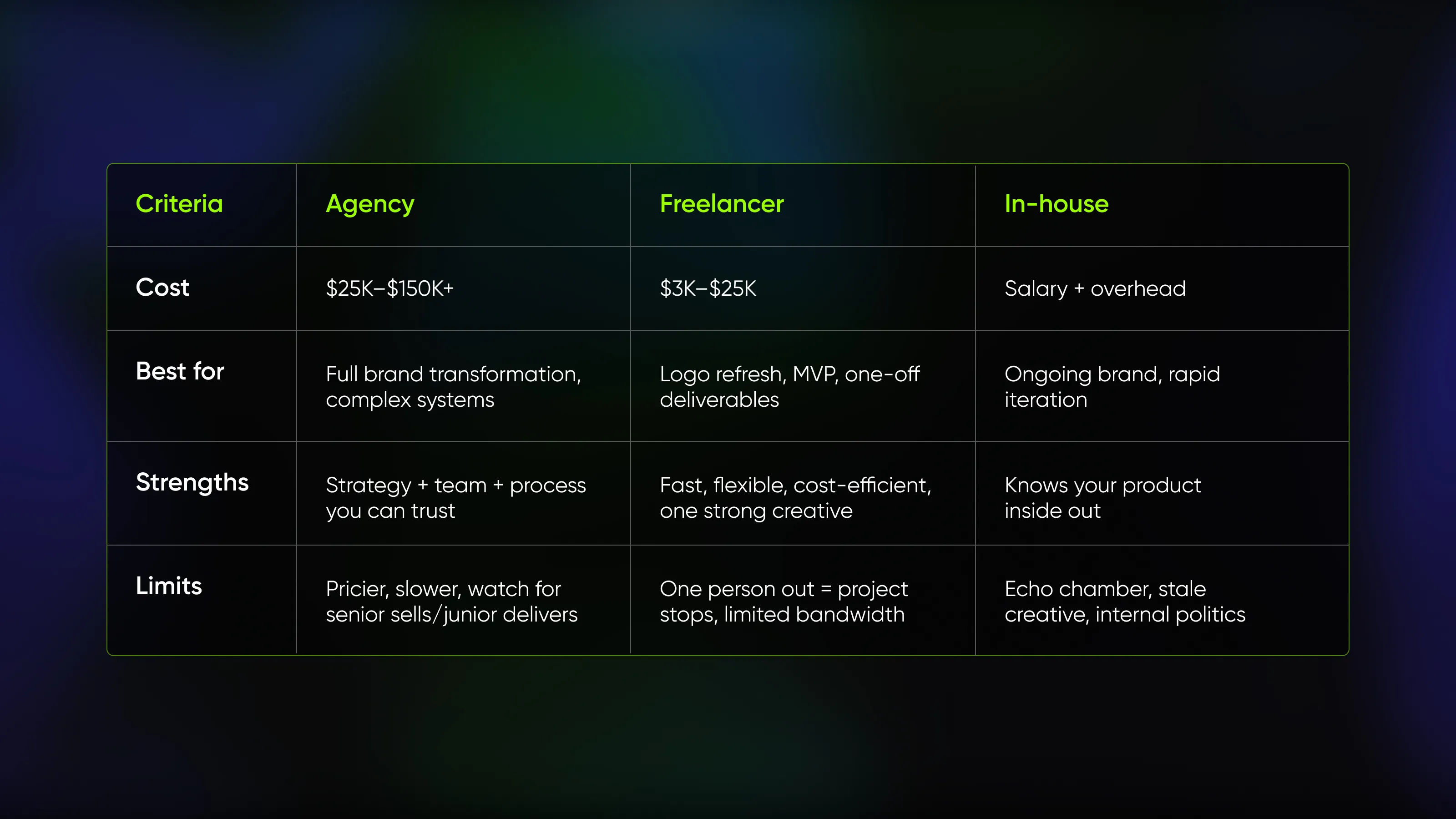
Agency
Works best for: full brand transformation, multi‑channel rollout, complex systems where positioning, identity, messaging, and website must align.
Strengths: strategic depth, team coverage (strategy + branding + design), reliable process, brand‑system thinking.
Limits: pricier and may be slower. Watch for "senior sells, junior delivers" and scope creep without cost clarity.
Pick this when: you're in a trust‑sensitive category (fintech, cybersecurity, healthtech) and need a defensible market position that scales.
Freelancer
Works best for: tight, well‑scoped deliverables: logo refresh, early visual identity, MVP branding, or one piece of the puzzle.
Strengths: speed, flexibility, cost efficiency, direct access to the person doing the work.
Limits: a single point of failure, limited bandwidth, and a more difficult project-wide overview, as they are not experts in every field.
Pick this when: you need a fast, affordable solution for a narrowly defined scope.
In‑house
Works best for: ongoing brand management, execution at scale, rapid iteration tied to product updates.
Strengths: deep company knowledge, always available, no briefing overhead.
Limits: hard to stay fresh, internal politics can shape creativity, risk of an echo chamber.
Pick this when: you need constant brand output tightly integrated with product and sales.
You can also mix them: agency for strategy and system, freelancers for tactical pieces, in‑house for scaling and activation. Qream is a brand transformation agency for tech companies. If your project is a full transformation covering positioning, identity system, messaging architecture, and website, an agency brings team coverage and strategic depth a solo operator can't replicate.
7 branding agency red flags that scream "Run, Forrest, run!"
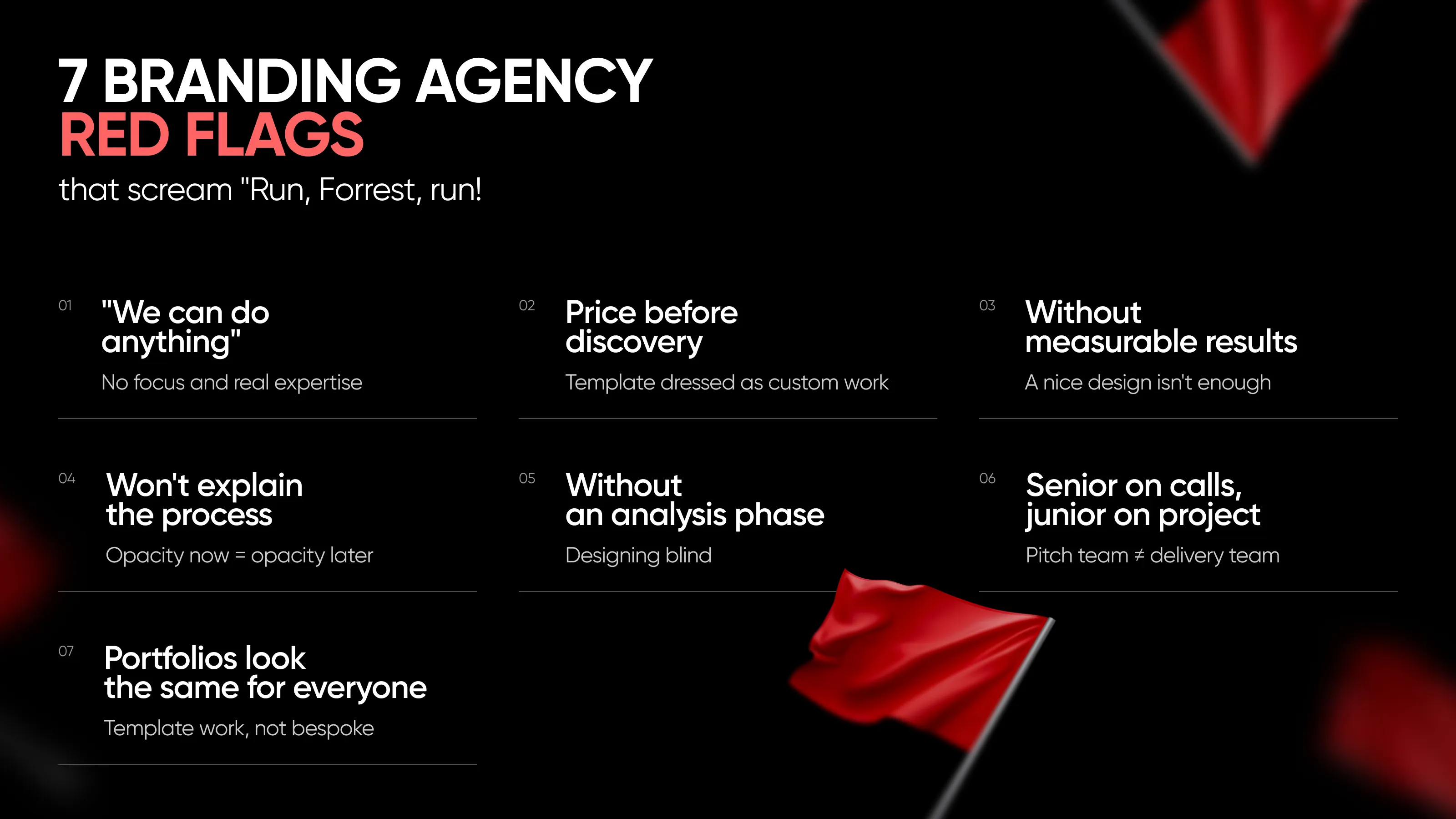
"We can do anything"
Strong agencies don't claim this—they say what they won't do. They protect their reputation by choosing: they know what they deliver well and what's outside their niche or complexity. They'll be honest about boundaries and tell you where they're ready to help and where they're not relevant.
They quote a price before discovery
If an agency sends pricing within 2 hours of a first call, before understanding your competitive landscape, your team, your timeline—they're selling a package, not solving a problem. A fast quote is a template dressed as custom work.
No case studies with measurable results
Visual portfolios are necessary but not sufficient. Push for before/after context. "We redesigned their brand" is a deliverable. "After the repositioning, they closed their Series A six months later" is a result.
They won't explain their process before you sign
Any agency with a real process should describe it in 30 minutes. If they deflect with "every project is different" or "we'll walk you through it once we're engaged", be cautious. Opacity here reliably predicts opacity later.
When the proposal skips analysis like it's optional
Discovery is structured research into your business, your competitors, your audience. It's what separates a strategic branding agency for tech companies from a generic execution shop. Skip it and you're paying for aesthetics, not positioning.
Senior on the calls, junior on the project
Ask who your day-to-day lead will be. If it's someone who wasn't in the pitch room, ask to meet them. Ask how many other projects they're running. The gap between pitch team and delivery team is one of the most consistent sources of client disappointment in agency work.
Templates dressed as bespoke work
Their portfolio gives it away: same structure, same visual moves, different client names. Ask them to explain the strategic rationale behind a recent project. Recognizing these patterns early is the difference between a great partnership and an expensive lesson—we wrote more on how red flags connect to agency churn.
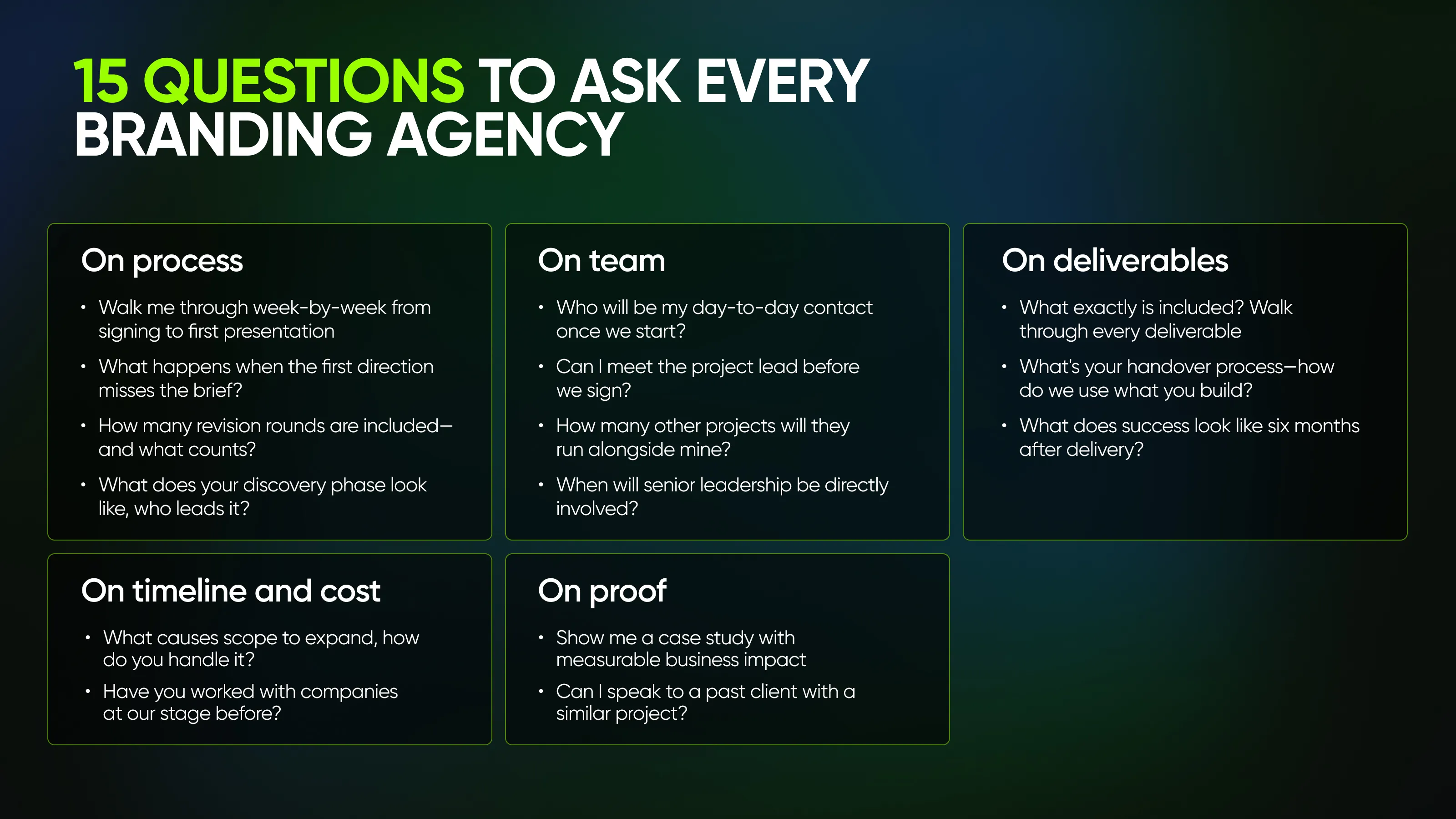
How to choose a branding agency—start with these 15 questions
Take a screenshot of this, and it might save you tens of thousands of dollars. These are the questions that separate agencies that look good from agencies that actually deliver—and reveal how an agency thinks before you're locked into a contract.
On process
- Walk me through exactly what happens between signing and the first creative presentation. Week by week.
- How do you handle a situation where the first creative direction misses the brief?
- How many revision rounds are included—and what counts as a revision?
- What does your discovery phase look like, and who leads it?
On team
- Who will be my day-to-day contact once the project starts?
- Can I meet the project lead before we sign?
- How many other active projects will that person be running alongside mine?
- At what points will senior leadership be directly involved?
On deliverables
- What exactly is included? Walk me through every deliverable.
- What's your handover process—how do you make sure our team can use what you build?
- What does a successful project look like to you, six months after delivery?
On timeline and cost
- What typically causes scope to expand, and how do you handle it?
- Have you worked with companies at our stage of growth before, and what was different?
On proof
- Can you show me a case study where the branding had a measurable business impact—not just a visual one?
- Can I speak to a past client with a project similar to mine in scope and industry?
Branding agency costs range from $20K to $150K+ depending on scope and strategic depth. A focused brand identity project for a tech company: logo, visual system, typography, color, brand guidelines—typically runs $30K–$50K. Full brand transformation covering positioning, messaging architecture, identity system, and website starts at $50K and up. Under $20K, a skilled freelancer is the better fit. For a detailed breakdown of what drives these numbers, see our web design pricing guide.
Seven things matter most: portfolio relevance, strategic depth, process transparency, clarity on who does the work, pricing that defines scope, working chemistry, and post-launch support. Of these, strategic depth is the hardest to evaluate in a discovery call—and the most important to get right.
Scope decides it. For a logo refresh or early visual identity, a freelancer is faster and adequate. For full brand transformation involving positioning, identity systems, and website, an agency brings team coverage a solo operator can't match. Tight scope and budget: freelancer. Cross-functional complexity: agency.
Brand identity: 6-10 weeks. Full brand transformation: 3-6 months.
Brand identity projects are shorter because they focus on core visual elements—logo, color, typography, and basic guidelines. Full brand transformation takes longer because it includes strategy, positioning, messaging, visual identity, touchpoint mapping, and often website or packaging integration.
Look for experience in trust-sensitive markets such as fintech, cybersecurity, SaaS, and healthtech; a strategic approach beyond visual execution; and case studies showing real competitive positioning. The right agency understands the difference between a gaming platform, a fintech startup, and an enterprise cybersecurity company before you explain it.
You have the framework. Now use it better than most.
Most companies spend weeks on agency selection and still get it wrong—because they're evaluating the wrong things. You now know what to actually look for.
When you're ready to see how this plays out in practice, here's how Qream approaches brand transformation.
Written by

Qream co-founder | Design and product direction
Leads Qream's creative and product direction, connecting brand strategy, experience design, and business goals. Reviews content where design strategy, UX/UI, customer experience, and brand execution are central.