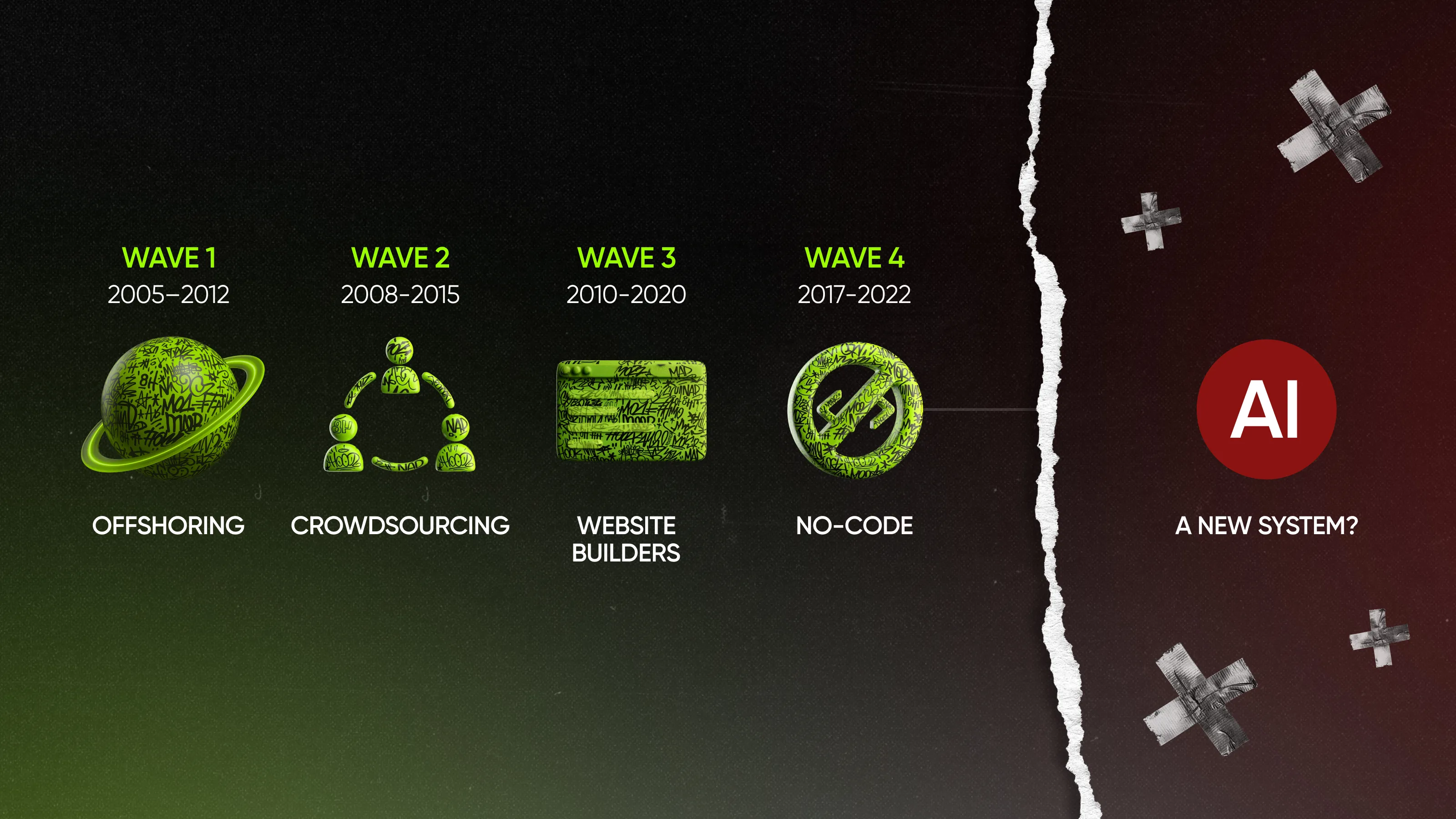
Offshoring (2005–2012), crowdsourcing (2008–2015), website builders (2010–2020), no-code platforms (2017–2022), and now—generative artificial intelligence. The five horsemen of the apocalypse for design agencies, or just logical stages?
Over the past twenty years, the “death” of design agencies has been declared at least five times. Each such wave promised to spell the end of agencies, and each, at least temporarily, seemed to be backed up by numbers.
In 2014, Sergio Nouvel declared, “Web design is dead”. Prior to that, industry observers had warned that offshore production centers would hollow out Western creative agencies from within. It sounded quite apocalyptic. But there was indeed some truth to it.
Each of these waves seemed like it would be the last. And yet, the rules of the game kept changing, traditional agency business models were breaking down, and from time to time, their very future was even called into question. But each time, the reality turned out to be far less dramatic. According to an IBISWorld report, in 2024 the global graphic design industry generated $54.7 billion in revenue, a 3.1% increase from the previous year, and its annual growth rate from 2019 to 2024 was 3.1%, despite numerous technological and economic shocks during this period. This trend is hard to ignore.
Since 2005, every obituary has made the same mistake—confusing failures in routine operations with the death of the industry.
Maybe this time the pessimists are right. Or not? History is cyclical. But before deciding whether things are different this time, it’s worth understanding what happened four times before.
The four fatal obituaries
Wave 1—Offshoring (2005–2012)
The first “obituary” for modern agencies appeared with the rise of globalization.
In 2006, YaleGlobal published an article describing outsourcing as something of an “invasion” of the marketing industry. The fears were understandable. By 2004, Mindshare, a WPP company, had already moved its global media analysis operations to India (Indian business press, 2007). Industry reports indicated that Western brands could cut TV ad production costs by 44–77% by moving operations overseas.
The logic seemed simple. If the same work could be done on the other side of the world at a fraction of the cost, why would clients continue to pay agency rates in London, New York, or San Francisco?
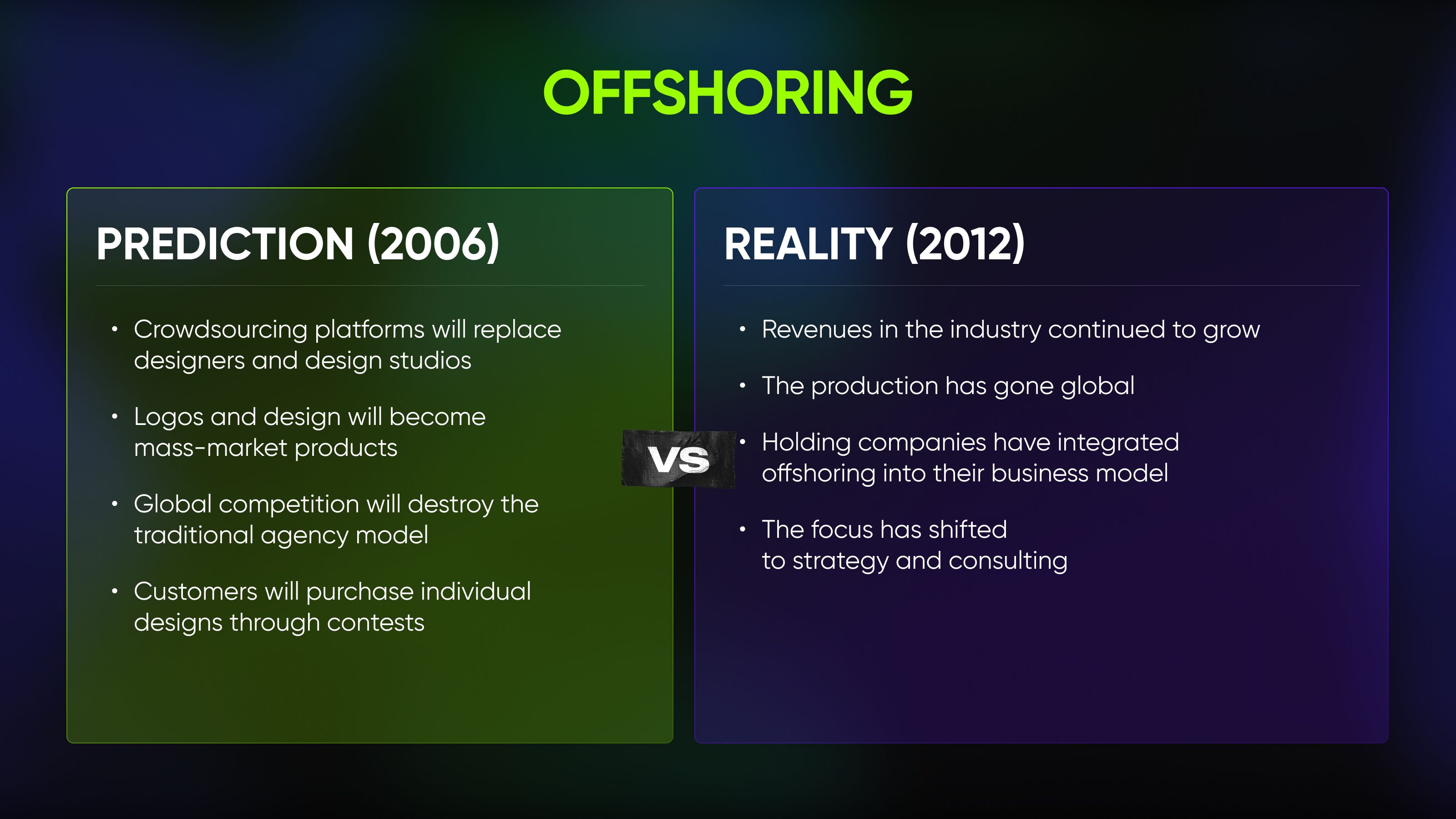
And, to be fair, there was some truth to that prediction. Production functions began migrating en masse to lower-cost markets. Media operations, banner production, creative versioning, and a significant portion of studio work gradually transformed into a globalized back office. For many mid-tier agencies that relied on production margins for their revenue, this was a serious hit.
But the “agency death” scenario never really happened. Instead, the biggest players did what big players do best—they adapted. WPP, Omnicom, and Publicis didn’t lose control of their businesses to offshoring. They made it part of their model, keeping strategy, client work, and consulting where the most value was created.
And you know what’s most interesting? The industry’s revenue kept growing. So it wasn’t the agencies that died. What died was the idea that clients would forever overpay for mere execution. And a similar story will repeat itself over and over again…
Wave 2—Crowdsourcing (2008-2015)
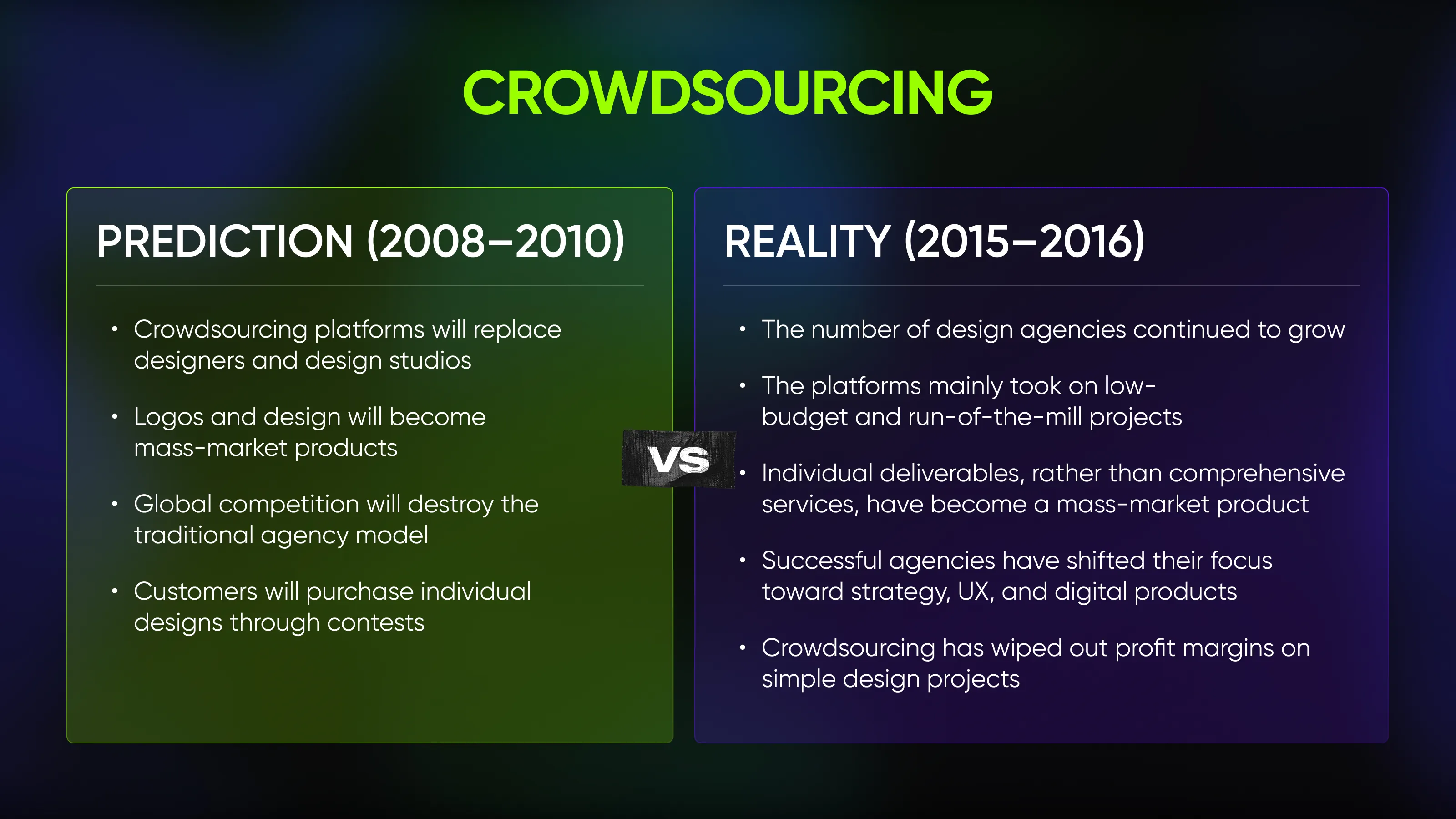
The industry had barely recovered from the first prophecy when a second “obituary” arrived from an entirely different front. This time, the threat came not from cheap labor abroad, but from global competition that had spread to every sphere.
Platforms such as 99designs have introduced a completely different model. Instead of hiring a designer or an agency, clients can launch a contest and receive dozens or even hundreds of submissions from around the world.
The reaction within the industry was stormy.
In an article “Crowdsourced Design: The Last Frontier” (2010), PRINT magazine described 99designs as a shift from “a profession to a purely service-oriented activity.” Again, the logic seemed convincing.
If a small business could buy a logo for a few hundred dollars through a contest platform, why would it hire a traditional agency? And once again, part of the prediction came true.
Logo design projects have actively moved to crowdsourcing platforms. Branding work for small businesses, basic brochure design, and low-budget creative projects were increasingly being submitted to contest platforms. By 2016, 99designs had paid out over $150 million to participating designers and distributed millions of dollars every month. However, the general situation in the industry was quite different.
The number of design firms around the world continued to grow. Rather than competing head-on with crowdsourcing platforms, many successful agencies rose to the top.
Companies such as Focus Lab, Clay, and Ramotion increasingly began combining brand strategy, product design, customer experience, and digital implementation into larger-scale projects. Clients stopped purchasing individual deliverables and began purchasing integrated solutions.
So, where is the agency's predicted death? The cards didn’t fall right.
Wave 3—Website builders (2010–2020)
The third wave targeted one of the agencies’ biggest sources of revenue at the time: websites.
As Squarespace, Wix, Weebly, and similar platforms became more widespread, a new question arose. If anyone could create a professional website without hiring a designer or developer, what role would be left for agencies?
This worry peaked when Sergio Nuvel’s essay “Web Design Is Dead” spread throughout the industry.
This argument wasn’t as absurd as it might seem now.
Millions of businesses suddenly gained access to tools that drastically reduced the cost and complexity of launching websites. Features that previously required specialized knowledge became accessible thanks to templates, drag-and-drop editors, and pre-built components.
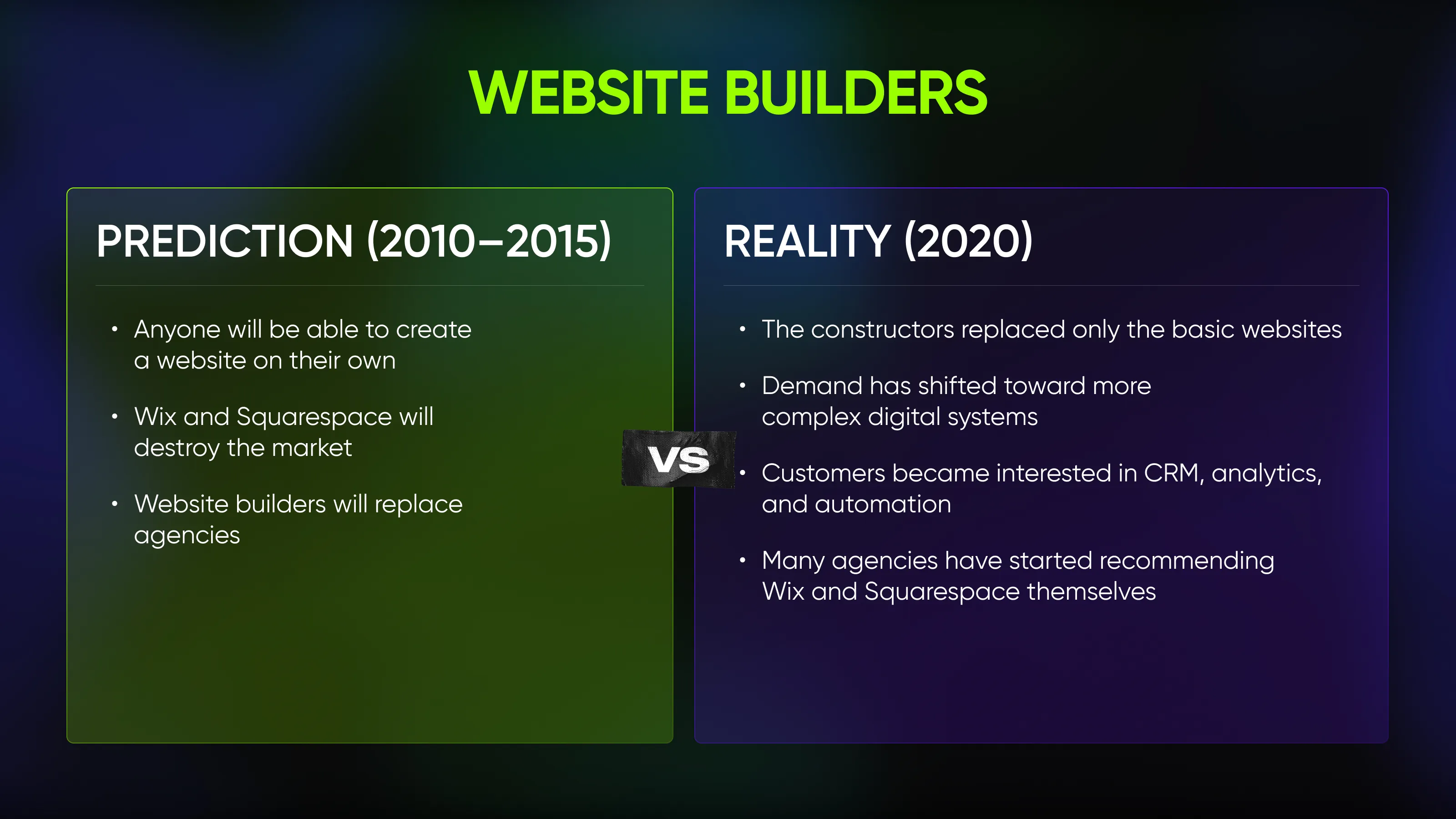
Many agency executives saw this as an existential threat, and some of them were right. The market for basic brochure websites has shrunk significantly. Template-based development firms, PSD-to-HTML conversion services, and agencies focused on simple WordPress customization have come under increasing pressure.
But the market as a whole has evolved again, rather than disappeared. As website creation became easier, customer expectations grew. Organizations needed CRM integrations, marketing automation systems, analytics infrastructure, content management, performance optimization, security systems, and multi-market management.
So the result was a shift, but not a collapse.
While developers were absorbed in the lower end of the market, specialized agencies shifted their focus to more complex projects. B2B companies operating in the SaaS sector regularly invested tens of thousands—and often much more—in digital solutions integrated with broader business systems. Many successful studios even began recommending Squarespace or Wix to clients in the very early stages of development.
And the winning strategy wasn't in trying to defend against the technology, but in accepting that the technology was solving a different problem.
Wave 4—No-Code (2017–2022)
If website builders held websites at gunpoint, no-code platforms seemed like a threat to software itself.
Between 2018 and 2022, investors poured approximately $8 billion into this sector, and Webflow, according to data from Sacra, reached a valuation of over $4 billion.
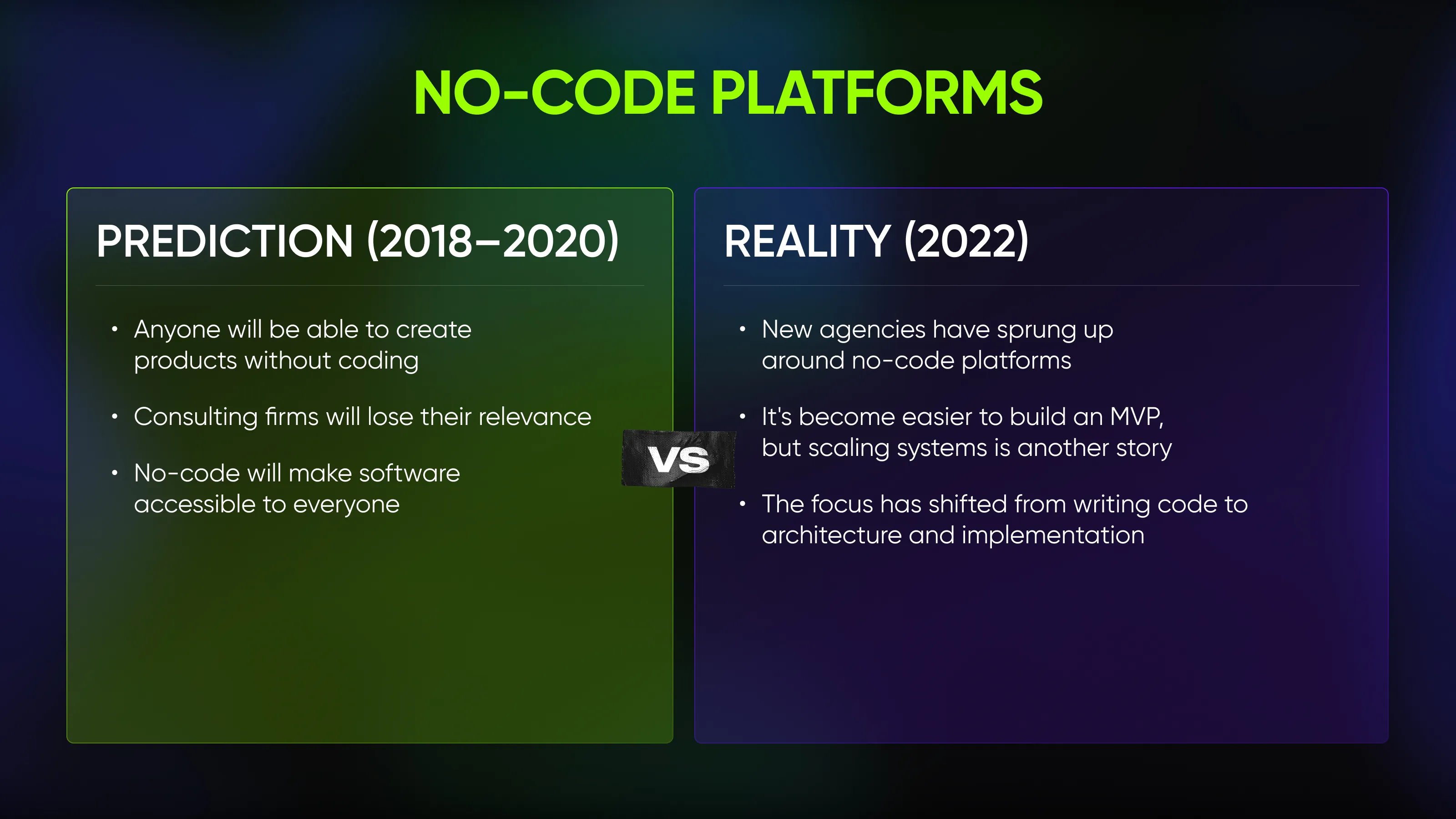
The promise was ambitious: full-fledged apps without writing a single line of code. And for a while, it seemed realistic. Founders were launching products faster, marketing teams were building their own internal tools, and startups were bypassing traditional development workflows.
Once again, observers predicted that agencies, and perhaps even software consulting firms, would gradually fade from the scene.
And part of the prediction turned out to be true. The “code-free” approach radically reduced the cost of prototyping. It became easier to launch internal dashboards, MVPs, and experimental products. Certain categories of development lost their value.
However, the demand for specialized knowledge has not disappeared. Instead, a new ecosystem has emerged around the platforms themselves.
Webflow agencies have gained expertise in design systems, performance optimization, content architecture, and enterprise implementation. Bubble consulting firms have built complex products at a cost significantly lower than that of traditional software development firms.
However, according to Publixly, in 2025–2026, company valuations crashed. Webflow’s valuation plummeted from $12 billion (in 2021) to approximately $800 million as a result of a fire sale. Bubble’s valuation fell from $6.5 billion to approximately $300 million (a 95% drop).
So, once again, the prediction did not come true. The platforms that were supposed to replace agencies have actually created new categories of agencies.
The constant: what didn't change
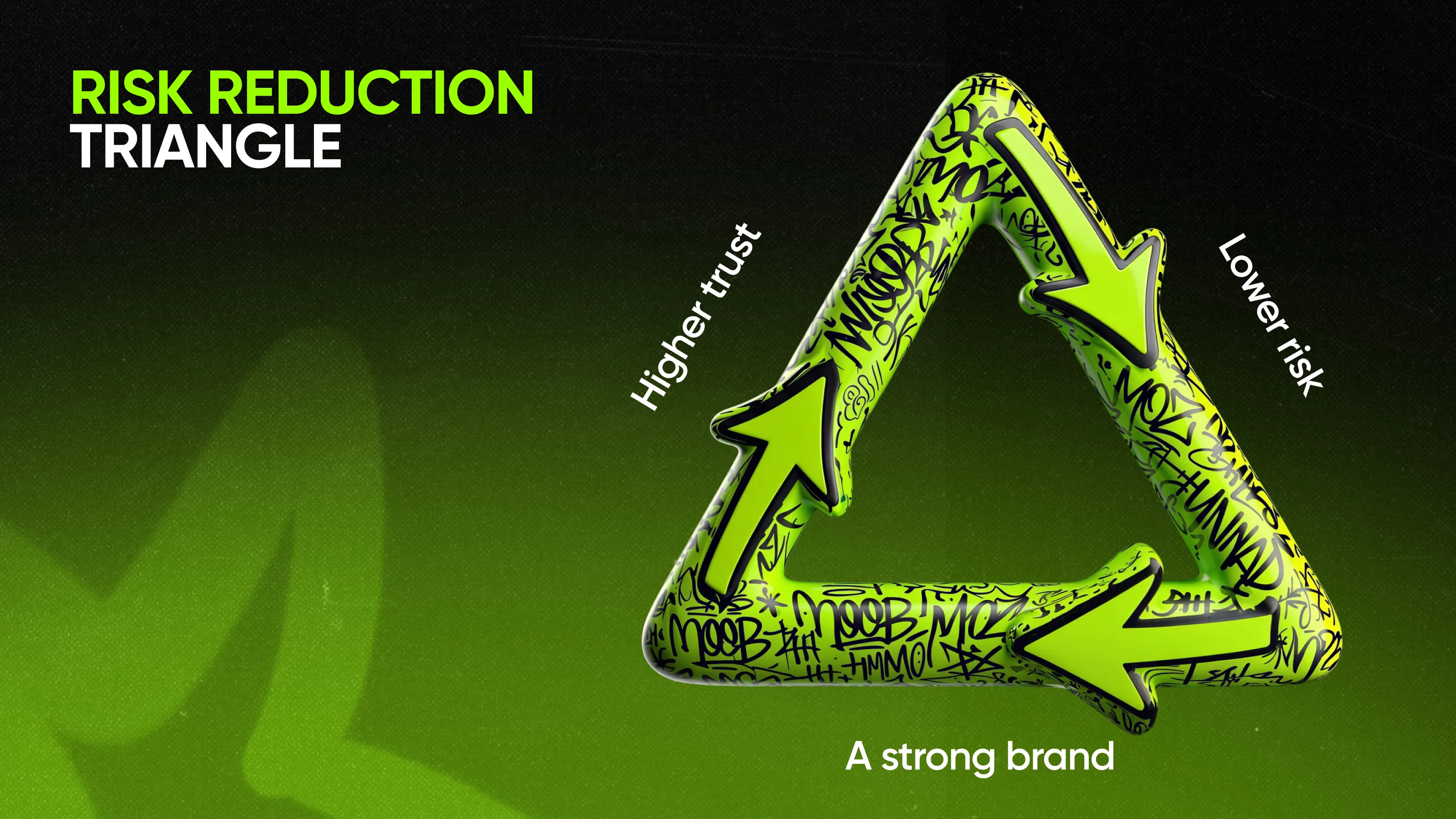
Did you notice a pattern across the four waves? The nature of the work, the tools, and the economic conditions changed, but what customers were actually buying remained the same. Risk reduction—that’s what lies behind the curtain.
Research by Erdem and Swait on buyer behavior in the B2B segment shows that brand strength acts as a risk reduction mechanism in high-stakes decision-making. As the risk of a purchase increases, sensitivity to the brand often increases as well. This helps explain a repeated observation: when decisions become more important, organizations rarely seek the cheapest possible option; rather, they prioritize confidence.
Throughout each wave of change, the agencies didn't sell the final product, but rather clarity in times of uncertainty.
Brian Collins pointed out that “design isn’t what we create. Design is what we make possible.”(2025 reflection) And that distinction sums up the entire evolution of the industry.
Corporate clients rarely bought just logos, websites, or campaigns on their own; what they were really looking for was consistency, a common language, and organizational clarity. In other words, a system that allowed product, marketing, management, HR, and sales teams to move in the same direction. The best agencies understood this before anyone else: the value lay in the systems.That's the point.
The irony is that AI doesn’t kill branding systems either; in fact, it makes them even more important. Because when anyone can create content, the decisive factor isn’t “what to generate,” but rather the rules for doing so. Brand systems, positioning, principles, and guidelines aren’t just dead weight sitting in Figma or PDF files; they become the software that powers the company’s entire AI stack.
In the past, the brand helped connect people; now, it connects machines as well. And perhaps this is the central paradox of the AI era: the cheaper creativity becomes, the more expensive the system becomes.
Finally, agencies continued to play the role of external observers. Large organizations accumulate assumptions, policies, and institutional history. Internal teams become deeply rooted in their own narratives. An external partner may see things differently, not because they are more creative, but because they are less limited by context.
Through every wave of disruptive change, this role has remained surprisingly stable.
The steelman: why this time everything might be different
All the patterns of these waves point to one thing: history repeats itself. Here comes another wave, yet another change in the rules of the game, and a new cycle of adaptation. A logical beginning and ending to the obituary of these agencies.
But what about Chapter 5? What if generative AI isn’t the fifth wave in the traditional sense? What if it isn’t a wave at all, and we’re trying to build a new path using a map of the old world?
There is growing evidence to suggest that generative AI represents a different category—and quite possibly a new era.
Previous revolutionary changes focused on specific functions, and more often than not, on changing just one.
- Offshoring transformed the manufacturing economy.
- Crowdsourcing changed the approach to talent search.
- Website builders transformed the process of creating websites.
- “No-code” transformed software development.
The 5th wave brings together numerous functions into a single, seamless conveyor belt. Copywriting, visual design, coding, research, idea generation, analysis, prototyping, and implementation,what once existed as separate planets now blends into a single solar system.
Benedict Evans, in his article, describes these systems as “infinite interns.” And this is no longer just a theory. Figma integrates agents directly into the environment where the product is created. What just yesterday needed a designer, copywriter, researcher, developer, and dozens of syncs between teams is now increasingly happening within a single interface. In other words, structurally, it looks quite different from previous waves.
What about the speed? The pace of AI integration is growing at a geometric rate. Previous technological revolutions unfolded over decades, but this one feels like someone has hit the fast-forward button. What used to take generations is now compressed into just a few years.
According to Sam Lessin research, over $500 billion has been allocated to investments in artificial intelligence infrastructure in an extremely short period of time. Previous waves followed S-curves over the course of a decade; this one has compressed to approximately 24 months.
Will these investments eventually yield a profit? That is another question. Nevertheless, scale and speed are important.
But does AI strike a balance between speed and quality?
- Each previous wave had its own “buts”, and these were visible in quality.
- Logos created through crowdsourcing looked like they were crowdsourced.
- Websites built using templates looked like they were made from templates.
- Offshore production often resulted in inconsistent quality.
What about generative systems? That’s where things get interesting… Studies of marketing creatives show that AI-generated visuals yield significantly higher CTRs than similar human-created work in certain scenarios. The 2024 Adobe Survey found that 83% of creative professionals are already using generative tools, while approximately two-thirds reported an improvement in the quality of their results. So the future of the industry is no longer a matter of dreams and speculation. Real-world use cases are on the rise.
Well, what about supply vs demand?
McKinsey's research on agency commerce points to a future in which AI systems will participate more and more in the search for suppliers, their evaluation, and buying decisions.
And it breaks the usual logic. None of the previous four waves radically changed who the buyer is. They changed who does the work. And when decisions start being made not by people but by systems, the market stops being what it used to be. This is no longer optimization, but a complete restructuring of the demand landscape.
And these are all serious points. Some of them are probably true. And the question isn't really whether the current wave differs from previous shifts. Of course it does.
The question is where these differences start to change the rules of the game.
What changes vs what holds
Perhaps we really are facing something unprecedented. At the very least, it would be naive to pretend that nothing is changing.
Some parts of the agency model are already feeling quite real pressure. And it’s not strategies or client relationships that are taking the brunt of it first, but production itself: stock visuals, basic content, initial concepts. All the work that used to require hours of human effort is rapidly becoming cheaper.
But perhaps an even more interesting change is taking place inside the agencies themselves.
For decades, they followed the same pattern: junior specialists handled a large amount of production work, gained experience, and gradually developed into skilled professionals. This is how the industry’s vast talent conveyor belt was built, but it is now beginning to break down.
And maybe one of the biggest problems of the AI era isn't that it's replacing experts, but that it could eliminate the very path through which experts emerged in the first place.
The economics of the agency business are changing as well. Clients are less and less interested in buying hours of work; rather, they want to buy results. As artificial intelligence reduces the cost of many standard tasks, the old pricing logic is starting to make less sense. If a job that used to take weeks can now be done in hours, why should the client continue to pay for the process?
Agencies that have comfortably existed in the middle of the market for years will likely face the greatest challenges. These are companies without a clear specialization, a distinct point of view, or unique expertise. In a world where operational work is rapidly becoming cheaper and basic capabilities are becoming accessible to almost everyone, competitive advantages have a strange tendency to become the market standard. What was a point of differentiation just yesterday is increasingly becoming simply the minimum expectation today.
After all, not all work is equally easy to automate. The most critical business moves—such as corporate repositioning, M&A integration, entering new markets, and complex B2B transitions—remain firmly in the territory of human expertise.
That is why the value of experience and professional judgment may not decrease, but rather grow. The most successful firms, such as Pentagram, Collins, or Wolff Olins, sold the ability to identify patterns, navigate ambiguity, and help organizations make decisions whose consequences would be felt for many years to come—and only then did they focus on the actual production. Therefore, in a world where generating options is becoming easier and easier, the ability to choose between them may turn out to be one of the rarest assets.
A similar logic follows in system design. Organizations increasingly have less need for brand books gathering dust on corporate drives, and more and more for operating systems capable of ensuring consistency in the interaction between people, software, and increasingly autonomous agents. Artificial intelligence can generate results, but someone still has to design the rules of the game. As machines gain more autonomy, the value of architecture only increases.
Finally, there is one more thing that turned out to be quite difficult to automate: the outside perspective. Generative models can synthesize information, analyze data, and suggest options, but they don’t sit at the table in the conference room. They don’t sense the tension between stakeholders, don’t pick up on unspoken conflicts, and don’t ask leadership teams uncomfortable questions. At least not yet.
And perhaps this is where the most lasting value of agencies lies. If their role were limited to creating artifacts, perhaps one of the waves would have been fatal even earlier. But their role also lies in their ability to help organizations see what they themselves can no longer see. Again, the key word is “yet.”
Not the end, just another beginning?
History shows that agency obituaries have often correctly identified the direction of change, but have been completely wrong about global predictions.
Offshoring transformed manufacturing, crowdsourcing transformed access, website builders transformed the creation process, and no-code transformed development. The current wave is already transforming all these aspects at once. This fact alone makes it worthy of more serious attention than previous revolutionary changes.
But the historical lesson remains valid. Every previous obituary has confused the destruction of one layer with the collapse of the entire system. Whether this pattern will hold true this time is an open question.
The most interesting question right now is not whether agencies will survive, but which of their branches will disappear and what entirely new categories will appear in their place.
This is the fifth obituary for agencies. Perhaps it is the first one that will prove prophetic. But the answer, as always, lies not in grand prophecies, but in the small changes that will gradually rewrite the rules of the game.
And if the last twenty years have taught us anything, it is perhaps this: as production costs fall, value is increasingly shifting toward branding, systems, opinions, and consistency.
Written by

Qream co-founder | Business growth and strategy
Leads Qream's business development and commercial strategy, bringing experience across sales, customer support, and complex digital projects. Reviews topics around project scoping, agency engagement, strategic partnerships, and growth.