TL;DR
The best setup depends on the work itself and on who owns it on your side. If you launch landing pages, update product details, or run tests every week and you already have the right people, keeping it in-house usually wins. A freelancer is a great fit for one well-defined job, as long as someone on your team can check the result. An agency earns its fee on a high-stakes launch where strategy, content, design, and development depend on each other. A hybrid works when you keep the big decisions in-house and bring in outside experts for one phase. Either way, someone on your side has to own the final call.
Ask a leadership team whether to outsource web development, and the debate often turns into a spreadsheet that puts a developer's salary next to a freelancer's quote and an agency proposal. The catch is that the spreadsheet compares an apple, an orange, and a whole fruit basket. In the US, the median annual wage for web developers was $92,650 in May 2025, according to the Bureau of Labor Statistics. That salary covers one person's skills and hours. A freelancer's quote covers one defined job, while an agency proposal covers a team and the process that holds it together.
Hiring help for a website works a lot like a home renovation. A contractor can build the kitchen, but someone in the house still has to choose the layout and keep the keys once the crew leaves. This guide compares in-house teams, freelancers, agencies, and hybrid setups by the work itself and by who owns it on your side, from kickoff to the months after launch. You'll finish with a model you can defend in a planning meeting and a list of things to ask before you sign or hire.
First, define what your B2B website project includes
Start with the work, because the right team depends on it. This guide covers marketing and corporate websites: the site that explains what you sell and turns visits into demo requests, quote requests, or calls with your sales team. A logged-in product, an e-commerce store, or an internal tool calls for a different decision, closer to software development. A growth program that ships new pages and tests every week is website work too, but it never ends, and that changes who should do it.
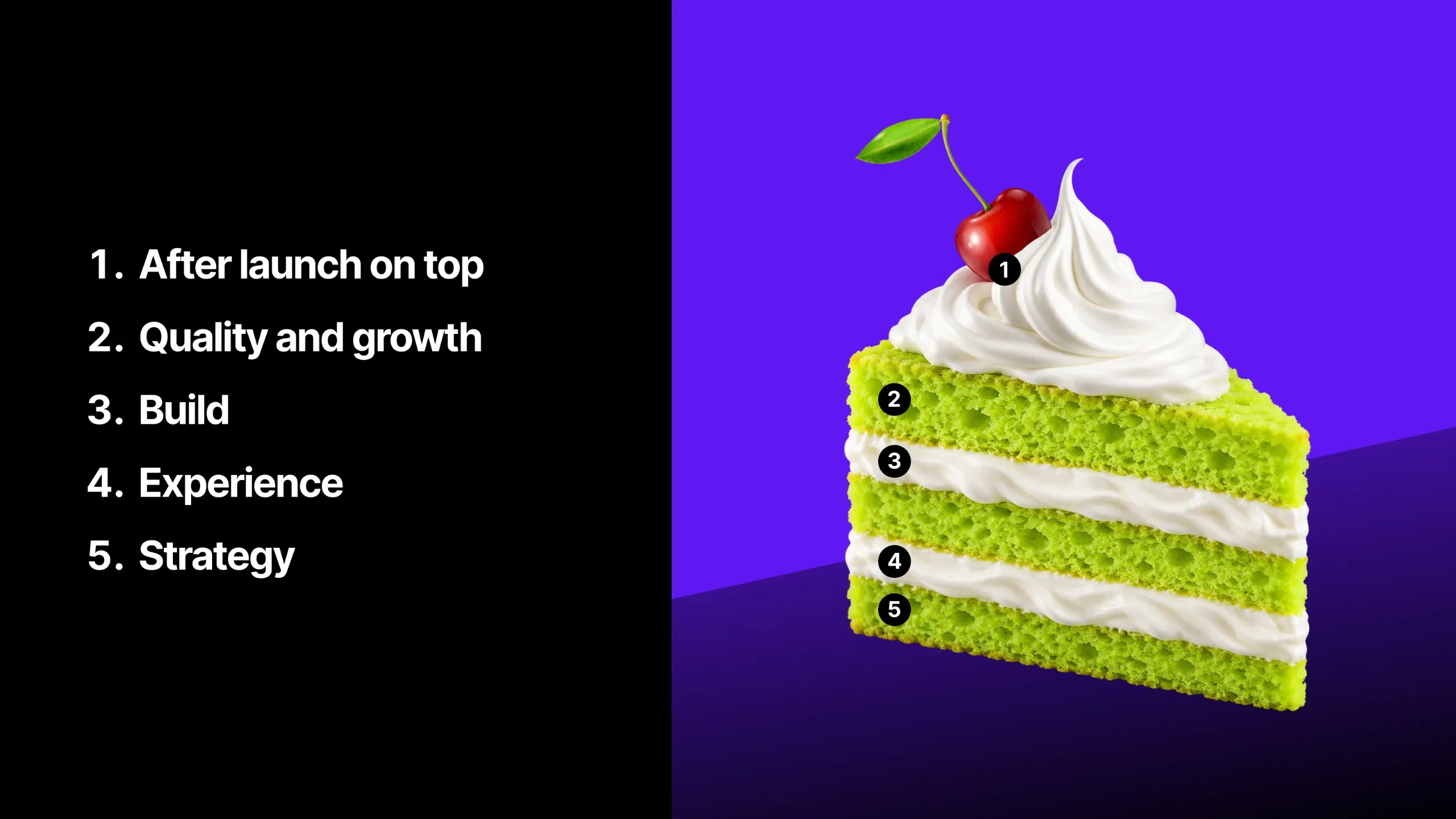
Next, list what this project needs. A full B2B website production project can touch all of these:
- Strategy: research, positioning, and information architecture, meaning how pages connect and in what order people meet them.
- Experience: UX and conversion paths, copy and messaging, visual design, and motion.
- Build: CMS setup, front-end and back-end development, and integrations with your CRM and marketing tools.
- Quality and growth: technical SEO, analytics, accessibility, QA, and content migration.
- After launch: training, documentation, and support.
Circle the items your project needs, then check how many of them have to happen together. Be careful with the word “quick,” because a quick refresh that touches positioning, copy, and the CMS already counts as a team job. The number of skills your project needs at once decides much of what follows in this guide.
In-house vs agency vs freelancer: the short answer
Agency vs freelancer vs in-house for a B2B website comes down to what each one actually takes off your plate.
In-house means people on your payroll build and run the site. It works for website work that never stops, as long as your team has the skills and time to do it.
A freelancer is one independent specialist hired for a defined job. Pick one when the job needs a single skill, the direction is already set, and someone on your side can review the result.
An agency brings a team of specialists and runs the project with you. It earns its fee on a time-bound, high-stakes launch where strategy, content, design, and development depend on each other.
A hybrid splits ownership by phase, so your people keep the decisions while outside specialists cover the part you can't staff. Under any model, the buck still stops with someone on your side.
The table lines up in-house vs agency web development, with freelancers as the third option, based on the conditions that drive each choice.
| What to compare | In-house team | Freelancer | Agency |
|---|---|---|---|
| Best scope | Open strategy questions | Range of skills | Coordination on your side |
| Continuous work on a site you run every week | Works if your team can settle positioning itself | The roles you've hired for | You manage priorities, people, and reviews |
| One bounded job that needs one skill | Needs the direction set before work starts | One person's specialty | You coordinate every other skill around the job |
| A time-bound build where several skills move together | Can include discovery if the proposal names who leads it | As wide as the named team in the proposal | You own decisions and approvals, and the agency runs delivery |
When in-house web development is the right model
In-house wins when your team runs the website every week, the way it runs email or paid search. The people inside already know which pages sales sends to prospects and why legal keeps flagging one claim on the pricing page. That context is an internal team's biggest advantage, and an outside team needs time to build it.
One CMO at a blockchain infrastructure company described on Reddit how their team rebuilt the company's web presence in-house in 3 weeks, after agencies quoted 3 to 4 months. The positioning stayed sharp because the people writing it lived it every day. The bill came due elsewhere: 60 to 80 hours of evenings and weekends, plus speed fixes after launch.
The risk is that website work gets pushed to the back burner behind everything else on the team's plate. A two-week task can stretch into a quarter when nobody protects the team's time. Teams that live with one site for years can also develop tunnel vision.
When a freelance web developer is the right model
Freelancing is a mainstream way to do this work: 18% of US web developers were self-employed in 2025, according to the Bureau of Labor Statistics. In the web development company vs freelancer debate, a senior specialist can win on the right job because you get the expert directly, with no layers in between.
The right job is narrow and already defined. Think of a CRM integration, an accessibility fix, a speed cleanup, a contained landing page, or a Webflow build from designs you've already approved. If it's that last one, the guide to hiring a Webflow developer covers what to check before you sign.
Qream's project managers put it plainly: a freelancer will build the component you ask for, to the letter. Don't expect suggestions on SEO structure, such as which headings the block needs, or ideas for making it reusable across pages. The CMS behind it may get less care, too. So the deciding question is whether someone on your side knows exactly what to ask for and can check the result.
Trouble starts when the job grows, and someone on your team ends up herding cats. One marketing lead described on Reddit hiring a freelance designer and a freelance developer for a redesign: both did good work. Still, nobody owned the project, so the marketing team became project managers by default. That coordination tax lands on your calendar.
When a B2B web development agency is the right model
An agency earns its fee when a launch has many moving parts and a date it can't miss, like a rebrand that goes public on a set day or a site that has to change its story and its structure at once. In those projects, strategy, copy, design, and development depend on each other, and a gap in one stalls the rest.
The real benefits of outsourcing web development go beyond extra hands. A good agency runs discovery, keeps every specialist in sync, tests before launch, and has bench depth when someone's out sick. It should also help you make decisions: in our project managers' experience, a team that has launched similar sites can walk you through the choices your brief didn't cover. A senior freelancer brings lessons from past projects too, though usually within one specialty, so questions outside it land back on your desk.
Strong launches share one thing on the client side, and Qream's team keeps seeing it: one owner who can say yes and a short list of approvers. When copy, design, and marketing each review separately, delivery stalls while it waits for feedback. A fast team with slow approvals still makes a slow project.
One plan for a launch with many moving parts
When strategy, content, design, and development have to land on the same date, see how one team runs delivery and brings you a clear recommendation at every decision point.

The hybrid model: assign ownership by phase
A hybrid works when each phase has one owner who answers for it. Without that, the project turns into a renovation where everyone assumes someone else ordered the tiles, and in the end, no one did.
The most common shape keeps the direction with your owner, gives the build to an outsourced web development team, and moves the finished site to your own team after launch. The phases split like this:
| Phase | Accountable | Involved | Your side brings |
|---|---|---|---|
| Discovery and strategy | UX and design | Copy | Development and integrations |
| Your owner | Agency | Your team | Agency or your developers, agreed before kickoff |
| Agency runs the sessions | Your reviewers | An agency copywriter, if you want a review | Your IT team |
| The site's job in the business and how you'll use it | Fast feedback from a short approver list | The copy, product facts, and final sign-off | System access and integration owners |
Our experience points to a clear minimum for the client side: know what job the site does for the business and how you'll use it next year. With that, the team can plan the structure, components, and page variations you'll use, without building a mansion or forgetting the kitchen.
Whatever the shape, don't let responsibility become a hot potato at the handoffs.
Compare the total cost of each setup
On a spreadsheet, outsourcing vs in-house web development looks like a quote against a salary. But the real number for any setup includes the hours your own people spend keeping the project moving, the skills you add along the way, and the price of a late launch. It's the renovation math again: the contractor's quote never includes your Saturdays at Home Depot.
Salaries aren't the full cost of an employee either. In June 2026, benefits made up 31.5% of what US private employers spent on full-time workers, according to the Bureau of Labor Statistics. Budget for scope creep too, because it loves the words “while we're here.” Price each setup you're considering with your own numbers, for your market:
| Cost line | What to count |
|---|---|
| Fees or salaries | Hiring and ramp-up |
| Salaries plus benefits, or the project fee or retainer | Recruiting time and the weeks before a new hire ships work |
How to decide whether to outsource web development
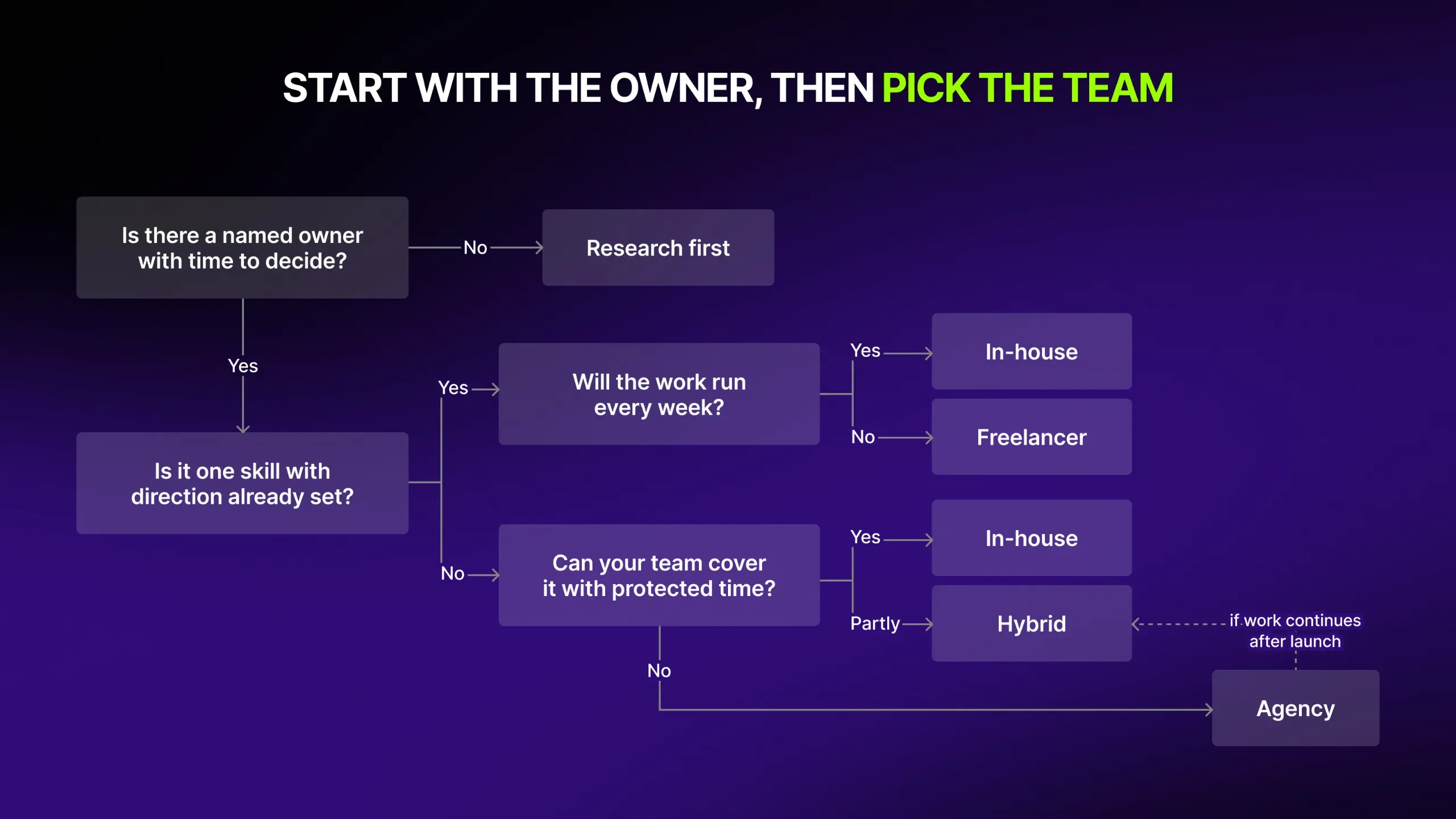
Work through these questions to answer the big one, “Should I build my website in-house or outsource it?” Stop at the first question that settles it. There are no points to add up. One decisive condition usually picks the model, and the remaining questions tell you what to set up around it.
| Question | Evidence to gather | What it points to | Risk if you skip it |
|---|---|---|---|
| What are we building? | Do we know what the site must say, to whom, and how we'll judge it? | How many skills have to move together? | Who on our side makes the calls, and do they have time? |
| The site type: marketing or corporate site, store, app, or internal tool | Approved positioning, priority audiences, and success metrics | The items you circled in the capability stack | A named owner, their decision rights, and their weekly hours for the project |
| This guide fits marketing and corporate sites. Products and apps need a software-team decision | Open answers call for a setup that includes discovery, UX, and copy | One skill fits a specialist, while several linked skills need one team running them | No owner means research first, whoever you hire |
| You staff a website like a product, or the reverse | Developers build on shifting sand | You end up as the integrator | Approvals stall and everyone passes the buck |
And you'll be able to write the decision as one sentence you can take into a planning meeting:
Use [model] because [the decisive condition]. [Name] owns the decisions. This holds while [two or three facts stay true]. We'll switch to [alternative] if [one fact changes].
Five B2B scenarios, decided
Five situations show how the same questions lead to different answers.
01 One landing page before a conference
Go with a freelancer. A 200-person cybersecurity SaaS company needs one product landing page before a conference 6 weeks out. Brand, design system, and copy are approved, and a product marketer can review the build, but nobody on staff writes code. The page also needs an interactive product tour and a demo form that sends leads to the CRM, and neither fits the blocks its CMS already has.
One skill is missing, and the direction is set, so you don't need a pit crew to fix a flat tire. If existing CMS blocks covered the whole page, the marketer could put it together alone.
02 A rebrand site that launches with the funding news
Bring in an agency once you name one owner. A B2B fintech has just closed a round and rebranded, and the new website must go live with the announcement. The brief has everything but the kitchen sink: new positioning, a new site structure, about 60 pages, and a CRM integration, all tied to one date. The CMO owns the decisions, and the agency runs delivery across strategy, content, design, and development.
A freelancer can't carry this many linked skills, and nothing suggests an internal team that could. The answer flips to a hybrid if a strong internal team needs only one specialist.
03 Weekly landing pages and tests
Keep it in-house. A mid-size industrial manufacturer ships new landing pages and A/B tests every week, and it already employs a web developer and a designer. The work never stops, and the core skills sit inside the company. The head of digital marketing owns the priorities, while the developer and designer own execution. Choosing to outsource web developers here would mean renting capacity for a marathon the team already runs.
04 A 400-page move to a new CMS
Pick a hybrid. A healthtech company is moving about 400 pages to a new CMS. Its web team knows the site inside out but has never run an SEO-safe migration, meaning a move that keeps the search signals the old pages earned. The head of web owns the decisions.
The team keeps the CMS and the long-term site, while an outside migration specialist owns the method, the redirects, and the checks. Handing the whole job to an agency would bench a team that's ready to play, and going fully in-house would skip the one skill it lacks. Make sure your access rules let a specialist into the systems. The answer moves to in-house if the team can show it has run a migration like this before.
05 Budget approved, nobody in charge
Research first. A Series A AI startup has budget approved for a redesign, but nobody owns the website, and the founders are still going back and forth on positioning. Any provider hired now would end up refereeing a decision that belongs to the company. Until the company names a permanent owner, the CEO owns the call and should give one person the final say on what the site must do for the business.
Hiring a build team now means paying people to aim at a moving target. A short discovery step can help, but with no web team in place, the answer will likely point to an agency.
How Qream runs delivery while you keep ownership
We run website projects with one team across UX, UI, motion, copy, CMS, development, and testing, with approval points agreed upfront. At every decision point, we bring a recommendation, and you make the final call. What stays with you is what lives inside your company: business context, stakeholder alignment, source material, and long-term priorities.
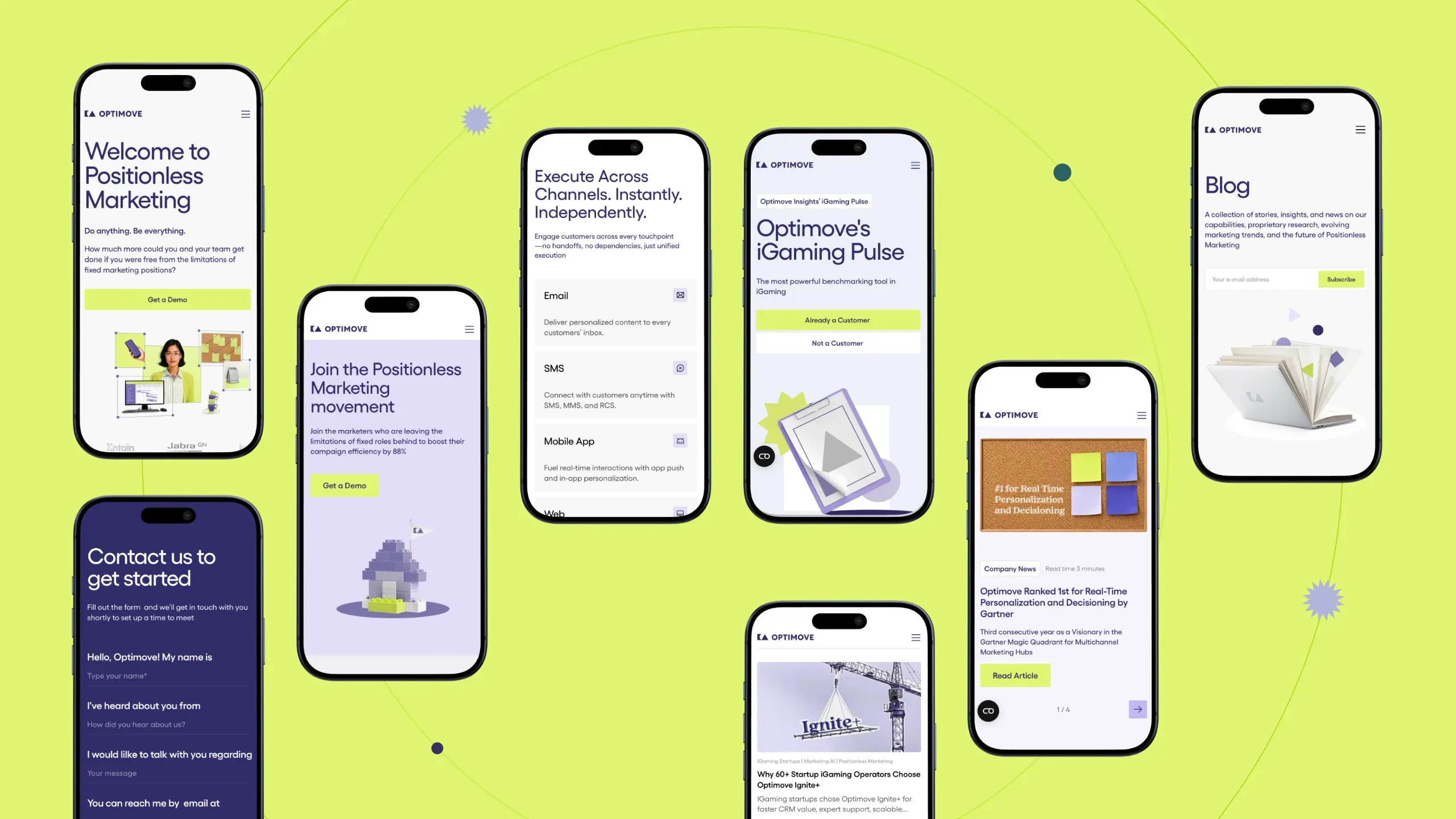
Optimove, a customer marketing platform, shows how that split works. The company had rebranded and was already rolling the new identity out on social, so the website had to play catch-up fast. Its in-house copywriters wrote most of the content for a rebuilt sitemap, while we reviewed early drafts and wrote one page ourselves. We covered UX, UI, illustration, motion, development, the CMS, QA, and migration of the old blog.
The launch covered 35 redesigned pages, 600 migrated blog posts, and 60+ new pages. We built the CMS so the client's team can edit pages without calling a developer, and localized updates that used to take hours now go live in near real time.
After launch, every estimate we send includes 6 months of support: knowledge transfer to your developers, training for your marketing team, bug fixes, and new features. Our Technical Lead, Ivan Stinskyi, handles the last step: the code already belongs to you, so the handover is about ownership and access. See how we run website projects or browse our case studies.
Let's scope your next B2B website together
Tell us what the site needs to do, and we'll recommend a setup and a plan that fit your team.
FAQ
Choose outsourced web development when the project needs several skills at once or a launch date your team can't hit. Keep it in-house when website work never stops, and your people cover the skills with time to spare. If nobody on your side can make the decisions yet, settle that first.
Neither wins across the board: an agency fits work where design, content, and development have to move together, and a senior freelancer can win on one bounded job with clear direction. Whether you hire a web developer or an agency, judge the named people and their process.
Hire in-house when your site needs new pages, tests, and fixes every week, with enough work to keep each person busy all year. Before you post the jobs, name the owner and decide which skills you'll still cover through web development outsourcing.
Keep the decisions, the approvals, the business context, and the accounts that run your site. An outside team can lead discovery and delivery, but someone on your side has to know what job the site does and how you'll use it after launch.
You should, from day one. Register the domain, hosting, CMS, and code repository in your company's name, and write the handover and support period into the contract. One general manager at a 20-person services company found out the hard way, as they shared on Reddit, that their vendor effectively controlled the whole site and its local SEO setup. If the next developer has to reverse-engineer your site, the handover wasn't finished.
Written by

4+ years in B2B content and copywriting
Writes research-driven content for B2B, tech, and design audiences, turning complex topics into clear, useful narratives. Her work spans long-form articles, lead magnets, newsletters, LinkedIn content, and UX copy.
Reviewed by

Qream co-founder | Design and product direction
Leads Qream's creative and product direction, connecting brand strategy, experience design, and business goals. Reviews content where design strategy, UX/UI, customer experience, and brand execution are central.