TL;DR
Do AI-built brands scale? Not on their own. The rebrand cliff is the point at which an AI-built brand can no longer scale with the company, and a full human-led rebrand becomes unavoidable. Qream sees this pattern across AI-generated identities: AI produces some brand assets but not a system that survives dozens of touchpoints. If your brand is approaching the rebrand cliff, stop patching inconsistencies and build a documented system before they multiply.
Every AI-built brand works—until it has to scale. That's the rebrand cliff.
The generated logo draft or wireframes might look good, but the visual system starts to drift when things get serious. New touchpoints bring inconsistencies: colors shift, typography changes, logos subtly mutate. And nobody knows which version is correct anymore.
The problem isn’t that AI is bad and you can’t use it for design. AI excels at generating assets, not maintaining systems. If you're already seeing cracks, it’s worth understanding whether you need another prompt—or an entirely different approach in branding.
What AI-built brands get right
Before judging AI fails, let’s discuss where it succeeds.
You should agree that image generation changed how orgs create visual assets right now. Small teams can produce work that previously required freelancers, photographers, illustrators, and weeks of production.
AI is definitely effective at creating:
- Hero section alternative visuals
- Product imagery without expensive photoshoots
- Multiple campaign variations from one concept
- Fast illustration & icon production
- Character or mascot generation
- Moodboards and creative exploration
Delegating these tasks makes AI more valuable during the earliest phases of building a startup. Instead of spending weeks validating visual directions, founders can test ideas in hours, and marketing teams can ship campaign assets faster than ever before.
The speed is real and impressive from the operational side until you see how those isolated assets turn into a coherent identity.
Where they break—the rebrand cliff
Brand foundation isn’t built on collections of images. They’re systems where every asset has its reason.
A strong identity works when every customer interaction reinforces the same visual language, no matter who creates the content or where it appears. Meanwhile, AI generates brand artifacts that work as separate pieces or alternatives—not based on the foundation mentioned.
As you already guessed, AI can’t maintain a brand system across dozens (or thousands) of touchpoints.
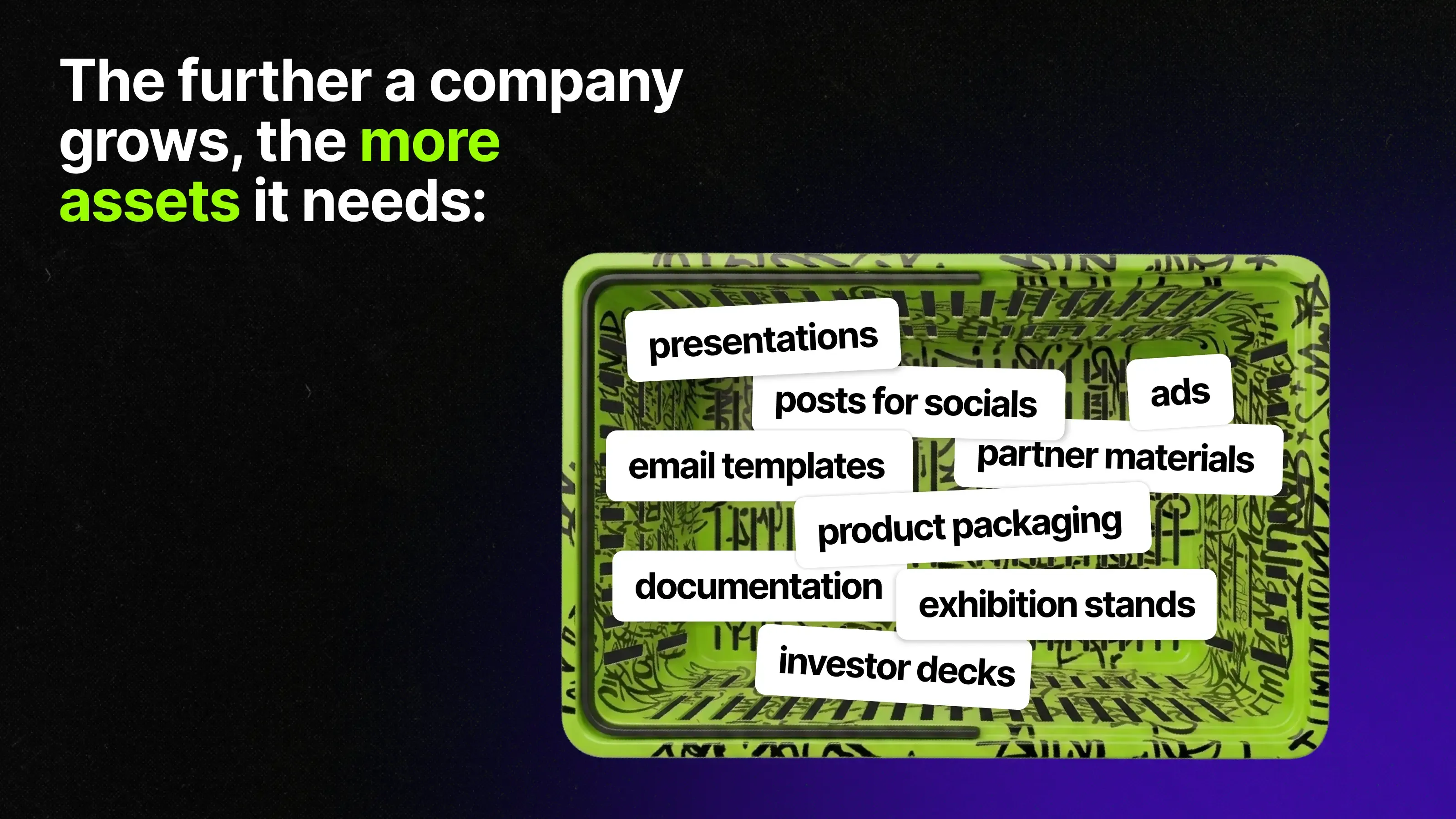
Each new asset becomes another opportunity for visual drift: one inconsistency isn’t noticeable, but forty are. That’s why brands that looked perfectly consistent at launch slowly become visual patchwork quilts. Every prompt introduces another tiny variation, and every designer interprets the outputs a little differently.
That’s the moment you hit the rebrand cliff—not because AI failed, but because the business outgrew a collection of AI-generated assets and now needs something far more valuable: a brand system that can scale.
Why AI-built brands hit the rebrand cliff
AI for design & marketing jobs is like a junior specialist. Give it a bunch of data or delegate a routine task of image creation—and it’ll figure it out. But for other challenges, it needs a senior to micromanage its outcomes. Here are 3 reasons why AI breaks at scale.
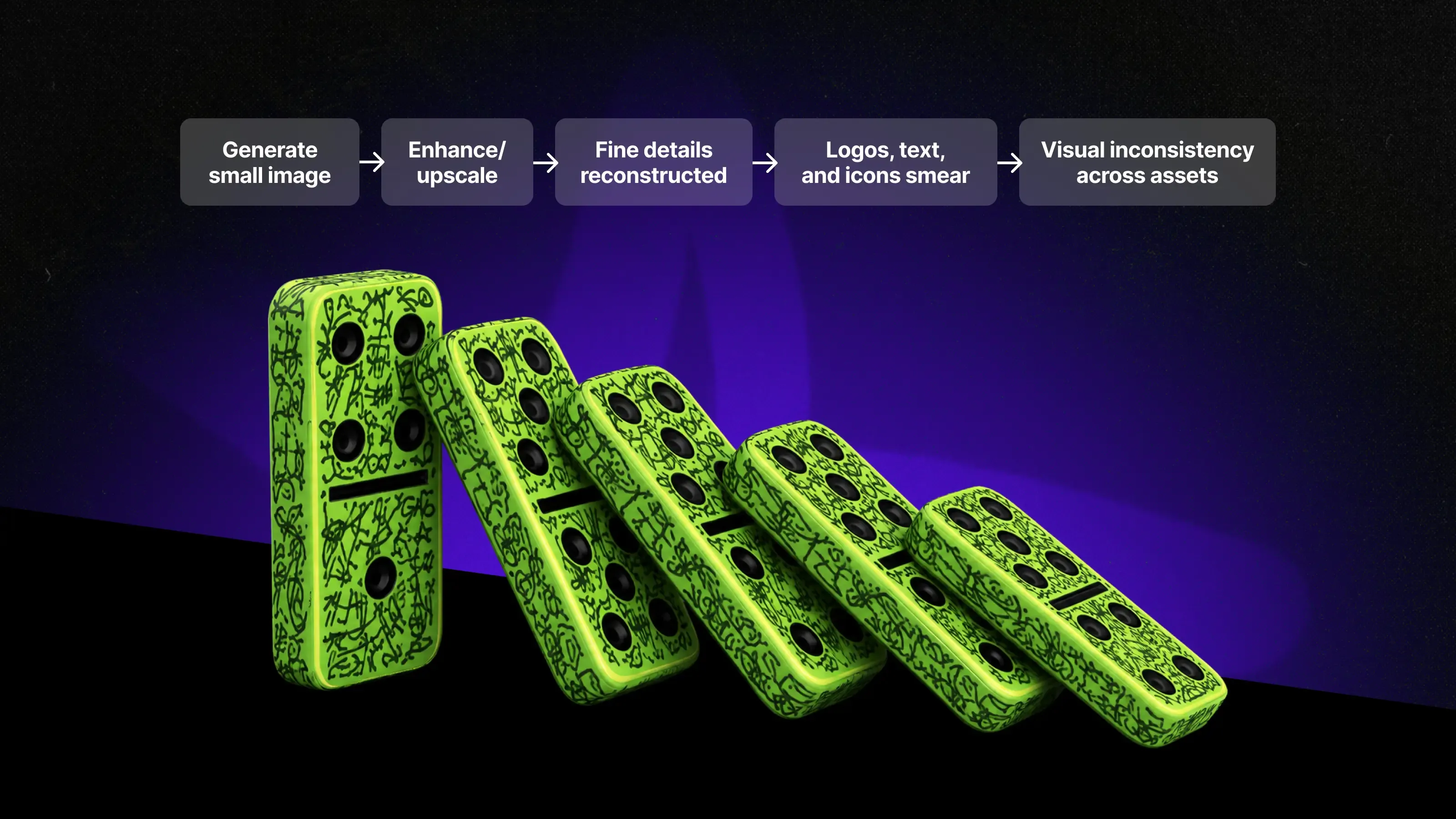
1. The enhancement mechanism smears details
This is a technical limitation rather than a creative one. Most image-generation workflows create an image at a relatively small resolution before enhancing or upscaling it. During enhancement, AI reconstructs fine details instead of preserving exact pixels.
That does work for textures, lighting, skin, and environments—but completely flops for precise elements such as logos, symbols, or product labels.
Small details become approximations rather than exact reproductions. That’s why you see details getting worse and worse with every variation each time an image is regenerated.
2. There is no single source of truth
AI is unpredictable by design, and that’s fine when you brainstorm or explore new aesthetics. It becomes a problem when you build a brand people need to recognize.
When every prompt creates a slightly different output, teams lose confidence about which version is correct. There is no authoritative master file that every future asset references—instead, each new generation becomes another interpretation.
That’s manageable when you’re a 5-person startup. It’s chaos when you start coordinating marketing across multiple teams, channels, markets, and agencies.
3. AI creates artifacts, not systems
This distinction matters: a favicon is not a brand, but the consistency connecting all assets is.
AI is consistent for technical, repetitive tasks and inconsistent for creative, fine-detail ones. If you resize hundreds of images, generate product mockups, or automate production workflows, AI performs brilliantly.
But once you ask it to preserve the subtle creative signals that make a brand recognizable—logo geometry, typography, iconography, visual hierarchy, tone of expression—it turns into more of a guess than a sure thing.
How AI approach breaks in daily design: real examples
As AI gets better every month, it’s easy to assume we’re only a few updates away from replacing most creative production. And honestly, for some tasks, we’re already there.
But working with AI on a daily basis has taught us something important: the biggest limitations don’t show up when you’re generating the first image. They appear when you need to use that image in the real world—across products, channels, campaigns, and teams. Especially if you care about the detail.
One case like that came from preparing product visuals for Dnipro-M’s Amazon listings (a major Ukrainian brand that manufactures power tools and equipment). With the limited production resources they faced and deadlines on fire, using AI made perfect sense.
The generated images looked great, and the product itself stayed consistent from one generation to the next. The logo, however, had other plans: every new generation slightly changed it. The proportions shifted, small logo details drifted, textures got messy, and the branding never landed in the same place twice.

It took around 40 regenerations before we had a version that was accurate enough to use. You bet this can be fixed—with enough editing, regeneration, retouching, and manual cleanup, you can get there. That’s the catch: the more precision your brand requires, the more human time gets added back into the process to keep it afloat.
Another situation appeared much later in some discovery calls. A client came to us with an AI-generated brand book. It had everything you’d expect—a logo, typography, and a mascot—yet different colour/font on every slide.
Every page represented a slightly different interpretation of the brand. More importantly, there was nothing underneath the visuals: production-ready files, vector assets, icon library, typography package, or application rules explaining how the identity should work across touchpoints.
The presentation did look like a brand book—but technically, it wasn’t something a marketing team or designer could build from.
That’s where human expertise still matters. Not to replace AI, but to turn AI-generated ideas into a brand system that’s technically sound, strategically consistent, and ready for multi-channel application.
Common mistakes that push you off the cliff faster
From working across AI-native brands or less tech-savvy orgs, Qream keeps seeing the same break point: treating AI as a human hire. If any of the mistakes below sound familiar, congratulations—you’ve found the fastest route to the AI trap.
1. Trusting AI output 100%
AI is extremely confident—it rarely says, “I'm not sure what’s the best option.” Instead, it generates a fresh interpretation every time, and you never guess if it’s getting better or worse.
Use AI to accelerate decisions but don’t replace judgment. Without human review, small inconsistencies accumulate until nobody knows which asset is the right way to represent the brand. Don’t remove humans from the loop, but consider removing repetitive work so humans can focus on the decisions that matter.
2. Confusing one excellent image with a complete identity
A strong hero section visual proves that AI can generate compelling imagery. However, it doesn’t prove that the identity will survive hundreds of future assets.
One awesome asset is like a movie trailer—you still have to make the movie. A brand system means you look like the same company on a website, sales deck, product UI, social posts, yada yada yada. So far, AI tools can’t promise it.
3. Building around AI instead of business needs
Technology should serve the brand—don’t confuse it with defining what the brand is. Teams often begin with what AI can generate rather than what customers need, which reverses the branding process.
This is the shiny-object trap. Someone discovers a new image model and suddenly the entire visual direction changes because the AI makes “really cool cyberpunk illustrations.” Meanwhile, your customers are accountants buying enterprise software.
| Chasing trends | Building a brand |
|---|---|
| New AI style every month | Excites the team |
| Same recognizable identity | Builds customer memory |
How to tell if your brand is near the rebrand cliff
The good news: your brand usually doesn’t fall off the cliff overnight and leaves a lot of breadcrumbs first.
Qream is a brand transformation agency that uses AI daily—and knows exactly where it stops holding up. So, let’s hit a quick reality check: don’t overthink it, just answer honestly.
Answer this checklist about your current brand environment:
- Does your logo remain identical across every new asset?
- Is there one documented source of truth for every visual element?
- Do fonts remain consistent across presentations, social posts, ads, and print?
- Do brand colors stay the same between channels?
- Can different designers produce identical results?
- Does your identity remain consistent across 40+ touchpoints?
- Do designers spend more time creating new work than fixing AI outputs?
- Do new materials require less manual correction or iterations before publishing?
So... how’d you do?
If you’re nodding along a little too often (and answered “no” or “it depends” more than 5 times), your brand probably isn’t “going through a phase,” but telling you the system starts to crack. Don’t panic—but don’t ignore it either.
The rebrand cliff isn’t a dramatic explosion where everything suddenly breaks. It’s more like debt for your brand: every tiny inconsistency seems harmless until one day you're burning hours fixing the same problems over and over. Let’s map how you can avoid the cliff.
FAQ
AI can create individual brand assets, but not a full, consistent identity. It generates artifacts well—a logo or hero image—but maintaining consistency across every future application still requires documented standards and human oversight.
AI-generated logos become inconsistent because image generation reconstructs fine details rather than reproducing them exactly. Small changes in prompts, enhancement, or regeneration can alter typography, symbols, spacing, and proportions.
A startup should consider rebranding when inconsistencies begin affecting customer trust, internal efficiency, or brand recognition. If teams no longer know which logo, colors, or typography are correct, the cost of patching usually exceeds the cost of systemizing.
Not by themselves. AI helps brands move faster during creation, but scaling requires a documented system that keeps every asset consistent over time.
Build the brand before the cliff arrives
AI can help you launch a brand—scaling it is a different challenge. If your identity starts to drift, explore how we approach branding.

Written by

Brand strategy | Content systems | UX writing
Builds messaging systems that connect positioning, product value, and audience needs. Reviews content through the lens of brand clarity, tone of voice, UX writing, creative concepts, and digital distribution.
Reviewed by

Qream co-founder | Design and product direction
Leads Qream's creative and product direction, connecting brand strategy, experience design, and business goals. Reviews content where design strategy, UX/UI, customer experience, and brand execution are central.