TL;DR
The difference between branding vs marketing: branding defines who you are and why a buyer should care, while marketing takes that story to market to generate demand. In B2B, the brand is the foundation—it decides whether your marketing spend converts or quietly disappears.
Most “marketing isn't working” complaints are brand problems wearing a marketing mask: unclear positioning, weak differentiation, and messaging that doesn't land. The Qream team has noticed a pattern among B2B brands: once the brand is up and running, marketing begins to justify its place in the budget. This article gives you the diagnostic to figure out which problem you're actually solving.
Branding vs marketing is one of the most argued and least well-managed distinctions in B2B. The two are conflated and funded as if interchangeable, but they are not. Branding shapes perception. Marketing creates demand.
The sequence matters more than most B2B teams realize: when the brand foundation is weak, every marketing dollar works harder for fewer results. If your campaigns are getting clicks but losing deals, or your pipeline looks fine until a qualified buyer asks “So why you specifically?”, then that means the problem isn't your ads. What follows is the real difference between branding and marketing, and a framework for figuring out which one you actually need to fix.
What is branding?
Branding is the strategic work of deciding what a company stands for, who it's for, and why it matters, then expressing that consistently across every touchpoint. A logo is one output of branding, not branding itself. Companies that miss this distinction walk away from a rebrand with a new visual identity and the same positioning problem they started with.
Here are four terms constantly used in this field but rarely defined clearly—with an example of how each one plays out in practice:
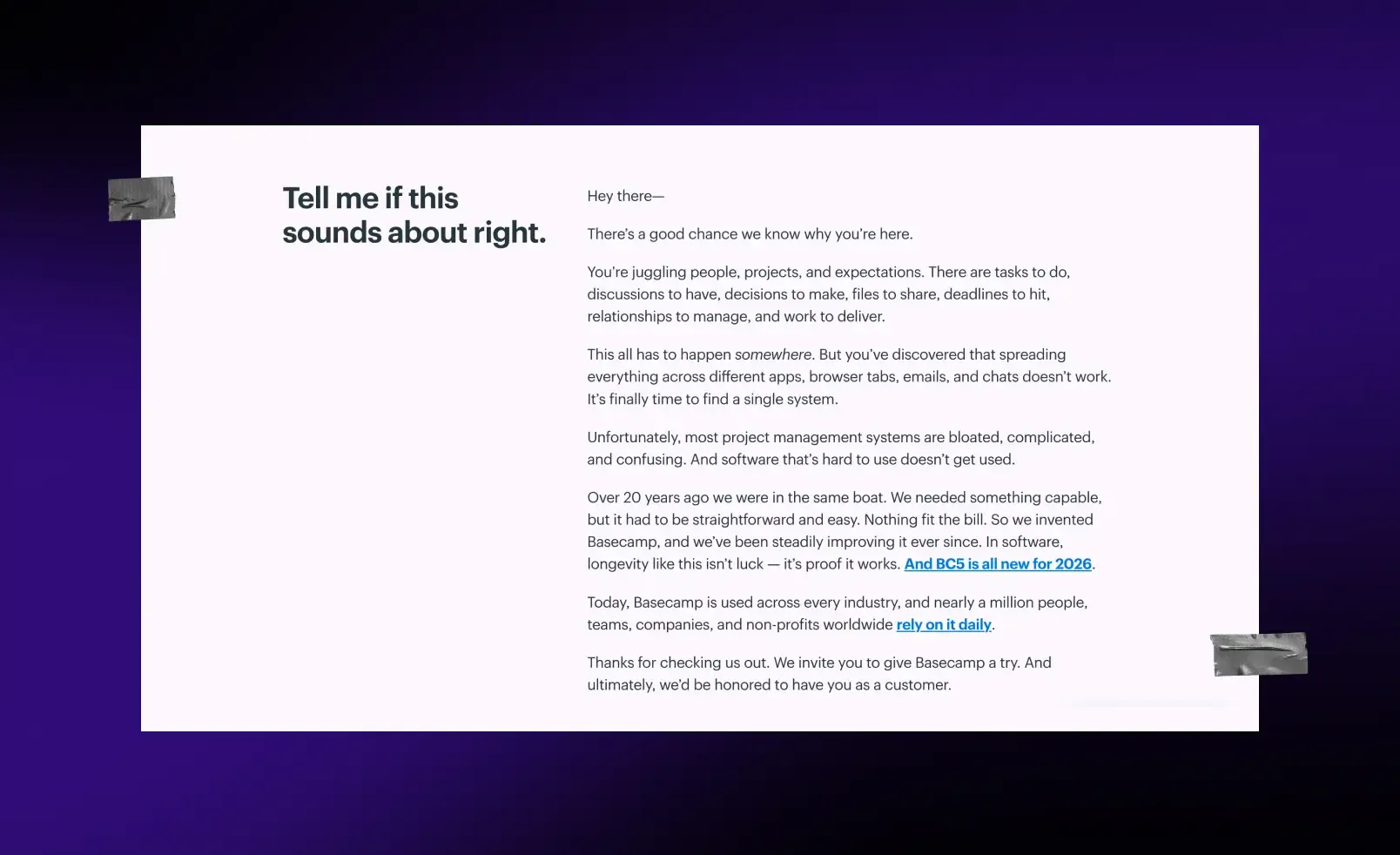
01 Brand identity is the visual and verbal system that makes a company recognizable and consistent: typography, color, name, tagline, and tone of voice. Basecamp writes like one direct, plain-spoken person talking to another, not a company reciting a script.
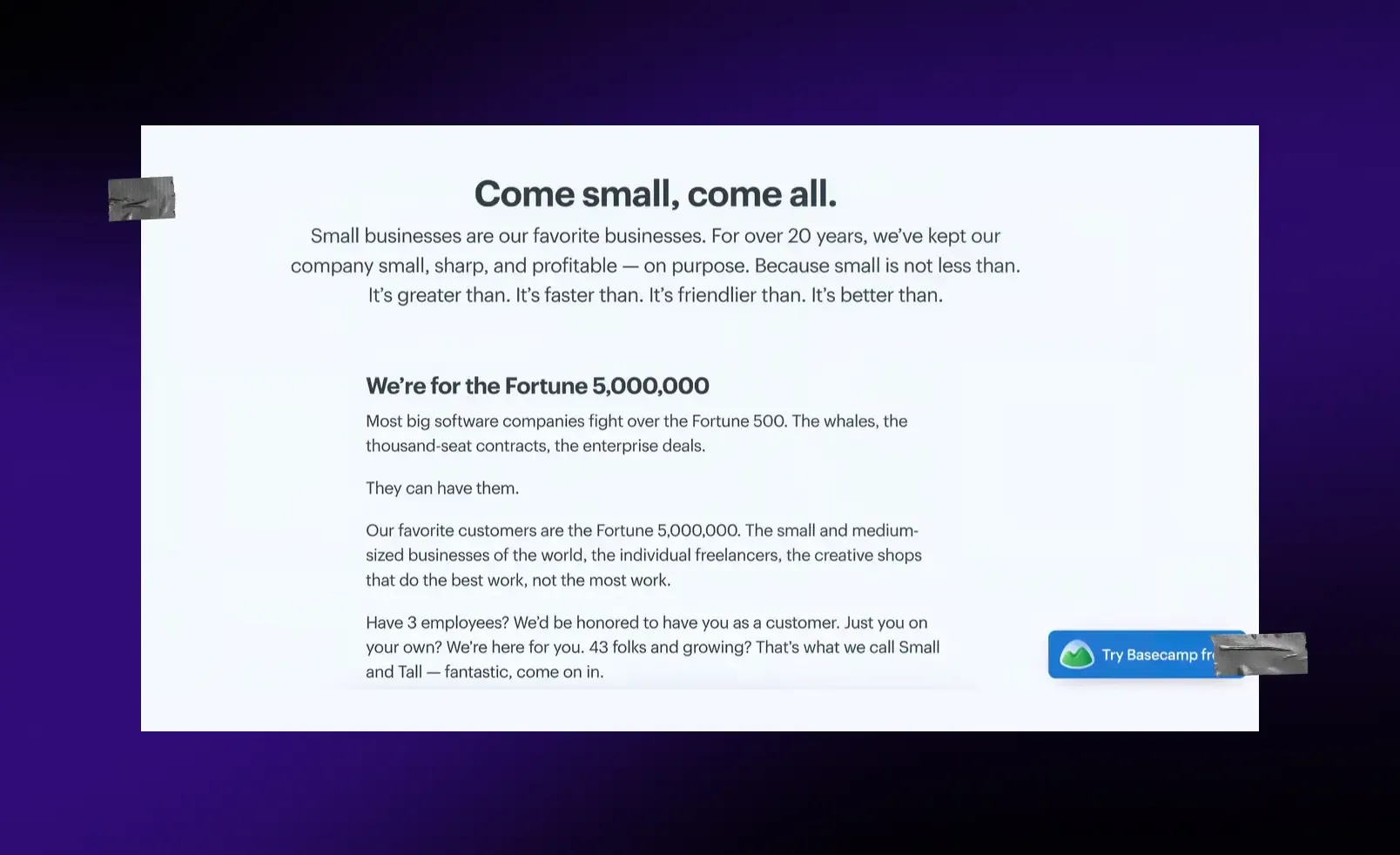
02 Positioning is the specific place a brand occupies in a buyer's mind relative to alternatives. Not "we help companies grow"—that's everyone. Positioning is the precise, defensible reason a buyer would choose you over the next option. Basecamp picked a side publicly, building the entire brand around "the Fortune 5,000,000": small businesses, freelancers, and agencies—rather than trying to appeal to everyone.
03 Perception is the sum of every signal a buyer picks up about the company, whether the company controls it or not—shaped by identity, sharpened by positioning. Basecamp's CEO still lists his own email on the homepage. Whether or not a visitor ever emails him, that single detail shapes how trustworthy the whole company feels.
04 Brand equity is the commercial value that comes from buyer familiarity and preference, beyond the product itself—and for the strongest companies, it's one of the most significant line items on the balance sheet. Basecamp has stayed profitable for 27 straight years against much larger, better-funded competitors—loyalty built on decades of a consistent brand outlasts any single feature comparison.
Marketing professor Kevin Lane Keller's brand equity model breaks down how that value actually gets built, in four stages:
Identity: buyers know the company exists.
Meaning: they associate it with something specific enough to care about.
Response: that association is strong enough to earn trust and drive action.
Resonance: loyalty that survives past the first purchase—the hardest stage to reach.
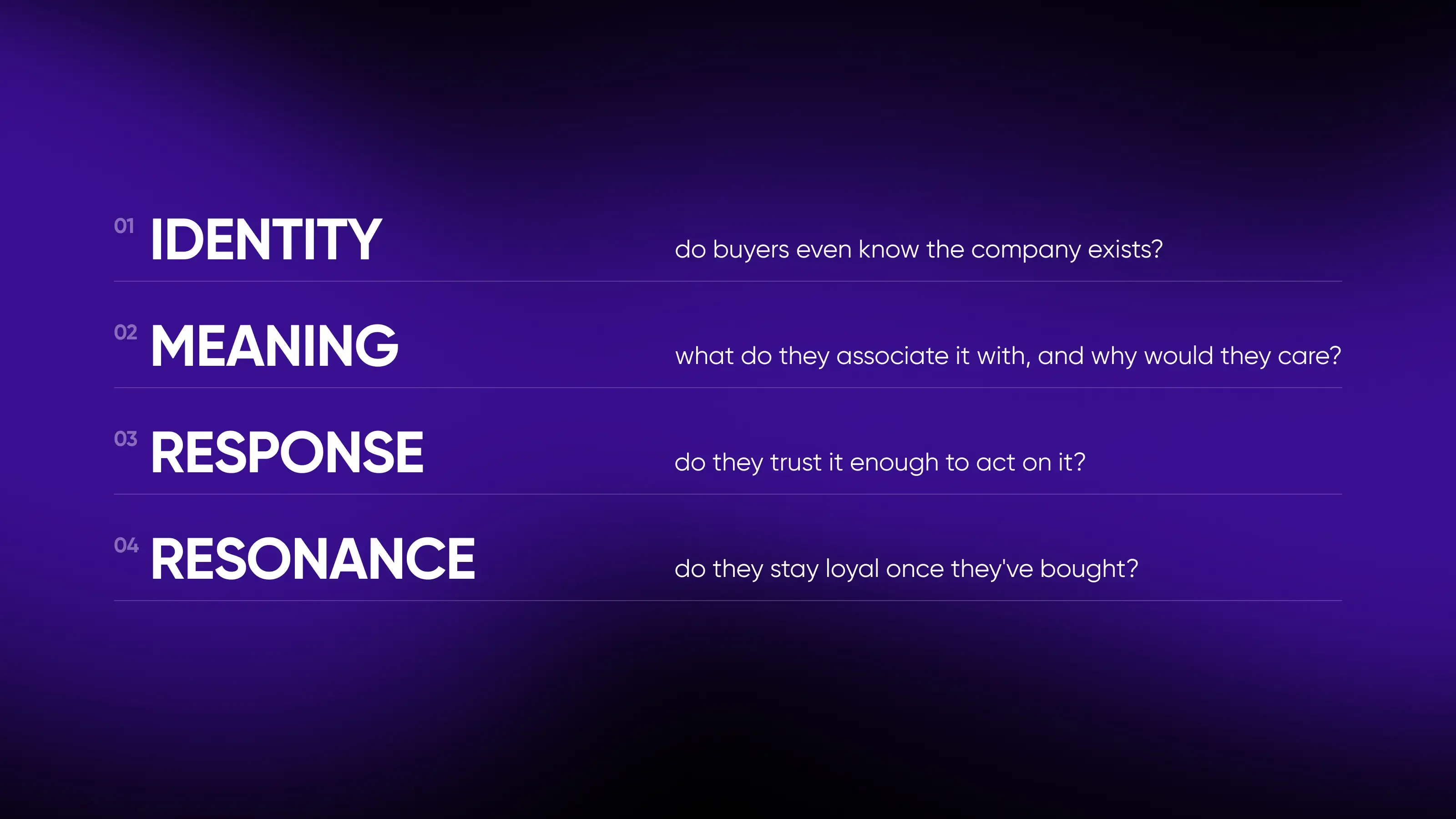
Each stage builds on the one before it, which is why brand equity compounds over years instead of appearing overnight.
So branding covers the full system: positioning, brand identity, and the experience principles that govern how the brand shows up across every surface: a LinkedIn post, a sales deck, a product demo. It operates on a long horizon—years, not quarters.
Therefore, branding decisions made (or not made) in the first year will shape how customers perceive the company in the fifth year. And yet, it's often the first thing cut when quarterly numbers make you want to look away. Because consistent brand-building is often undervalued among competing priorities—the results take too long to feel.
What is marketing?
Marketing is the work of taking a brand into the market, generating awareness, demand, leads, and revenue. Most of that work still traces back to the classic 4 Ps:
Product—what you're actually selling, and what makes it worth choosing over the alternative.
Price—what you charge, and what that price signals about value.
Place—where buyers find you, from your website to the channels you show up in.
Promotion—how you tell people you exist and why it matters.
All four get executed across specific channels and tactics: content, paid media, SEO, email, events, and every layer of creative marketing execution that turns brand intent into commercial results.
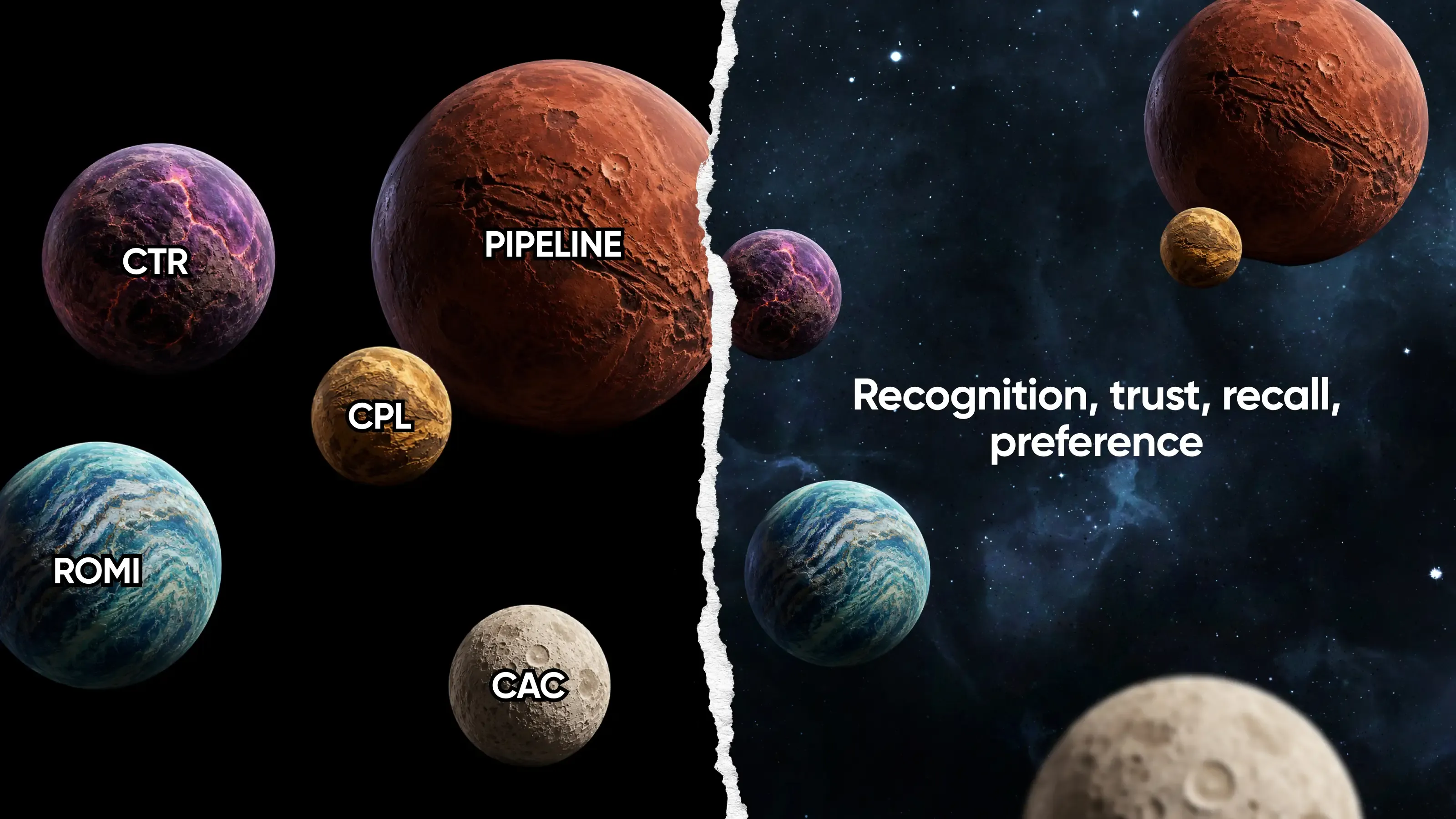
Marketing is measurable in ways branding often isn't, which is why it gets funded first and scrutinized harder: CTR, CPL, CAC, and ROMI. That visibility is valuable, but it's also misleading: it gives the impression that marketing is the main driver, when in reality the problem may lie deep within the brand itself.
Its job is to distribute the brand story to the people who need to hear it, at the moment they're ready to listen, in a format that lands—and then convert that attention into a pipeline. That means when the brand story is clear, marketing is more effective at conveying the message that needs to be heard. When it isn’t, marketing can spread confusion on a massive scale and call it an audience reach problem.
Branding vs marketing: the core differences (and where most budgets get it backwards)
The clearest of branding vs marketing examples become less abstract when you compare them side by side:
Branding
Goal: build perception and preference over time.
Time horizon: 3–5+ years.
How it's measured: brand equity, NPS, share of voice, and pricing power.
Effect over time: keeps working long after the campaign ends.
Output: trust, recognition, and differentiation.
Ownership: partly outside your control—it lives in the buyer's memory.
Marketing
Goal: generate demand and convert it into revenue.
Time horizon: quarterly or campaign-based.
How it's measured: CTR, CPL, CAC, pipeline, and ROMI.
Effect over time: stops working the moment the budget stops.
Output: leads, meetings, and closed deals.
Ownership: fully within your control—every lever, timing, and channel is yours.
But the gap that matters most between brand-building and short-term activation is this: who each one is actually built for. Professor John Dawes of the Ehrenberg-Bass Institute found in 2021 that only around 5% of B2B buyers are actively in-market and ready to purchase at any given moment. The math behind that number comes from the same paper: companies typically switch B2B suppliers about once every five years, which works out to roughly 20% of buyers being active in the market in any given year, and about 5% in any given quarter.
The other 95% aren't buying yet but eventually will. As Dawes puts it, "familiarity is built over time, with consistent messaging." Brand-building is what reaches that 95% early. Marketing built only for the 5% ready to buy right now hits a ceiling fast: it can capture demand that already exists, but it can't create new demand on its own.
Gartner's 2025 CMO Spend Survey shows how skewed most budgets already are toward that in-market 5%: paid media now absorbs 30.6% of the average marketing budget, even as 39% of CMOs cut agency budgets and another 39% cut labor spending—the very functions most responsible for building a brand in the first place. Media costs keep climbing while the budget for reaching anyone outside that in-market 5% keeps shrinking. That's how CAC creeps up every quarter: the same pool of ready-to-buy accounts gets chased harder each time, with less going toward everyone else.
So, your marketing might not be the problem
If campaigns are underperforming while the product and team haven't changed, the gap is usually somewhere else: positioning, consistency, or a brand that never gave buyers a reason to trust you first.
Is branding part of marketing?
From a technical standpoint, branding may indeed appear to be part of marketing processes in many organizational structures. But from a strategic standpoint, it is not. To some people, this question sounds like “Which came first: the chicken or the egg?”, but it's okay if not everything is obvious right away. Here's what I think: viewing branding as a component of marketing is one of the most costly structural mistakes a B2B company can make.
Treating branding as a marketing product squeezes strategic work—positioning, differentiation, the narrative that makes a company attractive to buyers—into campaign timeframes and reduces it to a logo refresh competing for budget against paid ads. And it loses every time.
Putting marketing before branding is putting the cart before the horse. You can move, but not efficiently and not in a straight line. There’s no getting around the truth: branding defines who you are. Marketing decides who hears about it, where, and how often. Run them in the wrong order, and you pay twice for the same work: first to generate attention, then to explain yourself to every buyer who arrives with no prior context about who you are.
Why most “marketing problems” are actually brand problems
The pattern Qream's team has seen across B2B brands: by the time a company brings in a new agency to fix underperforming campaigns, the real issue was already there. Brand stagnation sets in quietly, long before campaigns start underperforming—a brand audit should have happened three quarters earlier. The campaigns weren't enough because the brand wasn't clear.
Throwing more budget at underperforming marketing is throwing good money after bad. But I’m very happy that the industry is beginning to realize this and that there’s a positive trend. McKinsey's State of Marketing Europe 2025 report—500 senior marketing leaders across France, Germany, Italy, Spain, and the UK found branding ranked as the number one priority for the year ahead, above generative AI, martech investments, and performance marketing tactics. CMOs under real budget pressure chose to fix the foundation first.
Five signals where the brand is slipping:
Ads get attention, but nothing converts.You’re reaching the right people, but the brand doesn’t give them a strong enough reason to choose you.Sales explains the company differently every time.If your team can’t agree on what makes you different, marketing will scale that confusion instead of fixing it.You compete mainly on price.When price becomes the only closing argument, the brand is not doing enough to create preference or perceived value.Every campaign looks and sounds different.Inconsistency breaks recognition and trust. Each new touchpoint feels like a reset instead of a continuation.Sales says the product is strong, but the deal still stalls.That usually means the brand is not creating enough credibility before the first serious conversation.
If more than two sound familiar, start with the brand—a rebrand or repositioning first, campaigns second. If none do, the fix is likely inside the marketing layer itself: channel mix, targeting, or creative, not the story underneath it.
Every industry reads “brand problem” differently. See how Qream approaches it for companies like yours.
How branding and marketing actually work together
Brand strategy and marketing execution run in a fixed order, not in competition. Brand strategy defines the foundation: position, differentiation, narrative, identity system. Marketing executes against that foundation: reaching buyers, building pipelines, converting demand.
A sound branding and marketing strategy in B2B works like this: the brand does the long-horizon work of building recognition and preference among buyers who aren't in the market yet. When those buyers eventually do enter the market, marketing converts the familiarity of the brand already built. That's why strong brands have lower CAC (Customer Acquisition Cost) over time, not because they spent less on marketing, but because marketing had something to land on.
Edelman Insights 2025 puts a number on the downstream effect: 79% of hidden B2B decision-makers say they're more likely to advocate for a vendor during an RFP process if that vendor has consistently produced quality thought leadership. In other words, active brand-building directly reduces barriers to sales during the buyer’s decision-making stage.
Of course, even the strongest brands don’t make marketing unnecessary—they make it more effective. Because when the foundation is solid, the system runs more smoothly, and the path is clear. And when it isn’t, you’re simply spending money on an expensive reminder that you exist.
How fixing the brand made marketing convert
Every B2B company insists the product wins the deal. Often, what actually decides it is whether the brand earns trust the moment a buyer sees it.
Shoring is a clean example of what happens once that gets fixed. This company provides IT staffing for German retail businesses—real delivery and technical depth. What hadn't caught up yet was the brand: without a distinct visual identity, no consistent voice, nothing that gave an enterprise buyer a reason to remember them over the next vendor in the inbox. The team was already putting in real marketing effort: content, outreach, and a growing LinkedIn presence. It just wasn't converting into the leads that the effort deserved.
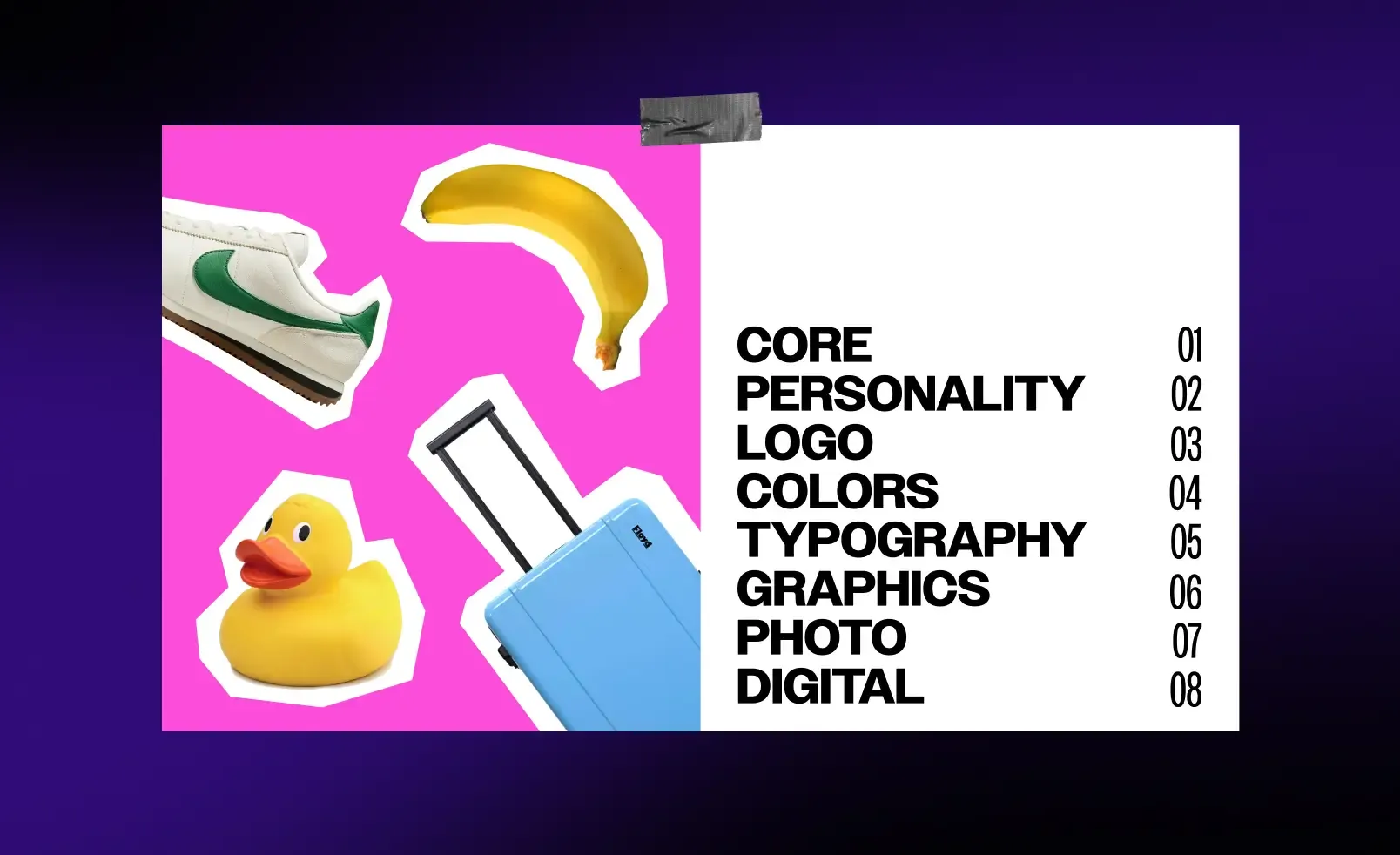
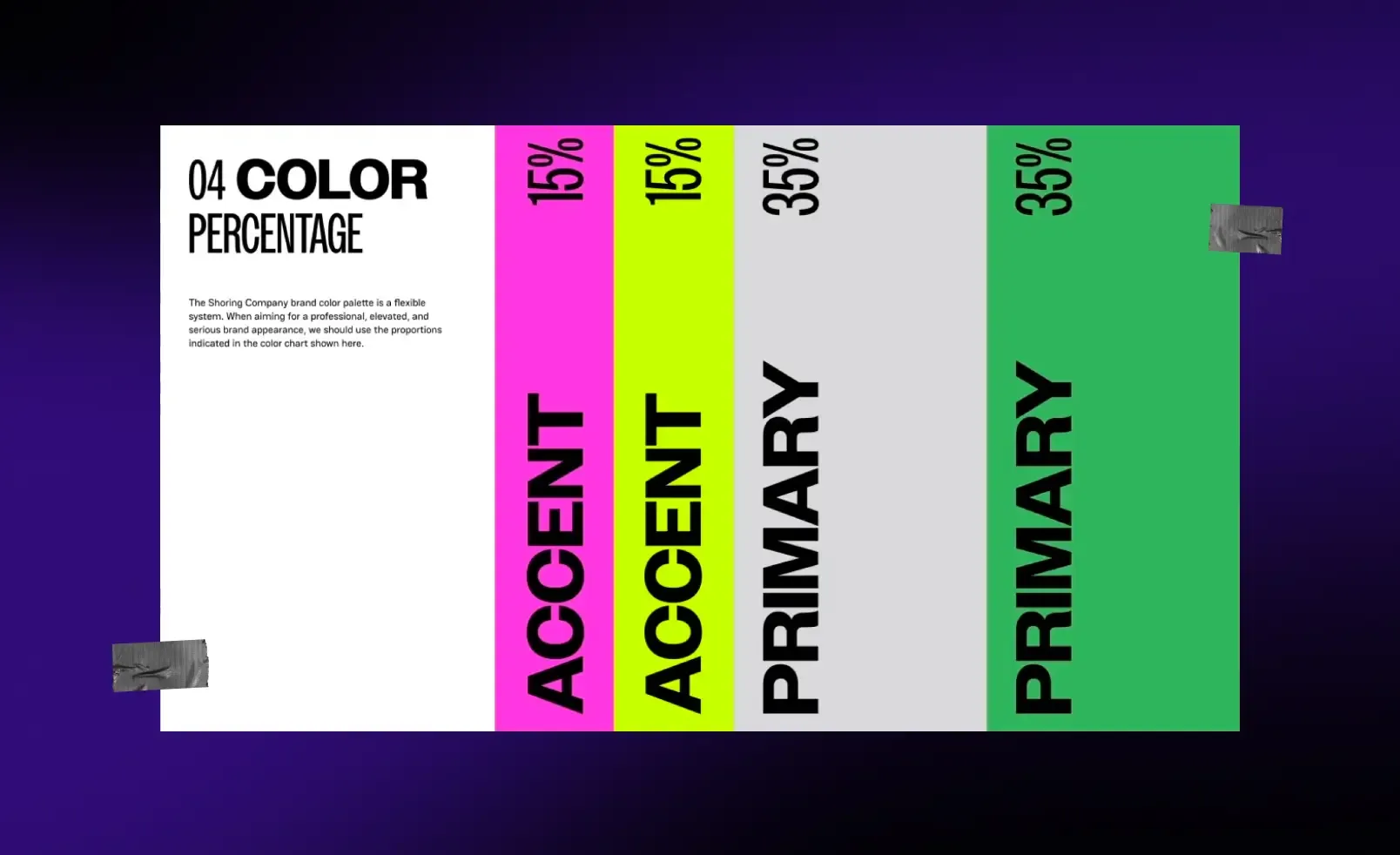
Qream rebuilt the brand system from the ground up: positioning, visual identity, and a new website—built to read as credible and distinct, not just another staffing vendor in a crowded inbox.
Six months after launch, Shoring signed an enterprise contract with BioMarkt. The marketing director at BioMarkt noticed it right away: “Wow, you have such a great brand.” And that’s the best compliment we could receive.
160 warm sales leads. 4 calls booked. An 180% jump in LinkedIn visitors. The rebrand also picked up an Awwwards Honorable Mention in 2023.
“We stand stronger than before,” Shoring's CEO, Tobias, said afterward. In B2B, that's what a rebrand is actually for—giving a buyer a reason to trust you before your team ever gets the chance to prove it in person.
Marketing that converts starts with a brand worth converting on.
If campaigns are getting attention but not closing deals, positioning is usually the fix—not a bigger budget. A brand audit shows you exactly where the gap is before you spend on another campaign.
Branding comes first, but only in sequence, not in importance. You can run marketing without a defined brand—most B2B companies do and pay for it in inefficiency: every campaign has to build credibility from zero instead of starting from familiarity. Brand strategy defines what gets said. Marketing decides who hears it and how often. Reverse the order, and you end up paying twice for the same ground.
Yes, but you're paying full price to rent attention that a recognizable brand would get at a discount. The cost shows up in higher CAC, lower conversion rates, and deals that stall mid-funnel because no one in the buying group can articulate why your company is the right choice. Marketing without branding is distribution without a reason to care.
Neither is more important in isolation. They do different work on different timescales. The mistake is framing them as competing budget lines. A strong brand makes marketing more efficient. A weak brand makes it more expensive. If you must sequence, brand first—but the goal is both, properly ordered.
Branding is who you are. Marketing is how you go to market. Advertising is one paid distribution tactic inside marketing—the layer buyers actually see and click. Each fails differently without the others: advertising without a strong brand is noise, marketing without a strong brand is expensive guesswork, and branding without marketing is a position nobody ever hears about—the three work in sequence, not in competition.
Written by

Qream co-founder | Business growth and strategy
Leads Qream's business development and commercial strategy, bringing experience across sales, customer support, and complex digital projects. Reviews topics around project scoping, agency engagement, strategic partnerships, and growth.