Other agencies won’t like that we spill this tea, but…
Most clients come with a brief that sounds like: “We need a refresh, a design that feels more modern.” They’ve already decided what the solution is. The problem is they diagnosed themselves—and they got it wrong. It’s like using ChatGPT as your doctor.
A new design is just a small part, usually coming after positioning and a strategy. Yet many vendors just follow the brief. Discover why it’s wrong before starting another branding project.
The redesign trap
There’s a reason “let’s update the look” is so easy to say in a meeting. It’s concrete: you can point to before and after. You can brief, budget, and present it to the board. It feels like progress (it’s also a trap).
Visual change without strategic change is decoration that doesn’t fix a brand that’s confused about why anyone should choose it. A new coat of paint on a confused brand is still a confused brand, just more expensive now.
The graveyard of cosmetic rebrands is full of cautionary tales. When Twitter became X in 2023, its brand value dropped from $5.7 billion in 2022 to $673 million by 2024—an 88% collapse.
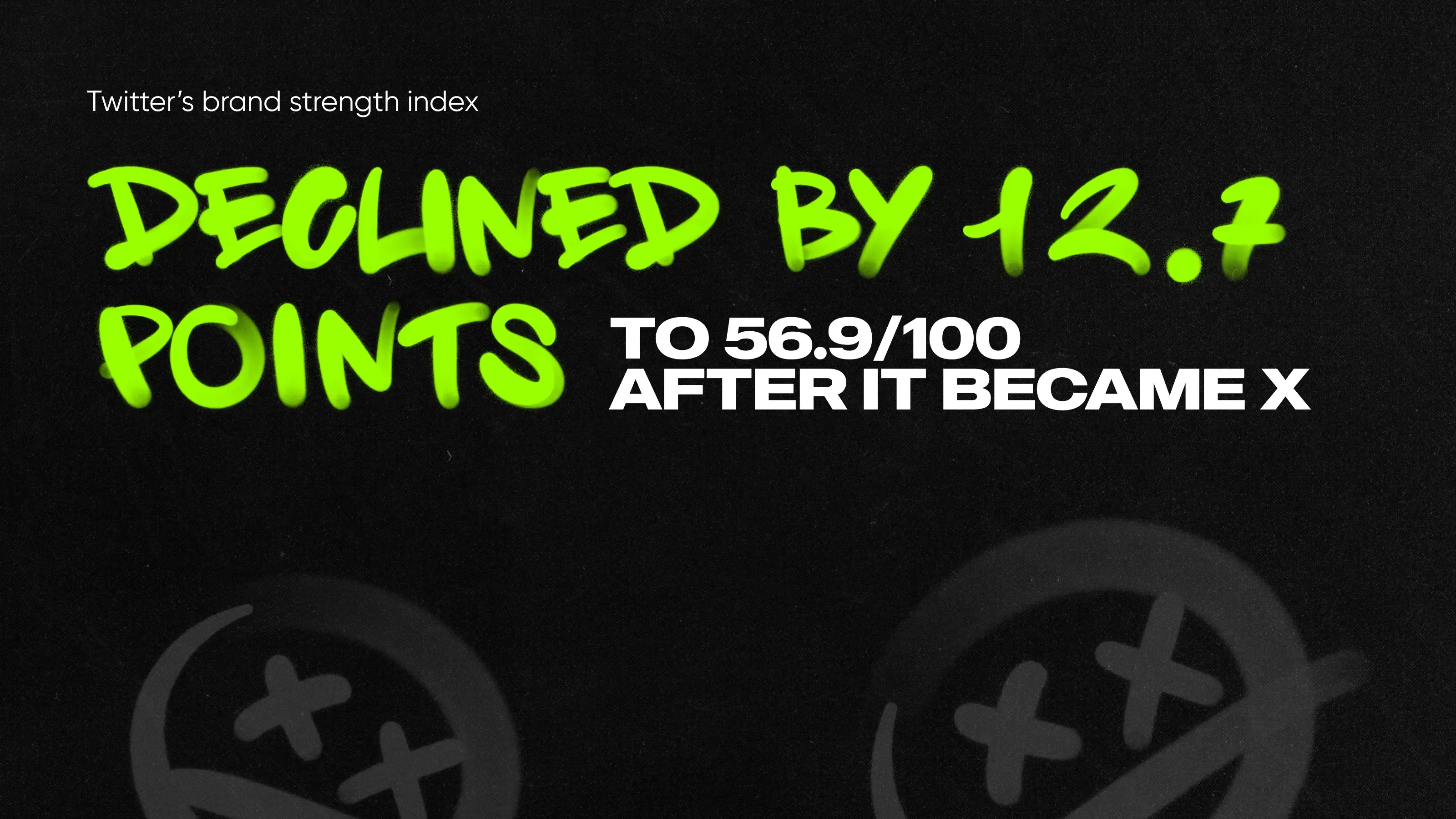
They changed the name, the colors, and the typography, yet they didn’t earn the new position. For users, it was the same platform—the emotional shift didn’t happen. A public poll showed that 95% of users still call the X platform by its original name, Twitter.
And we can’t say it’s a design failure. That’s what happens when you change the visual identity based on personal desire and a vague brief. The product didn’t change, nor did the meaning. The redesign didn’t stick because repositioning was never done, just announced.
What repositioning actually means
Qream doesn’t treat repositioning as the same as an identity redesign. Usually, it means deliberately shifting where your brand sits in your audience’s minds relative to competitors.
It answers three questions that a redesign can’t:
- Should we reach the same audiences or focus on a specific segment?
- Why do we exist? What emotion or belief do we carry?
- Why should anyone choose us over everything else available?
When those questions don’t have clear answers, no amount of polished design will save you. Let’s break down more points before you come up with a new brief.
Position vs identity
Your visual identity is how your brand looks. Your position is what your brand means. So, a strong visual identity built on a weak position still means nothing.
Let’s say, you wouldn’t start with the interior design before laying the foundation of your building. The same logic applies here: positioning leads you somewhere, and identity helps you achieve it through communication or stand out in a sea of sameness.
Differentiation is not a design brief
“Make it feel like Apple” is an aesthetic reference, not a competitive position. Differentiation is earned in strategy by mapping your market, identifying the territory nobody has claimed (emotional or feature-based), and staking a flag there. Then the design expresses it.
Clarity before creativity
The single most common failure mode in branding is rushing to the creative before the strategic work is done. The brief arrives half-formed—the client has a gut feeling. The designer interprets it, and three rounds of revisions later, everyone’s frustrated because the design doesn’t solve business problems.
This kind of clarity is not the designer’s job to manufacture from a brief. It’s the agency’s job to dig in before a single concept is developed.
Strategic branding becomes the key
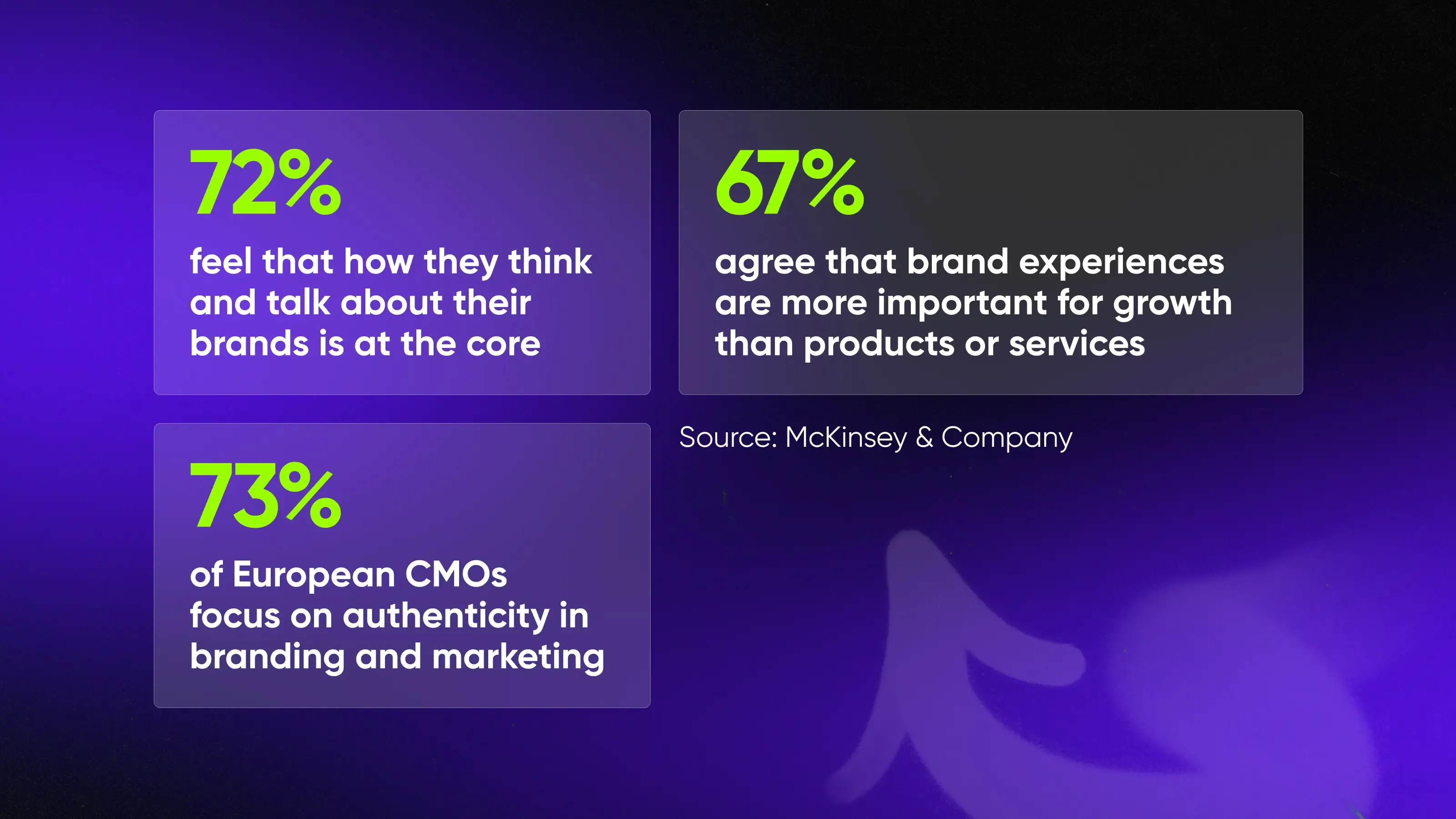
Overall, branding is the first priority for European CMOs, according to the State of Marketing Europe 2026 Report by McKinsey. 69% of marketing leaders agree that purpose-driven and authentic brand experiences are what matter most to their companies.
The visual work comes last, and it’s for the better
What most clients don’t expect is that when the strategy is solid, the design work gets easier, with less back-and-forth and fewer rounds of subjective revision. Because designers aren't guessing at a feeling anymore—they’re solving a defined problem.
Concepts are easier to create when you know what challenge or risk the business has. The Bittersweet.cars case—the US junk cars reseller—is the clearest example of this in practice.
Early in the process, we identified a significant strategic gap: every competitor was speaking the same rational language—fast, easy, but very bland. The emotional dimension was completely unoccupied territory: no one treated a junk car as the memory attached to it, or showed the small grief of letting it go.
That single insight dictated everything that followed: the name, nostalgia-driven aesthetic, tone of voice, graphic elements, and even the logo (which became a lemon to highlight the bittersweetness of keeping an old car). None of those were stylistic preferences—they were logical outputs of a strategic finding.
This is the part we call strategy-led branding. It gives everyone in the room a shared language for making decisions.
It replaces “I don’t love the font” with “Does this communicate the right level of support for our audience?” And you should agree that those are different conversations, since the second one produces useful outcomes.
When the brand foundation is built, the creative work is liberated. Designers can push further, take bigger swings, explore territory they couldn’t justify before—because there’s a brief that supports the direction. The work becomes intentional rather than random guessing.
But sometimes you do need a design and not positioning
Surprise, surprise! Not every business at every stage needs a full branding process.
A founder 3 months into their startup doesn’t need a brand strategy document. They should focus more on customers, feedback, and evidence that their offer works. Spending $20,000 on branding before you validate your business seems like an avoidance.
Small businesses with limited resources should spend their early capital on things that test the model: selling, distributing, and talking to customers. A basic and functional brand identity is enough at that stage. It doesn’t need to be extraordinary. Yet.
Once you start scaling, a brand strategy becomes non-negotiable. The moment you’re hiring people who will speak on behalf of the brand, entering new markets, or competing with bigger players, the absence of a clear position starts costing you real money.
At that stage, “we’ll sort the brand later” is not a good decision. Founders who start simple and then spend years patching a brand that was never built to scale, adding a new logo here, a refreshed website there, eventually realize the brand is the bottleneck. And they’ve already paid for two redesigns.
How to know what you need now
Not every situation calls for the same response. Seed startups or scaling enterprises need different solutions—only your context (growth stage and business challenges) determines that. Here’s a straightforward way to evaluate where you are and what you should do.
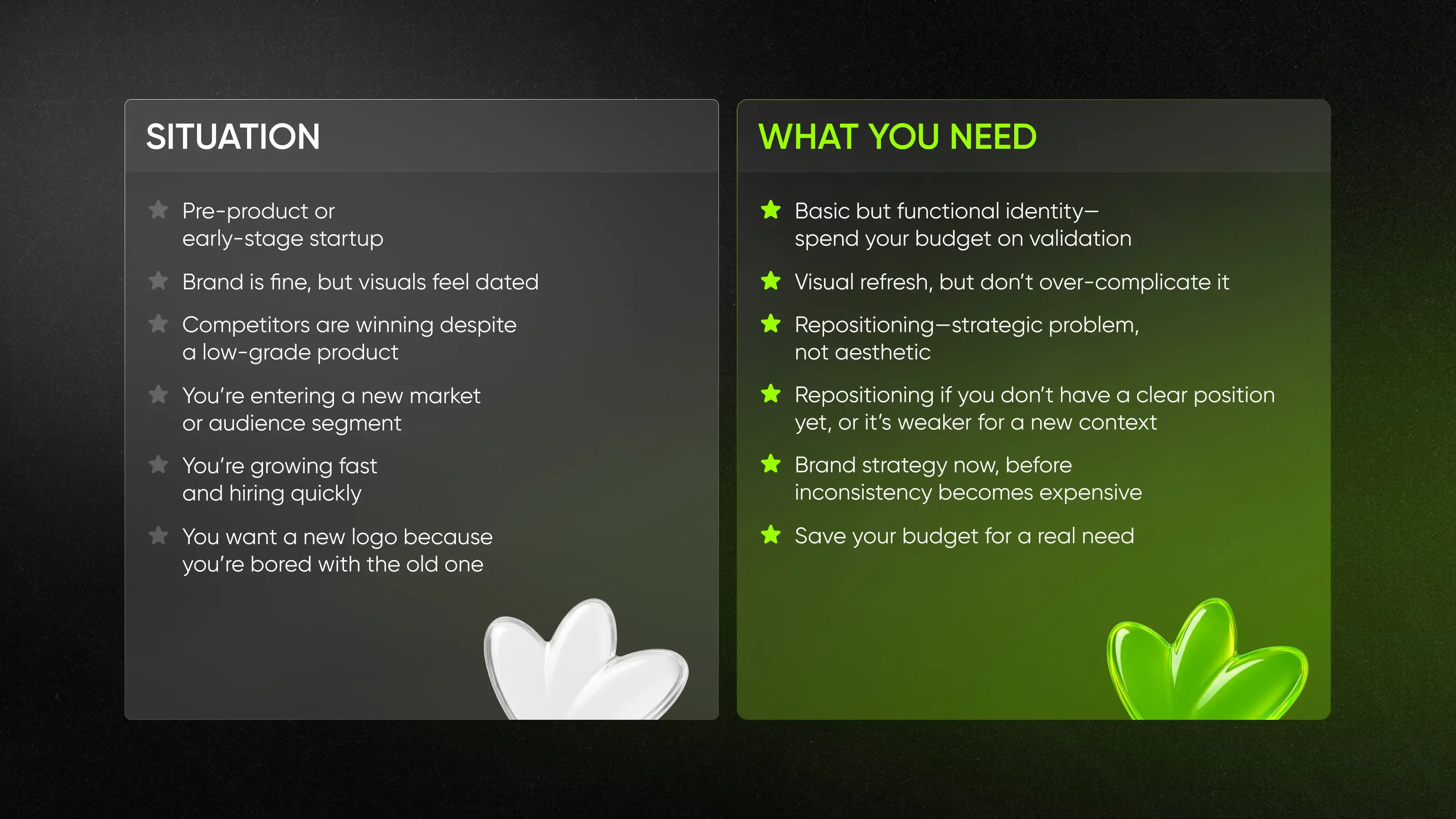
Summing up: most businesses come to agencies too early in the process—having already decided on a visual solution—or too late, after spending money on design that didn’t move anything.
We’d say that the right moment for full repositioning is when you’ve outgrown your current position, and you know it. When the brand is holding you back rather than propelling you forward, or when the thing you built in year one no longer describes what you’ve become.
The final take: choose the right partner for the right problem
Businesses can fail at branding if they hire a vendor to do a quick design when they need a partner for transformation.
Showing up with “we need a new look” when the real question is “why we’re losing” is the wrong choice. But if you’re not sure what you need, that’s where we start.
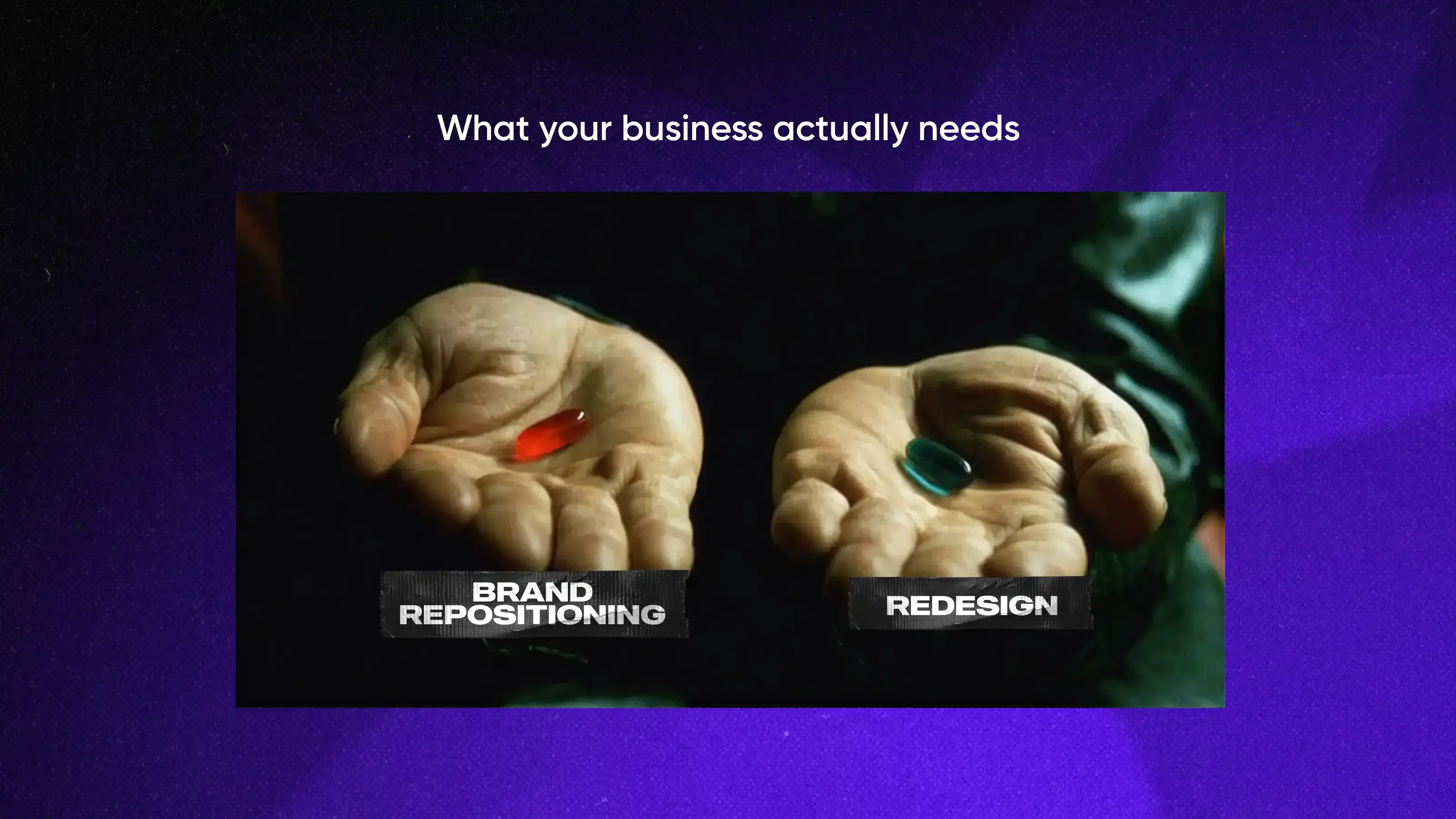
Not every client who walks in knows whether they need a redesign or a full repositioning. Most don’t, and that uncertainty is actually the most honest place to start from.
If you can’t clearly articulate why the audience doesn’t remember you or why a competitor with a weaker product keeps winning—that’s information. It tells us the problem is strategic, not aesthetic. From there, we figure out together what kind of engagement makes sense—and whether we’re the right fit for it.
In some cases, you’ll need a quick redesign, and at some time, you’ll need repositioning. Both works start with a question rather than a filled brief. If you’re ready for that conversation, we’re here.