TL:DR
How much does rebranding cost? A strategic B2B rebrand costs $35,000–$80,000+. Strategy is always part of the scope—the question is how deep it goes. The single biggest variable: whether a website is in scope. Add one and the investment can reach $80,000+. If you need a visual update without repositioning, a brand refresh starts at $7,000. When the budget is fixed, reduce deployment volume before touching the brand core.
Discussions about rebranding prices always start with the phrase “it depends,” and to get a specific figure, clients sometimes feel like they have to jump through hoops. We want to get down to specifics right from the start.
How much does rebranding cost? For a B2B company, the range is $35,000 to $80,000. What moves it: how many layers of the business change, how broadly the new brand deploys, and whether a website is part of the scope.
A visual-only update: new logo, updated colors, no change in positioning—that's a refresh. It runs $7,000 to $25,000 instead, no strategy included.
On Reddit's r/Entrepreneur, someone asked whether $3,499 was affordable for a small business rebrand—and the most upvoted response was: “I'd want to see a portfolio. $3,500 seems cheap tbh.” That anchoring is real, and it's one reason most rebranding conversations go sideways early.
If your only problem is an outdated logo and nothing else has changed structurally, you might not need a full strategic rebrand—updating your visual identity could be enough.
What a B2B rebrand actually costs in 2026
A B2B rebrand typically costs between $35,000 and $80,000+, based on Qream's closed projects.
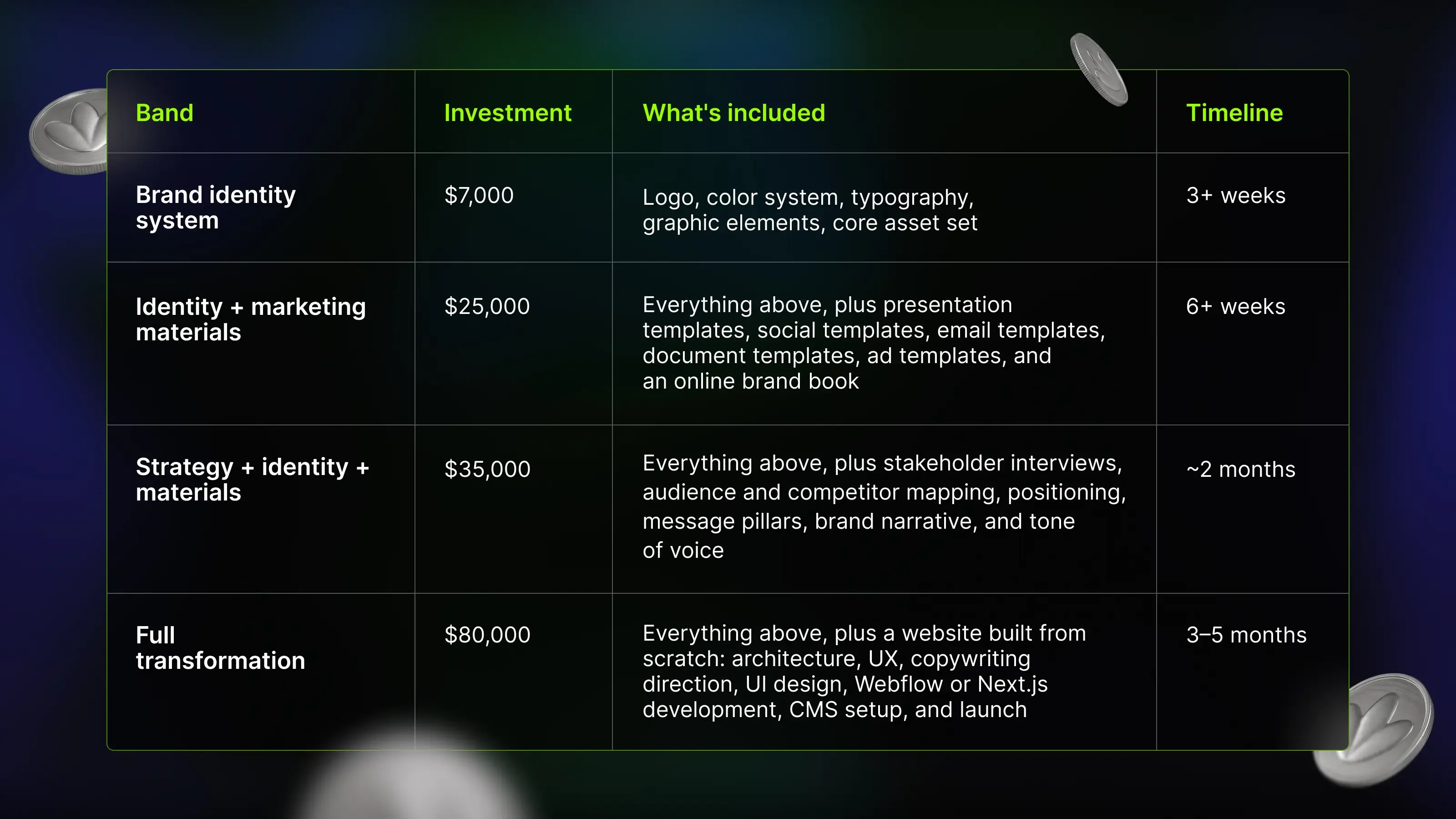
Let's start with a distinction. A brand refresh updates how a brand looks. A rebrand changes what it stands for. The bands below reflect both—starting with visual identity updates and moving through to full strategic overhauls.
The first two bands are brand refresh territory. Rebranding, in the full sense, begins at $35,000.
Starting at $7,000—Brand identity system.
Logo, color system, typography, graphic elements, and a core set of brand assets.
- Typical timeline: approximately three weeks.
- The right scope when the strategy is solid but the visual identity needs updating—squarely a brand refresh.
$25,000 and up—Identity and marketing materials.
Everything in the identity system, plus presentation, social media, email and document templates, ad assets, and an online brand book.
- Typical timeline: approximately six weeks.
- Still a brand refresh—the strategic foundation stays, but the brand gets a full toolkit to work consistently across every channel.
From $35,000—Strategy, identity, and marketing materials.
Everything above, plus the strategic foundation: stakeholder interviews, audience and competitor mapping, positioning, message pillars, brand narrative, and tone of voice.
- Typical timeline: approximately two months.
- This is where rebranding begins in the full sense—when positioning, messaging, or audience needs to shift alongside the visual identity.
$80,000+—Full transformation.
Brand strategy, identity, marketing materials, and a website built from scratch—covering information architecture, UX, copywriting direction, UI design, Webflow or Next.js development, CMS setup, and launch.
- Typical timeline: three to five months, depending mostly on website size.
- For companies ready to transform the full brand experience, from identity through to the live site prospects actually land on.
These figures cover Qream's design scope. Rollout costs—trademark registration, signage, printing, domain acquisition, internal communications—are budgeted separately. More on that below.
“Whether the website is in scope is the single decision that moves the price most. Everything up to and including strategy can fit within 35K. Add a website rebrand, and the investment can exceed $80K. A website is a different discipline: UX, copywriting, design, development, QA, and launch.”
— Yaroslav Khaletskyi, CBDO, Qream
What drives the rebranding cost up or down
So what determines the rebrand cost in practice? Four factors understanding which ones apply to your project helps you scope the right engagement from the start.
01 Strategy depth. Some level of strategic thinking goes into every rebrand—even a visual refresh starts from understanding what the brand currently communicates. The question is how deep that work goes.
At the lighter end: a competitive audit, a brand review, and internal stakeholder interviews.
At the deeper end: customer interviews, focus groups, audience segmentation, market mapping, positioning tested against alternatives. This level of work surfaces what the brand actually stands for—sometimes confirming what the team already sensed, sometimes revealing something they hadn't articulated yet.
02 Deployment volume. How many surfaces the new brand has to cover. A company with one sales deck and a website deploys differently than one managing twelve template types across four business units—every additional asset type adds design time and review cycles.
03 Website in or out of scope. When a website is in scope, two separate tracks of work run in parallel—brand design and web production, with different teams, tools, and timelines. When a brand stops living in a PDF and has to work live on the site your sales team sends to every prospect, the scope changes shape entirely.
04 Compressed timelines. A four-month scope doesn't shrink to six weeks for free. Parallel workstreams and accelerated decision-making carry real cost.
That covers what most design agencies include in a proposal. What comes next doesn't appear on it—but it still needs a line in the budget.
What the rebranding proposal doesn't include
During the rebranding process, Qream becomes your partner, handling all aspects of design and branding while keeping your broader business goals in focus. What happens after our work is complete is a separate expense for the buyer.
For a full breakdown of what the brand identity fee covers, this article on brand identity cost separates the components clearly.
Other costs to plan as separate budget lines:
- Trademark registration. Start clearance searches before the identity is finalized. Filing a trademark in the US costs $350 per class (USPTO); across all 27 EU member states, €850 for the first class (EUIPO).
- Physical assets. Signage, business cards, packaging, event materials—for companies with offices or vehicles, physical production can equal the design fee.
- Internal communications. Announcing the rebrand, updating sales materials, rewriting onboarding content—its own project, not on the brand identity proposal.
“We budget everything before signing. The client sees exactly what they're paying for within which scope—and after the deal is signed, the invoice never grows beyond that number. No mid-project surprises, no 'this turned out bigger than expected' invoice,” says Yaroslav. Every item above is a reason to build a second budget, not a reason to expect the design fee to grow.”
What to cut when the budget is fixed
When the budget won't move, the scope has to. Here's the order that actually works.
1. Marketing materials—first to go. If you have in-house or freelance designers, give them a strong core identity and let them build the templates. Deployment becomes slower and less consistent, but the brand foundation stays sound.
2. Strategy depth and when a lighter touch is enough. If the positioning is clear and the audience hasn't shifted, you don't need a full strategic overhaul—a brand review and competitive audit may be sufficient. But if any of that is genuinely unclear, going too light on strategy is the more expensive decision by the time the project wraps. As Yaro puts it: “Spending $10K to patch just one hole without understanding the full picture—that's waste. And I'll say it plainly.”
3. Phase the rollout, keep the foundation whole. Fewer template types, format variants, and asset sizes. Prioritize the surfaces your team touches every day and defer the rest to a second phase.
Of the three cuts, strategy is the one clients come back for—almost every project that returns for an emergency fix assumes positioning rather than defining it.
The line we don't cross is the brand core. Logo, color system, typography, graphic elements—everything else builds on this. A cheaper core doesn't save the budget—it defers the cost. And it produces work we won't put our name on. Someone else will take that project—knowing full well the client will be back in two years to redo it. We'd rather say no the first time.
Before committing to a second rebrand, this piece on why first rebrands fail is worth reading first.
Are you worried that the scope of work in the budget might turn out to be a “pig in a poke”?
Tell us what you're working with—we'll map the right scope before writing a proposal.

Agency vs freelancer vs in-house
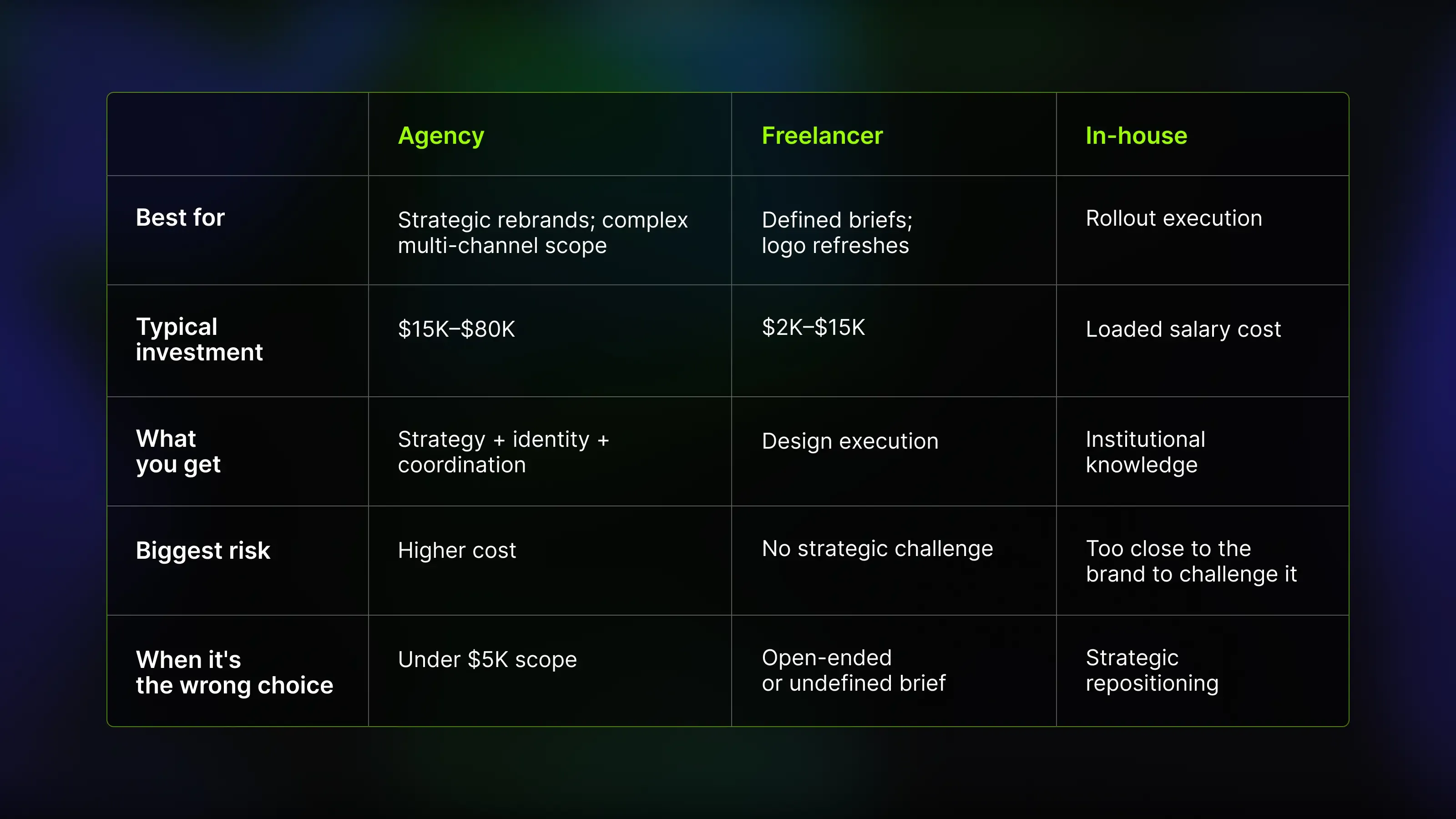
Under $5,000 for a logo refresh, you don't need an agency—anyone trying to convince you otherwise is selling their rates, not solving your problem. That's when it earns its place: when the positioning is unclear or the rebrand spans several tracks of work at once.
Agency—$15,000–$80,000
Best suited to strategic rebrands and complex, multi-channel projects. You get strategy, brand identity, and coordination across different workstreams. The main trade-off is the higher cost. Adding an agency to a narrowly defined project under $5,000 adds overhead without adding value.
Freelancer—$2,000–$15,000
A good fit for a clear brief, a logo refresh, or a focused identity project. Freelancers primarily provide design execution, which makes them a cost-effective option when the strategic direction is already established. The main risk is that they won't challenge the brief or provide deeper strategic input. If the brief is still being defined, a freelancer may not have enough context to question the direction—and will likely just execute what's written.
In-house team—loaded salary cost
Best for ongoing rollout and day-to-day brand execution. An in-house designer brings institutional knowledge and stays close to the business, but that proximity can also make it harder to challenge the brand’s existing assumptions. When the brand needs strategic repositioning, an in-house team can be too close to see it clearly—and rarely has a dedicated brand strategist on hand. An outside perspective brings the distance and the expertise that internal teams, by definition, can't provide themselves.
If you're still deciding who should do the work, thе breakdown of agency vs. freelancer pricing comparison covers the trade-offs in full. And if two agencies quoted wildly different numbers for what sounds like identical scope, the reasons behind that gap tend to come down to the same few things.
How to budget for a rebrand without guessing
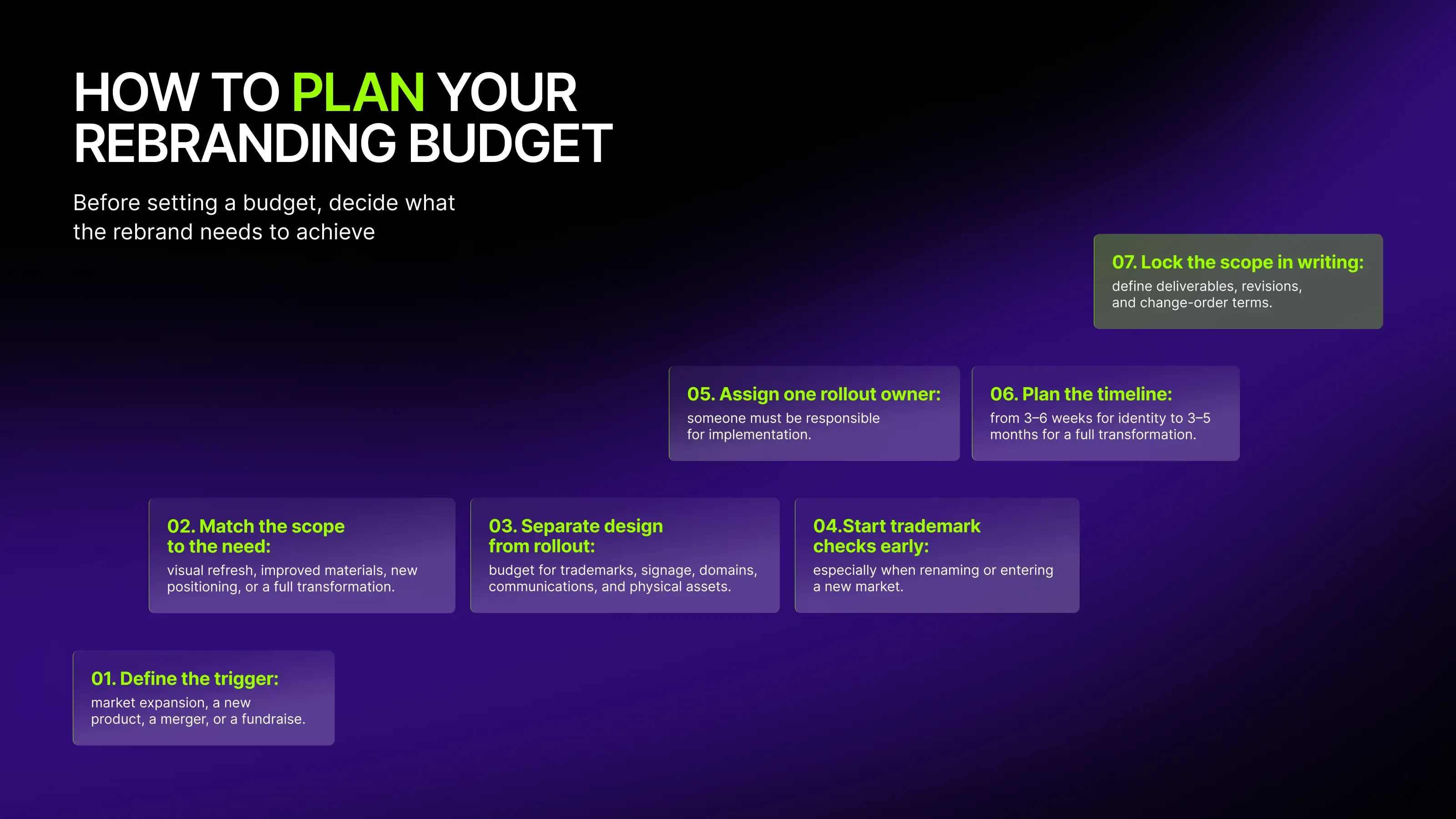
- Start with the business problem. A new market, product, merger, or fundraising round may require more than a visual update. The broader the business change, the deeper the strategic work needs to go.
- Match the trigger to a band. Positioning changing? You're looking at strategy + identity ($35K) or full transformation ($80K).
- Separate the design fee from the rollout budget. Trademark, signage, domain, internal communications, and physical assets are a different line item—build that budget before the project starts, not once delivery begins.
- Start the trademark process early. If renaming or entering a new market is on the table, run clearance searches before the identity is finalized.
- Name an internal owner for rollout. Without one named person responsible, rollout stalls—assets pile up waiting for approval, channels get updated in the wrong order, and the transition never gets properly coordinated. That's the most common reason rebrands take 11 months instead of 6.
- Plan the timeline before approving the budget. Brand identity: 3–6 weeks. Identity with materials: 6–10 weeks. Full transformation with website: 3–5 months. Factor in rollout after delivery—updating every asset, training the team, and completing internal adoption adds significant time even after the design work is done.
- Get the scope in writing. Deliverables, revision rounds, what triggers a change order. A clear contract is how a $35K project stays a $35K project.
How Qream scopes and prices a rebrand
Before putting a number on the table, Qream asks three questions:
- What changed in the business that makes this necessary now?
- Which touchpoints need to carry the new brand?
- Who does the result need to convince?
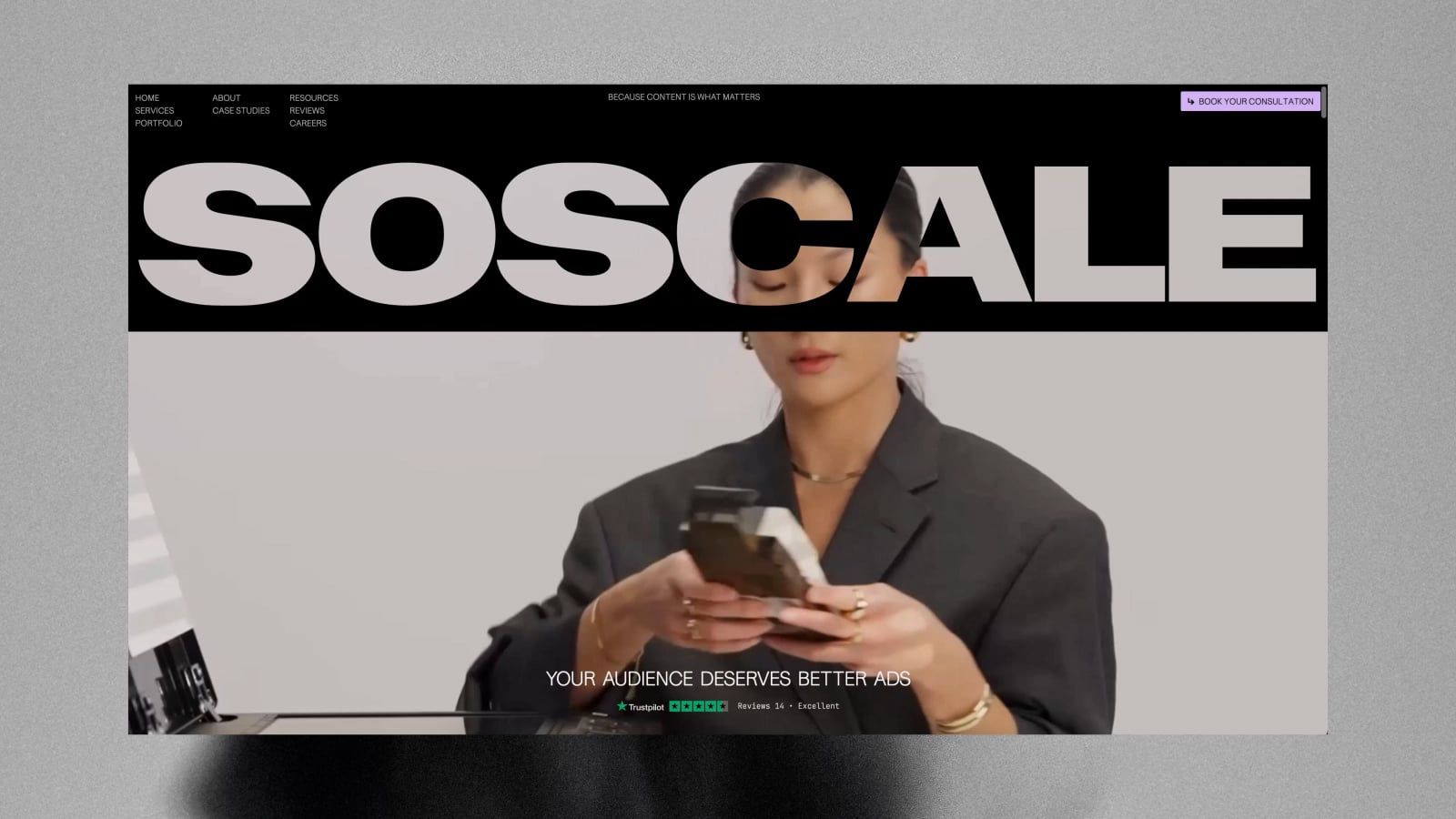
When SoScale came to us, they needed to be positioned as the #1 performance creative agency in Scandinavia—with the brand platform and website to match that claim. The engagement delivered 44 design templates, 39 icons, two motion guidelines (Adobe AE + Blender), and an award-winning website—supporting SoScale in reaching $2.5M ARR.

Your brand scope shouldn't be a guessing game.
Tell us what's changed in the business. We'll put the right band in front of you and scope a proposal before any commitment.
FAQ
The cost of rebranding for a B2B company runs $35,000–$80,000+. Strategy is always part of the scope—the question is how deep it goes. Without a website, the engagement sits at $35,000–$45,000. Add one and the investment can reach $80,000+.
A brand refresh for a small business starts at $7,000—and for many small businesses, that's the right scope. A full strategic rebrand, where positioning and messaging are reconsidered, starts at $35,000. The cost of rebranding a business at this scale depends mostly on whether the strategy needs to change alongside the visual identity.
Because how much it costs to rebrand a company depends on two things: what's actually changing in the business, and who's doing the work. Two companies the same size can end up at $35,000 and $80,000 for entirely different reasons—scope, strategic depth, the level of expertise on the other side of the table. The cost of rebranding a business isn't arbitrary, but it does reflect who you're working with, not just what they're delivering.
On Clutch, where clients report their own project budgets, the most common bracket for branding work is $10,000–$49,999. For a strategic B2B rebrand, the range based on Qream's closed projects is $35,000–$80,000+.
Qream's design scope runs three weeks to five months, depending on what's included: a brand identity system wraps in roughly three weeks, a full transformation with a website in three to five months. For context, Bynder's 2023 survey of over 1,000 marketers puts the average end-to-end rebrand at 7 months (Bynder, 2023)—that's the industry baseline. Getting there faster without losing quality work is the goal.
Written by

Qream co-founder | Business growth and strategy
Leads Qream's business development and commercial strategy, bringing experience across sales, customer support, and complex digital projects. Reviews topics around project scoping, agency engagement, strategic partnerships, and growth.