If you know you need a double dose of magnesium before your Q3 pipeline review—something is wrong. Normal: getting together with the same team in the same room, same format, same faces. Not normal: three quarters running with roughly the same result. No growth.
Because this story is sadder than a Hemingway novel: head of sales blames the SDR. The head of marketing blames the close rate. Someone floats a new outbound sequence. Numbers scroll past, everyone takes the same notes, and the meeting ends with yet another list of things to fix in the funnel.
Give a bonus to whoever mentions the website
Before your Account Executive books a call, most of the work that determines whether a serious buyer shows up more ready to decide has already happened. Including in a browser your team never saw. It's happening somewhere at a desk in another company's procurement office—one you'll never visit. Most founders who come to us convinced there's a pricing problem or a product gap confirm something else.
The pricing is fine. The trust signal isn't strong enough.
You already know which two or three competitors you keep losing to. What you probably haven't done is open their site next to yours and ask yourself honestly: which one looks like it's ready for new six-figure contracts? Try it.
Series B is where founder magic stops working
At Series A, the founder closes deals, leaning on the personal pitch. Product vision holds. Relationships compensate for whatever the website lacks. Then Series B arrives. Real growing up.
Now you're selling to entire committees—not small businesses, and their expectations around image are a different level entirely. According to Gartner's research on complex B2B purchases, buying groups often include 6 to 10 stakeholders. Most of them will never get on a call with your team if they open your website and it doesn't match the stage you're actually at.
With no one from your company in the room, an opinion forms in under a minute—and either you're on the shortlist, or you get a quiet "uhh, no". That shortlist forms early. Not randomly.
Brand doesn't close deals on its own. But it determines who even gets a chance to start closing them. At Series B, that's the most expensive part of the funnel to ignore. And the way most growth-stage companies lose there is through mediocrity and invisibility.
Maybe you've outgrown your brand while nobody was watching
There's a specific visual language that still reads as "early stage"—even when the revenue and headcount say otherwise. Including a website design that explains nothing about the actual product. One that could probably belong to any company in any category.
Picture this: the product matured. The pitch deck matured. The team grew from twelve people to sixty. But the website is still about the company you used to be. And right now it's acting as your first sales rep in every room you're not in.
Procurement teams running informal vendor assessments—before any Request for Proposal, often before any inbound signal, they give each homepage about thirty seconds before forming a view. A site that signals "scrappy startup" fails that assessment without explanation. The buyer doesn't say why they're not moving forward. They just know they're not.
One founder got the direct version: "We would love to work with you, but you don't look ready yet."—@Dacivisualz, X, May 2026. Three weeks of silence after a demo that seemed to go well. No feedback. No follow-up. Just a site that still looks like year one.
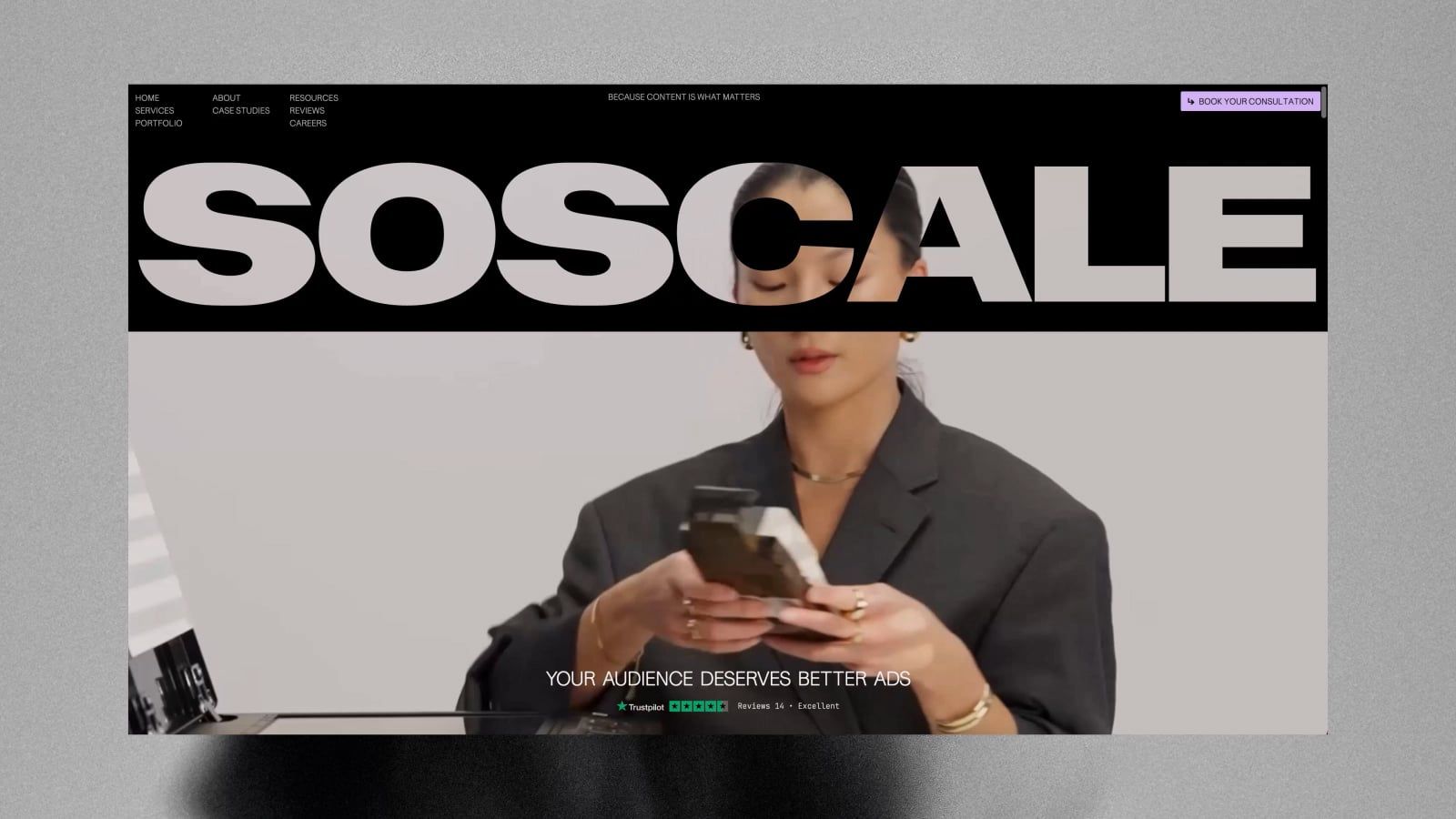
Every niche needs updating—especially those built on performance. SoScale is a Swedish performance marketing agency that builds conversion campaigns for clients. When they came to Qream, their own site didn’t fully reflect what they were capable of. A team of conversion experts losing ground through their own web presence. The site Qream built for them won FWA Of the Day and Honorable Mention Awwwards in 2025. The Trust Gap doesn't spare any industry.
The Silent Objection: the one nobody voices
The most expensive deals you lose aren't the ones that went to a competitor. They're the ones that never considered you at all.
The buyer never says your brand looks weak. They say "I'll circle back"—sometimes sincerely. But somewhere in their evaluation, something told them this vendor doesn't quite fit the picture of who they'd stake a recommendation on. At Series B pricing, recommending a vendor is a career decision for the person who signs off on it. Procurement processes have informal credibility filters that never appear in a CRM note. The worst part is the silence.
If your sales representative says something like this: “I sense there’s some unspoken resistance when I talk to them, but I can’t quite put my finger on what it is. I have a feeling they don’t trust our company”. Then the representative hasn’t been able to pinpoint exactly what the problem is. The buyer hasn’t either—but both of them felt it.
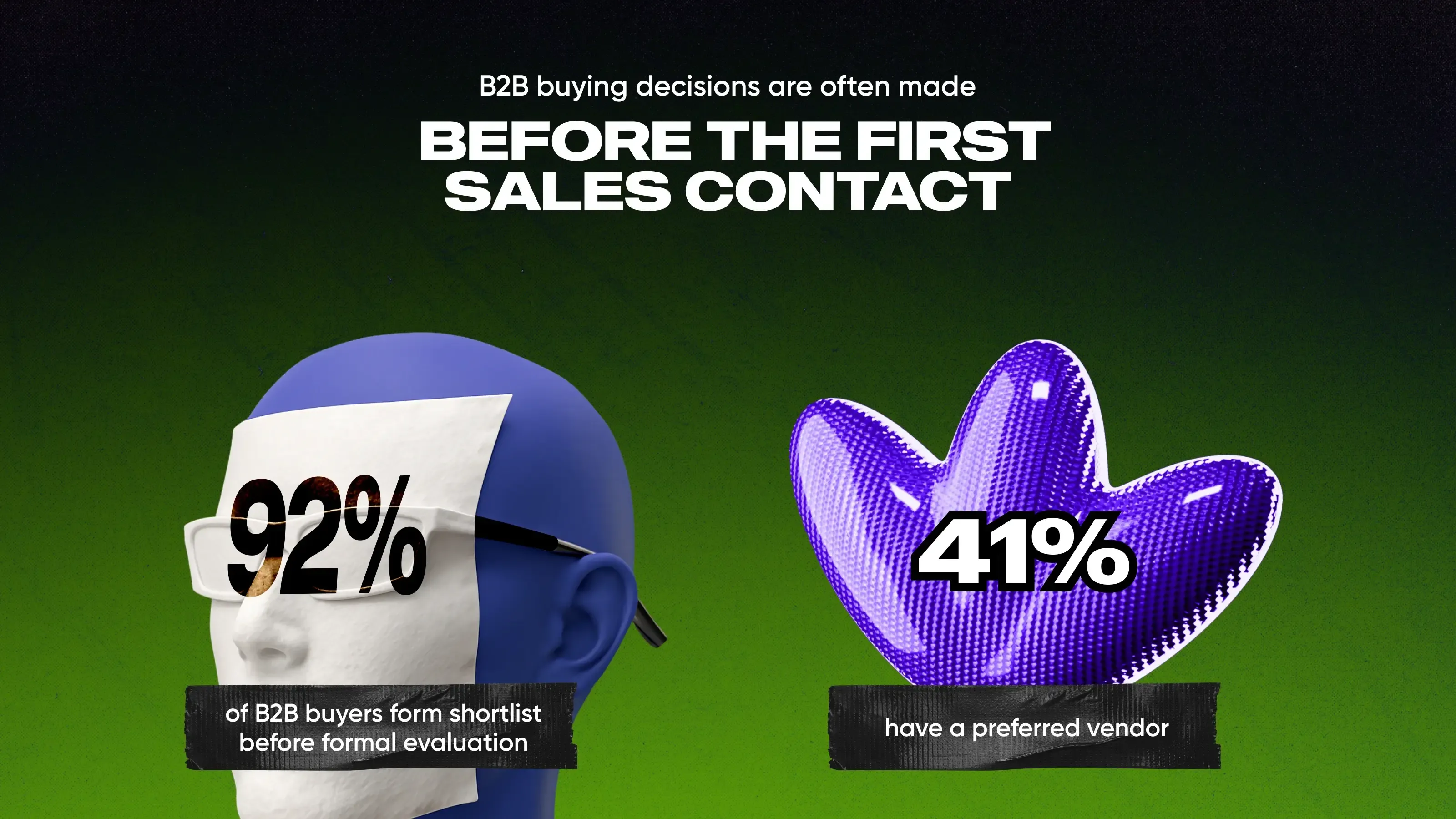
This is where the Forrester 2025 numbers become harder to ignore. 92% of buyers form their shortlist before formal evaluation begins. 41% have a single preferred vendor before the process even starts. That phase is completely invisible to your sales team. No intent signal fires.
The buyer visits your site, forms a conclusion, and either includes you or doesn't—before the first meeting. The game is mostly over before your sales team knows it started.
Brand is the only thing that travels into those rooms without you. And when you're not on the shortlist, there's a third way the problem compounds—especially as the buying group grows.
The Mismatch Tax: when every stakeholder is working from a different version of you
The buying committee doesn't all see the same thing. The CFO found a case study from before your last product update. The engineering lead read a G2 review referencing features you've already rebuilt. VP Marketing saw an outdated LinkedIn post. Procurement pulled up the website. Your "champion" shared the deck.
Each one is building their own version of what your company is, because each surface was updated by a different team, at a different moment, with no single system holding them together. The deck by Sales at Series A. The site by an agency at Seed. The product by engineering at $15M Annual Recurring Revenue. Now those surfaces tell five slightly different stories—and the buying committee is comparing notes.
"I've sat in rooms where the PM, engineer, and marketer are literally describing three different products. No wonder the sales deck doesn't match the demo which doesn't match the website."—@prshivaram, X, Nov 2025.
The result: a buying group spending its energy untangling confusion instead of building conviction about the right choice. Confused committees don't pick vendors. They delay or default to whoever is clearest.
And there's a direct operational cost. "Every demo starts with the same 20 minutes of context-setting that should've happened on the website."—@dangough, X, May 2026. Twenty minutes per demo, per account, per quarter—time your AEs spend as brand educators instead of closers.
None of this requires a full diagnostic to spot. Three tests and ten minutes is enough.
Three tests. Ten minutes. Run them before your next pipeline review
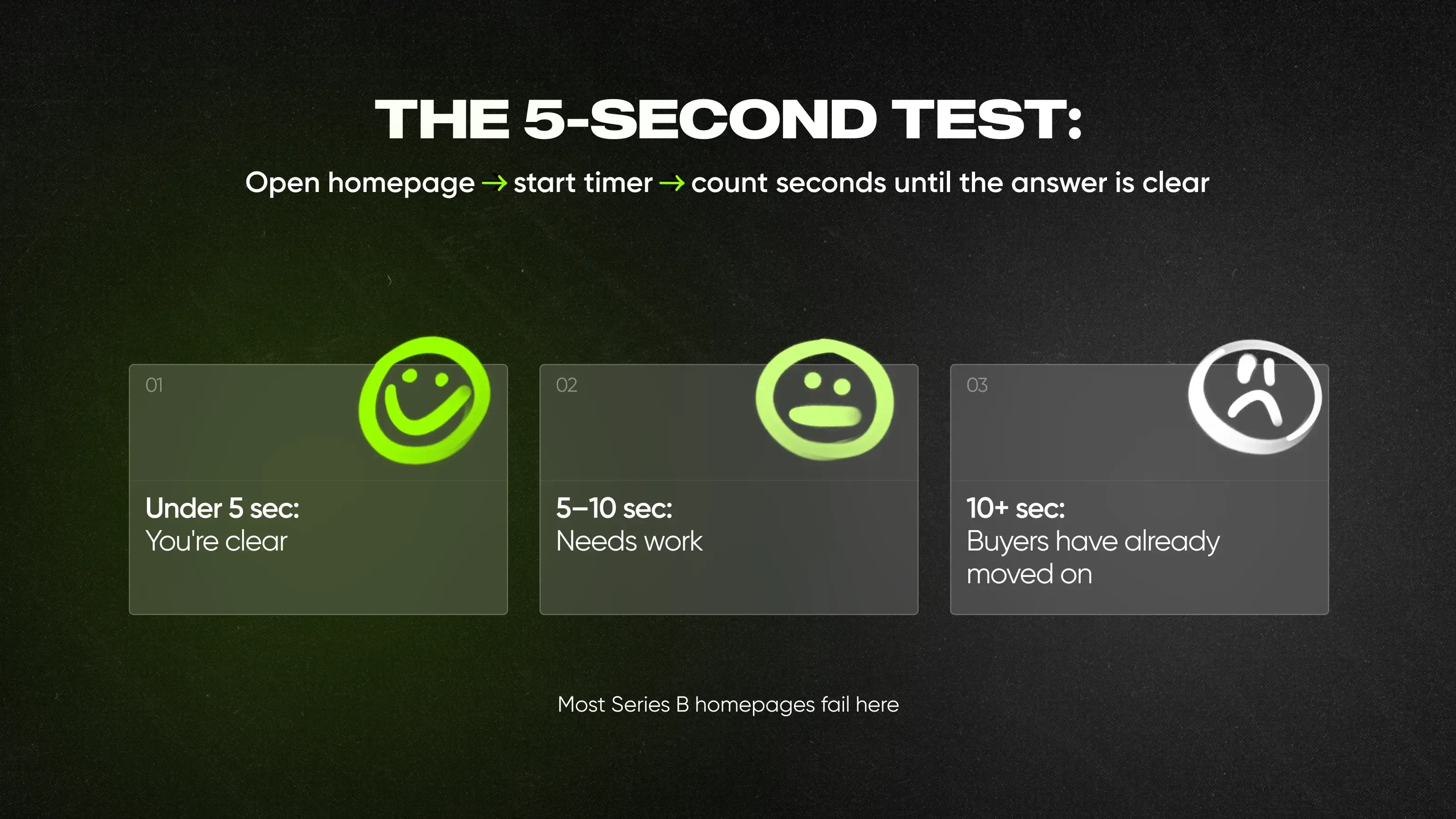
The 5-second test
Open your homepage. Set a timer. Count the seconds until someone who's never heard of you can clearly answer: what does this company do, and who for?
Longer than five seconds—that's how long a distracted procurement manager gives a vendor site before moving on. Most Series B homepages fail this test not because the product is unclear, but because the brand is still speaking to the buyer the company had two years ago. Not the one it wants now.
The deck-vs-website headline test
Pull up the current title slide of your sales deck. Open your homepage. Read both headlines side by side.
Same language? Same level of confidence? Same positioning? If the deck says "the enterprise workflow automation platform" and the website says "move work forward together"—you're running two positioning strategies for the same buyers simultaneously. The committee notices before your AEs do.
The seniority test
Show your homepage to someone at a company one funding round ahead of yours. One question: would they stake their professional reputation on recommending this vendor?
If they hesitate, even for a moment—that's exactly what your buyers feel every time they land on your site.
The pipeline math most founders ignore
If your average contract value is $80K and you're converting 22% of active opportunities—a 5% improvement in shortlist inclusion adds 2 to 3 qualified deals per quarter before the pipeline review even opens. At Series B multiples, that's not a marketing metric. That's an ARR conversation.
Here's what most growth-stage companies miss: the brand built to survive Series A was exactly right for that stage. It communicated what early adopters needed, what tolerance-flexible buyers responded to, what founder-led deals required. It got the company here—and that's genuinely impressive.
But Series B buyers: procurement committees, enterprise leads, CFOs who've never met the founder—read different signals. And when the company has evolved but the brand hasn't caught up, that gap costs real pipeline: quietly, quarter by quarter, without appearing in a single revenue review.
Closing that gap is a growth decision. And it almost never requires starting from zero—it requires identity, web presence, and verbal positioning that all describe the same company. The one you already are, not the one you were when you raised your last round. Every quarter that gap stays open is a quarter of shortlists you're not on.
The deals you lose silently don't leave a trace in the CRM. The fix isn't a new outbound sequence. It starts with an honest look at whether the brand represents the company you have now—and the one you want to build next. Run the three tests. If two fail, that’s the conversation we should be having.
Written by

9 years scoping and running client projects
Sed do eiusmod tempor incididunt ut labore. Has scoped 300+ B2B design and web production projects, and sits on the first call with almost every client.