TL;DR
The companies most fluent in AI are usually the last ones to let it near their branding. Across Qream’s client conversations, the “let’s just do it faster with AI” pitch rarely comes from teams who live inside these tools every day. The pattern is different: the further a company sits from building AI, the more it believes AI can spit out a finished brand identity in one clean prompt. If you’re thinking of just winging it with a generator, the people best positioned to know are telling you: don’t.
The orgs that use AI most heavily are the ones that won't let it near their brand. Talk to anyone working alongside AI-native teams—the ones shipping model updates like it's nothing—and you'll notice they never suggest using AI for branding. That request comes from somewhere else entirely. Let’s figure out why.
Who asks for AI-made branding
Plot twist: it’s not the AI-driven companies. Across our work, the request to “just use AI and make it faster” comes from a different type of buyer and use case.
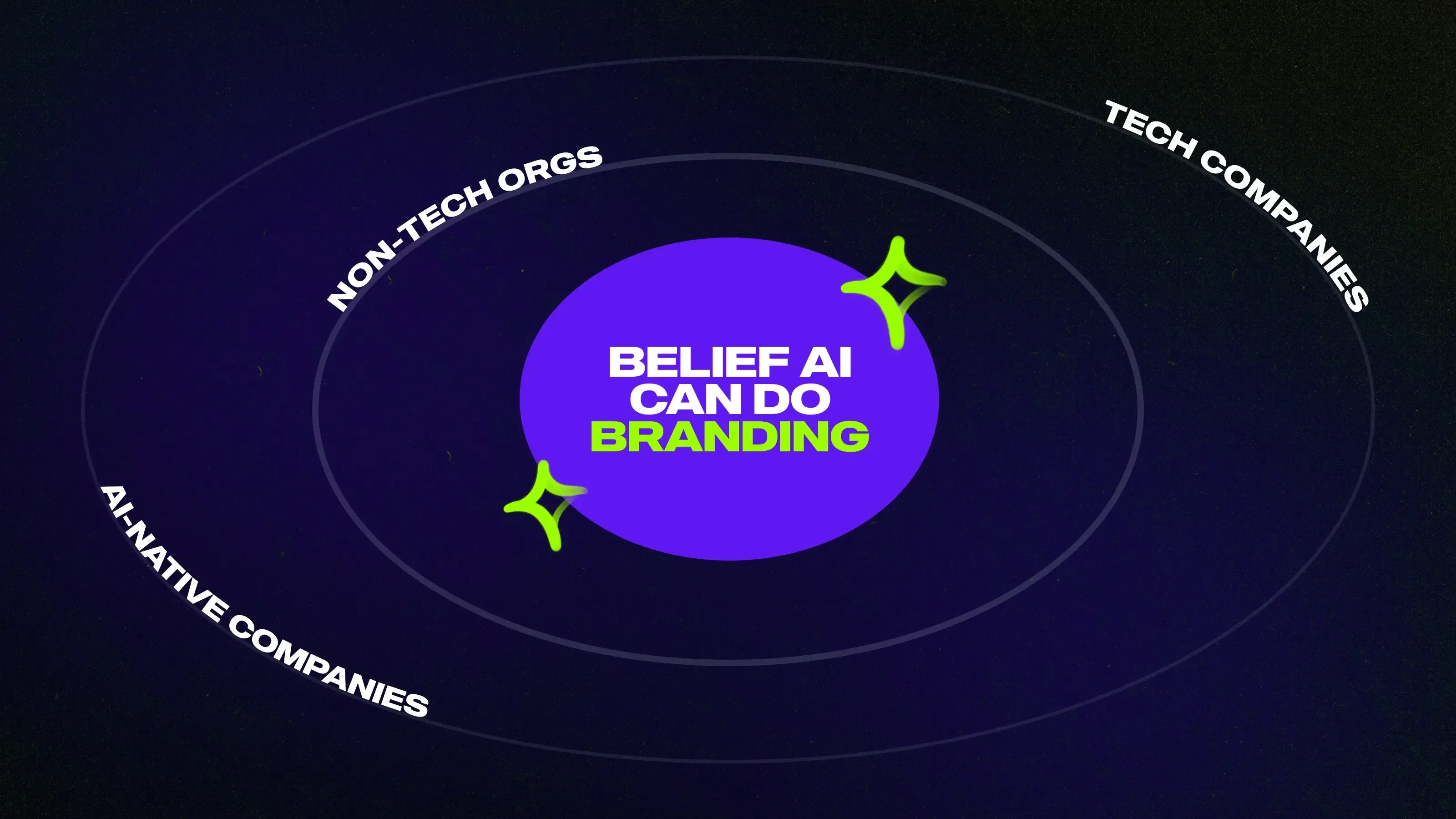
Global companies like SoundCloud, Spotify, and Transporeon don’t come into branding conversations asking which generator we’ll use. We kick off with other questions: How do we make this asset feel distinct? How do we align multiple products? How do we make people trust us faster? AI might come up as part of the workflow, but never as the strategy.
The same thing happens with AI-native companies. Arrakis builds AI security, Coralogix uses AI to analyze billions of observability events—these are teams that spend every working day pushing models. Yet nobody walks into the room saying, “Can ChatGPT make our brand look consistent?”
See the pattern, why? Because the closer the company is to AI, the less mystical it becomes.
People who work with these systems know where they fall apart: consistency, taste, long-range thinking, originality, strategy, and the ability to connect dozens of tiny decisions into one whole picture.
Ironically, the strongest belief that AI can replace branding usually comes from companies that haven’t integrated it into their workflows much. They’re trying to solve a budget problem, not a branding problem.
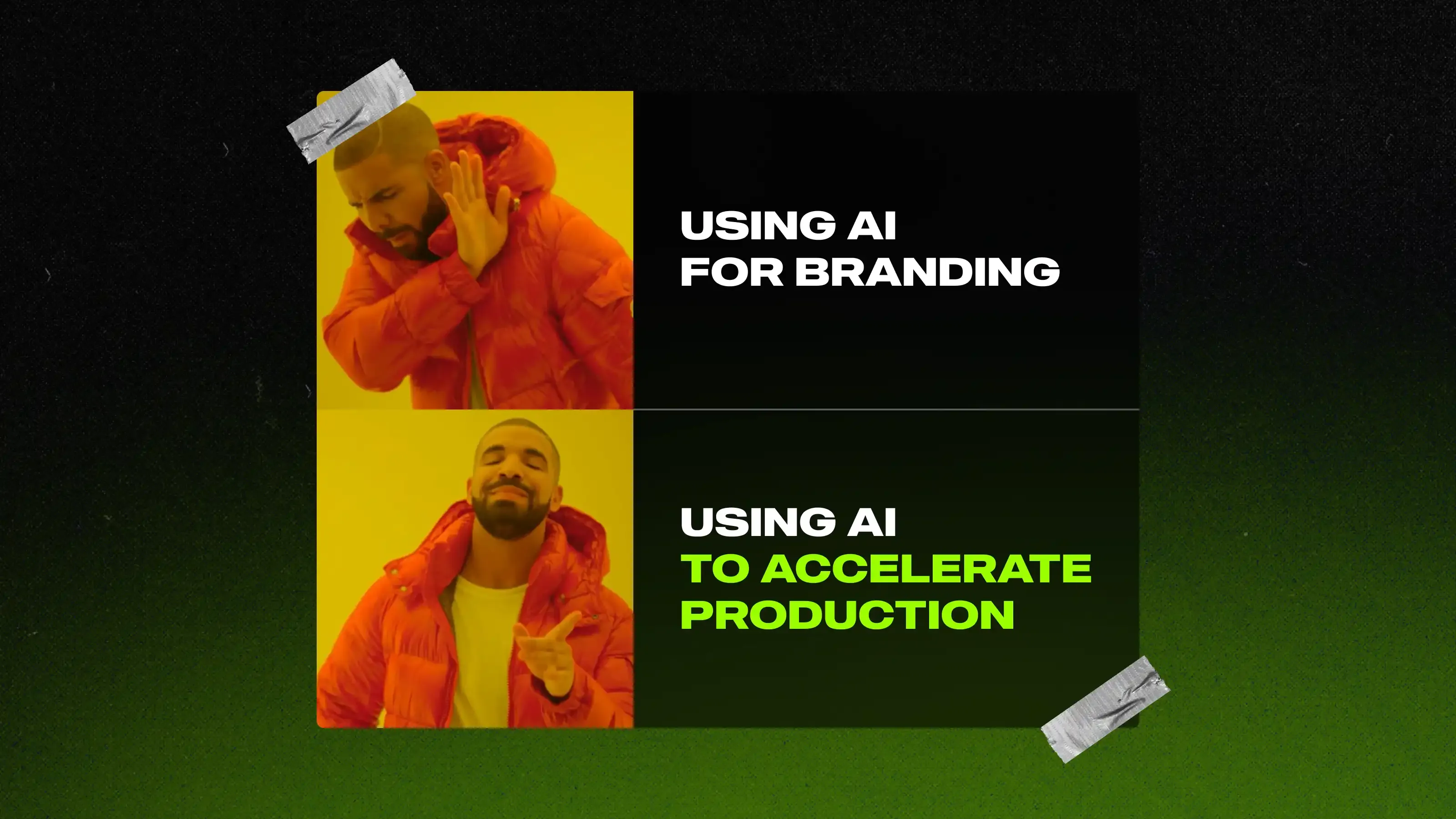
If you’re about to hire a studio or develop your own identity, don’t focus on whether AI is good. Consider whether branding is the kind of problem AI can solve.
Why the AI-fluent orgs keep AI off their brand
It’s not that these teams think AI is bad, but the people using AI are usually the ones who've hit its ceiling the hardest.
A brand isn’t a single output you can prompt into existence. It’s a system of the logo, voice, icon set, spacing rules, a Figma file, merch, and more. AI is great at compressing effort, but it can’t hold a system like that.
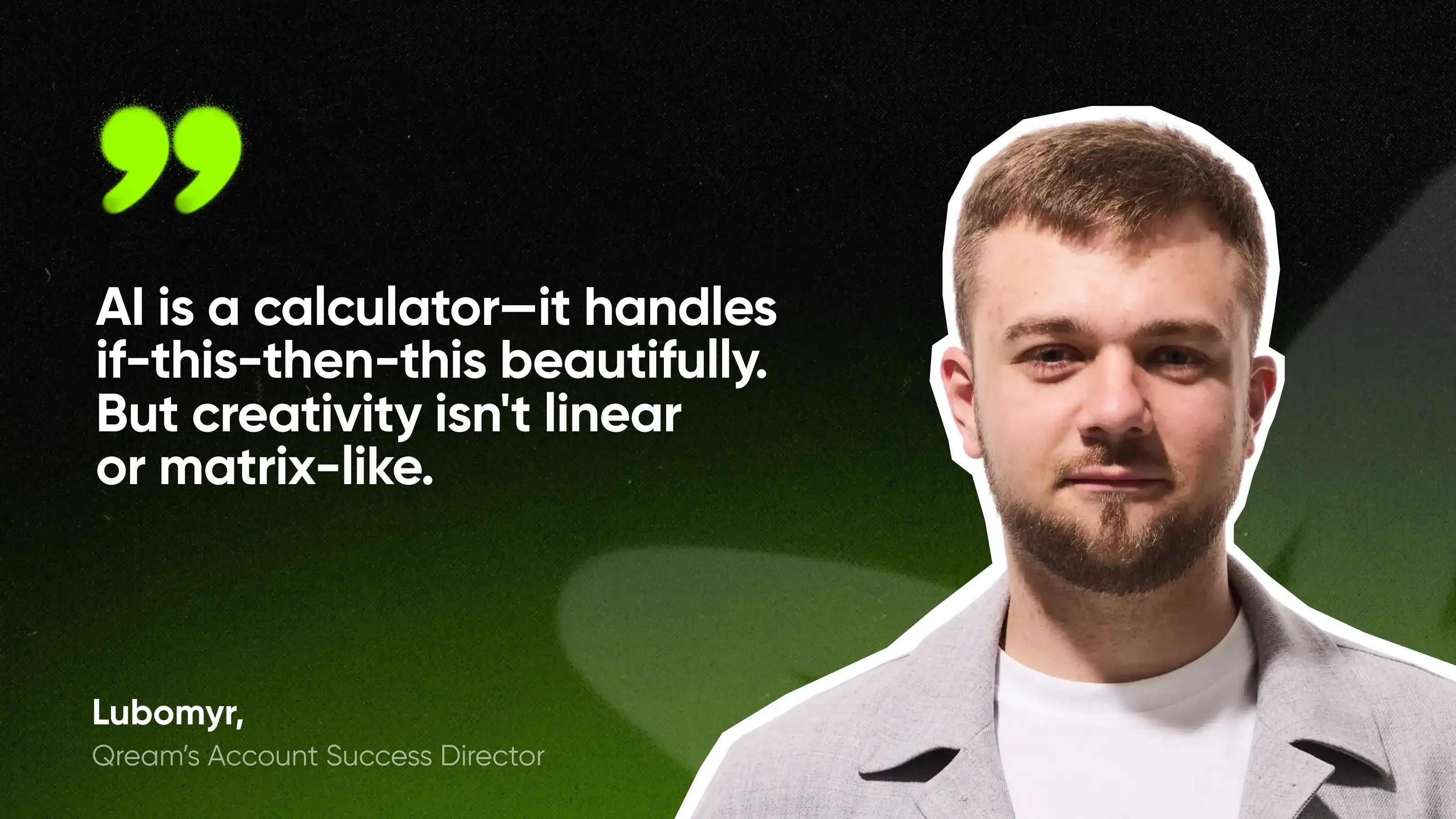
AI tools are better for other types of tasks in related processes:
- To summarize meeting notes or research data
- To generate 50 headline alternatives
- To craft a few visual options just for the concept
But ask it to decide how a company should feel 5 years from now, what emotional territory it should own, or which ideas are worth killing—and suddenly you’re asking a calculator to become a creative director. That’s not what AI is built for. (At least for now, we can’t promise it won’t change by 2029.)
A brand is not a collection of random assets. The logo has to make sense on a tiny favicon and a trade show wall. The typography has to work in product UI, pitch decks, emails, recruitment posts, LinkedIn carousels, and ads that don’t even exist yet. Every decision affects the next, and you need a solid foundation to keep everything afloat.
AI is very good at generating individual pieces—someone still has to decide how they fit together. Across some client discoveries, Qream keeps seeing the same pattern: some orgs treat these pieces as separate deliverables. That’s the misconception that cracks your brand into inconsistent marketing assets.
The proximity pattern
AI itself isn’t a villain. But those who believe what AI can do are often wrong.
The closer someone works with the technology, the more realistic their expectations become. The further away they are, the more likely they are to believe AI is a complete replacement for creative work.
There are 4 reasons why belief in AI branding grows with distance from the technology:
01 Proximity reveals the ceiling
If you prompt AI every day, you notice patterns. You see the same compositions or sentence rhythms coming back. By the end, what seems fresh and innovative turns into a tendency toward average ideas. It might work when you're looking for speed, but it's useless when your job is standing out.
02 Distance disguises it as magic
Someone who only opens ChatGPT twice a week has a completely different experience. That’s why prompting to craft a logo seems like a push-button solution rather than a tool with real limits. What they don’t see are the dozens of invisible decisions that still haven't been made: positioning, differentiation, scalability, consistency, motion, etc.
03 The “AI replaces branding” pitch givesnon-technical
We never hear this argument from SaaS orgs or AI founders—that’s a belief made by companies under pressure to move faster. Unfortunately, it’s driven by harsh times: marketing budgets shrink, or leadership asks whether AI can replace agencies.
04 Confidence and understanding move in opposite directions
The less time someone spends working with AI, the more confidently they’ll predict what it’ll replace next. The opposite tends to happen among heavy users. Experience makes people less impressed by flashy outputs and more interested in where judgment still matters.
What AI signals we see
AI requests show up in Qream’s client base, but patterns are different.
Tier-one clients almost never ask us to replace branding with AI. They ask how AI can speed up research, accelerate content production, organize workshops, generate copywriting, or prototype faster.
AI-native companies behave similarly. They don’t want AI-generated identities—it’s even ironic how they aim for a more human look. They want sharper differentiation, better storytelling, and clearer systems that AI can’t provide.
Another pattern is underestimating new tools. (And it reminds us of something we heard a few years ago.)
Back then, prospects would say, “Design the site, and we’ll just build it ourselves in Webflow.” And now, companies hire us to build sophisticated Webflow sites because they discovered that owning the tool isn't the same as knowing how to create a great product with it.
The same cycle is happening with AI. As technology becomes accessible, everyone assumes expertise is optional. Then reality hits, and specialists become even more valuable.
The question changes from “Can AI do this?” to “Who actually knows how to use AI well?” Those are very different conversations, and our clients’ discoveries prove it.
The misreading—treating creative like a matrix
A lot of the “just AI it” energy comes from a misunderstanding that creative work is something predictable. It easily breaks down in practice.
Misconception 1. Expecting the prompt to nail it on the first try
Creative direction doesn't work like a search query—it's iterative. The first round creates questions, the second round finds patterns, and only the third starts revealing something interesting.
Misconception 2. Treating creative decisions as if-this-then-this logic
Branding isn't a flowchart. Creative work is built on judgment calls stacked on judgment calls, shaped by context AI doesn't have.
Misconception 3. Assuming the AI carries the expertise, so you don’t need any to steer it
It's like managing a thousand contractors—you still have to tell every single one of them exactly what to do, or you get a thousand different guesses.
Misconception 4. Mistaking speed for direction
AI can generate fast, but can't tell you if fast is the right move for your brand now. We mean, generating 200 logo concepts isn’t difficult, but choosing the one that your company can hold for 5 years from now? That’s a different story.
How to tell if you’re outsourcing judgment to AI
You don’t need to stop using AI—you just need to know when it stops being a tool and starts making decisions for you. If you're not sure where that line is, follow this quick gut-test. The answers will reveal whether you’re speeding up the work or outsourcing the thinking.
- Are you using AI to generate options or to make the decision for you?
- Can you explain why the output looks the way it does, or are you just hoping it’s good enough?
- Is anyone on your team trained to evaluate creative work, or is “looks fine” the whole review process?
- Would your brand survive being scaled across 10 different formats, or does it only really work in the one asset you generated?
- If a competitor generated something visually similar, would you even be able to tell your brand apart?
- Do you solve for “fast and cheap now” or for something that still makes sense in 2 years?
- Has anyone stress-tested your brand’s identity against the product, users, and market category?
Not sure where your brand sits on that list?
No, the companies that use AI rarely use it for their own brand. Across both enterprise and AI-native clients, the request to “do it with AI” almost never comes from the technically fluent side of the table. It tends to come from teams who are further removed from how these tools actually work, day to day.
Because they’ve seen firsthand where AI’s ceiling is. Teams that build or run AI for a living understand that branding is a system, and that even a good generator can’t hold it together under real-world pressure the way a trained team can.
It’s good enough for speed and exploration, not for the full job. AI can help generate options fast, but a brand identity needs consistency, judgment, and the ability to flex across formats you haven’t even thought of yet (which is still very much human territory).
It can, if it replaces judgment instead of supporting it. The risk isn’t using AI—most serious studios do so. The risk is treating it as a substitute for creative direction rather than a tool inside it.
Ready to build a brand that holds up?
Qream uses AI, and we know exactly where to keep it away from your brand. Let’s talk through where your identity stands—or see what brand transformation with us looks like.