TL;DR
Since 28 June 2025, the European Accessibility Act (EAA) requires most digital products and services sold in the EU—websites, apps, e-commerce, banking, e-books—to meet WCAG 2.1 AA-based accessibility standards. A year on, enforcement is real but not yet in full force: France saw its first lawsuits, Norway issues daily fines, Germany sends private warning letters, and no country confirmed a single fine under EAA-transposed law by mid-2026. Below: the checklist to audit against, who's exempt, and what non-compliance costs by country.
What is the European Accessibility Act?
The European Accessibility Act (Directive (EU) 2019/882) changed the rules for the EU digital market: websites, mobile apps, e-commerce platforms, banking services, e-books, and transportation tickets must be accessible to people with disabilities by default. The law kicked in on June 28, 2025, when all 27 member states completed the transposition of the directive into national law.
There is a single technical benchmark here—the harmonized European standard EN 301 549 v3.2.1, which, for web and digital content, is virtually identical to WCAG 2.1 AA. The standard sets one idea: a person with a disability should be able to use the same website or app as anyone else, without a separate, simplified, or inferior version.
According to Eurostat data cited by the Council of the EU (2024), there are approximately 90 million people with disabilities living in the EU—that’s 1 in 4 adults. This is a huge audience—and for businesses, it’s both a legal requirement and an opportunity you can’t afford to ignore.

Who does the EAA apply to?
The EAA knows where your customers live. A company based in the US or the UK that sells e-commerce, digital banking, or e-book services to consumers in the EU is subject to the law just as much as any company registered in Paris or Warsaw. The location of the headquarters doesn’t matter here.
There is only one exception that makes a difference: micro-enterprises with teams of up to 10 people and an annual turnover of up to 2 million euros are exempt from EAA service obligations. But it doesn’t apply to manufacturers of goods of the same size, and it doesn’t mean complete immunity: national accessibility laws still apply and may be enforced in parallel.
So if you’re a medium or large business selling in the EU, the most productive question to ask is “how well do we meet the European Accessibility Act requirements under EN 301 549 v3.2.1?” This is the key to successful functioning in the long run.
When we rebuilt the website for Valerann, a traffic intelligence platform, the brief was: take genuinely complex, real-time road data and present it with total clarity—clean structure, no clutter, nothing fighting for attention. That’s exactly the instinct EAA compliance rewards.
The WCAG 2.1 AA checklist for EAA compliance
This is the core of what an audit actually checks. Test yourself to make sure you don’t fall into the same trap as most websites:
- Color contrast. Text meets a minimum contrast ratio of 4.5:1 against its background (3:1 for large text and graphical/UI components).
- Alt text. All meaningful images, icons, and non-text content have descriptive alternative text.
- Captions. Video content includes accurate captions; pre-recorded audio content has transcripts.
- Text resize/zoom. Content remains usable and readable when zoomed to 200% without loss of functionality or content.
- Keyboard navigation. Every interactive element (menus, forms, buttons, modals) is fully operable using a keyboard alone, with no keyboard traps.
- Skip links. A “skip to main content” mechanism is available so keyboard and screen-reader users can bypass repeated navigation.
- Form labels. Every form field has a programmatically associated, descriptive label—not just placeholder text.
- Touch target size. Interactive elements on touch interfaces are at least 44×44 CSS pixels, with adequate spacing between targets.
- Focus indicators. A visible focus state is present on all interactive elements when navigating by keyboard.
- Semantic structure. Headings, lists, and landmarks are marked up semantically so assistive technology can parse page structure correctly.
Each one maps to a specific WCAG 2.1 AA success criterion—the same criteria EN 301 549 (v3.2.1) points to. For a quick internal check, this list is a good place to start. But if you’re preparing for a full compliance audit, limiting yourself to these 10 points is a half-measure. The standard is much broader, and, much like simplifying UX for complex products, it’s often the parts you skipped that turn out to matter most.
What happens if you don’t comply?
This is where the picture has changed the most since the deadline passed. The EAA itself doesn’t set penalty amounts—that's left to each member state, which is why enforcement looks different depending on where your customers are.
France
The first push came from civil society. In November 2025, human rights orgs took major retailers—including Auchan, Carrefour, E.Leclerc, and Picard—to court after months of unanswered formal warnings (Auditsu, 2026; AEL Data, 2026).
As of mid-2026, the cases are still pending, with no rulings or fines yet. But the message is already clear: in France, it's advocacy groups, not government regulators, that drive the EAA from theory to action.
Norway
Regulators didn’t stop there. They’re hitting the HelsaMi portal with daily fines of NOK 50,000 for non-compliance (Web Accessibility Checker, 2026). Probably the clearest case so far of an EAA fine that’s being enforced, day after day.
Germany
Germany’s national law (the BFSG) took effect in August 2025, and within weeks, e-commerce operators started getting private warning letters (Abmahnungen) under German unfair competition law (Auditsu, 2026). These aren’t regulatory fines, but they still carry real legal and financial risk.
Netherlands
The Dutch Authority for Consumers and Markets (ACM) sent information requests to e-commerce operators around the world, including companies based outside the EU. Real, formal enforcement is expected in the second half of 2026 (Level Access, 2026).
By mid-2026, though, no country had issued a confirmed fine under its national EAA law. The machinery is running—regulators, complaint mechanisms, advocacy groups—it just hasn’t produced an actual fine yet. That’s a different reality than “70% of sites will get fined,” and it’s more useful to plan around: the risk isn’t hypothetical, but the window’s still open.
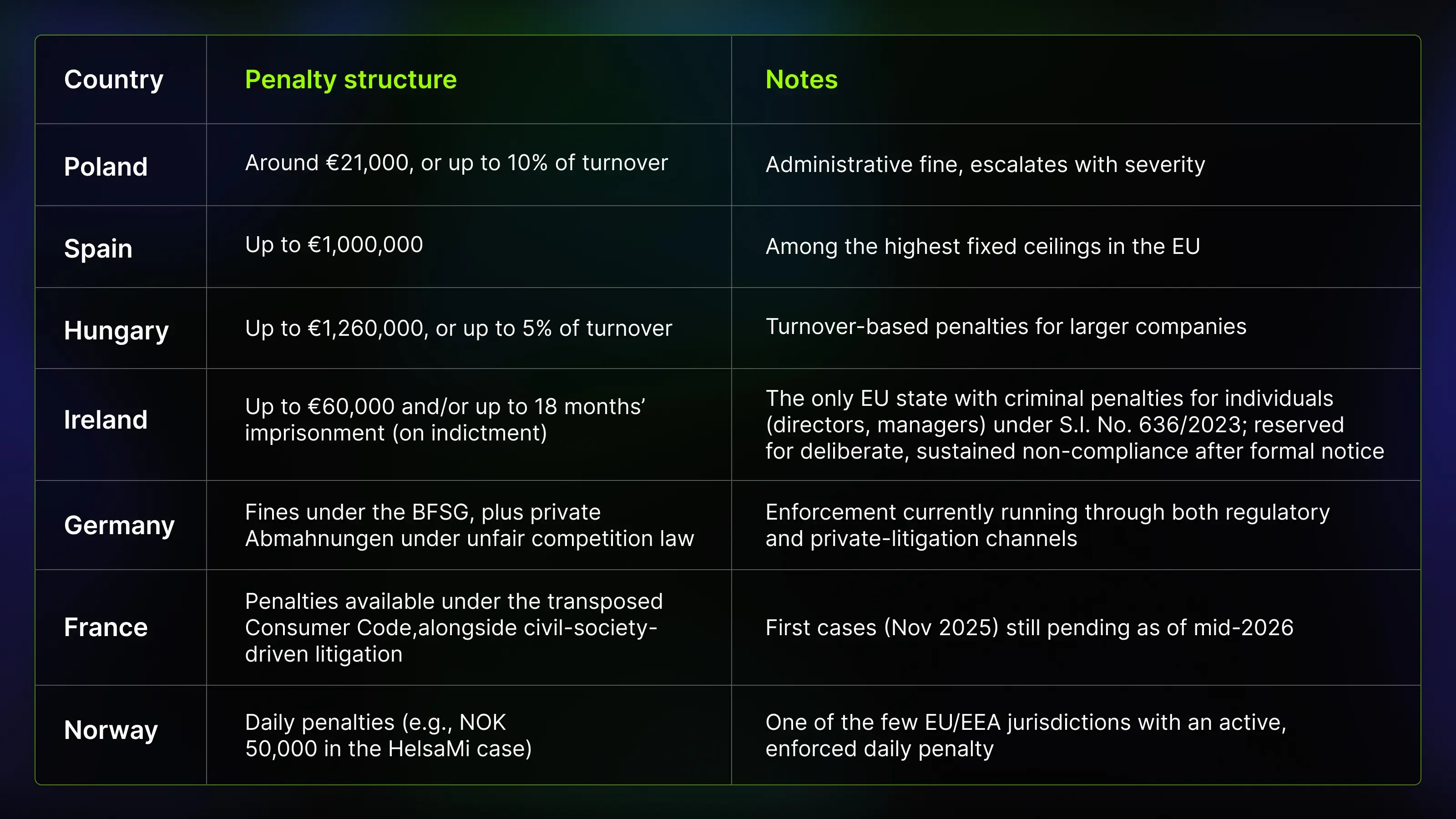
Think of these as the maximum penalties rather than guaranteed fines. They reflect the current enforcement landscape as of mid-2026, and the rules are still evolving. Use this table as a guide for planning your European Accessibility Act compliance roadmap, not as legal advice.
How to audit your site for EAA
The enforcement mechanism is in place, but so far there haven’t been any high-profile fines. The smart move is obvious: run an audit on your own before someone else does it for you through a complaint or an official request. Here’s how it works in practice:
- Benchmark your site or app against EN 301 549 v3.2.1 and WCAG 2.1 AA, not just the checklist above.
- Start with the most painful areas: placing an order, creating an account, and basic navigation. That’s where traffic is highest, and that’s where most complaints come from.
- Fix, document, and re-test—regulators and advocacy groups in several countries have shown they'll accept a documented remediation timeline more favorably than silence.
- Publish an accessibility statement, which several transpositions treat as a separate, explicit obligation.
Not sure if your site passes? Get an accessibility audit.
FAQ
Yep, and there’s a fundamental difference here: EAA focuses on your customer base. If you sell goods or services subject to the law to consumers in the EU, the rule applies regardless of where your team is physically located.
The compliance deadline has already passed. The EAA has been enforceable since 28 June 2025; there is no future date to prepare for, compliance is a current, ongoing obligation.
There’s no single EU-wide fine. Each member state sets its own penalties, ranging from roughly €21,000 in Poland to €1,000,000 in Spain and up to €1,260,000 in Hungary, with Ireland uniquely allowing criminal penalties, including up to 18 months’ imprisonment, for serious cases. As of mid-2026, no confirmed fines have actually been issued under EAA-transposed national law, though enforcement activity, lawsuits, warning letters, information requests are underway in several countries.
It’s the right technical foundation—EN 301 549 v3.2.1, the standard EAA enforcement is measured against, is built on WCAG 2.1 AA for web content. Full EAA compliance for services also includes requirements beyond web content, such as accessible customer support and documentation, so a WCAG-only audit is a strong start, but not the complete picture.
Written by

Qream co-founder | Design and product direction
Leads Qream's creative and product direction, connecting brand strategy, experience design, and business goals. Reviews content where design strategy, UX/UI, customer experience, and brand execution are central.