TL;DR
Custom B2B website pricing ranges from $15,000 to $150,000+—not because agencies price arbitrarily, but because the scope of what a B2B site needs to do varies dramatically. A site that generates inbound, supports a complex sales cycle, and integrates with your CRM is a different product than a site that just describes what you do.
The variables that actually move the price are: vendor type, whether strategy and copy are included, integration depth, and the number of stakeholders involved in approvals. Page count is a minor factor.
Most budget mistakes happen not from overpaying on the build but from underscoping it—skipping discovery, handing off copy internally without bandwidth to deliver, or buying a $10k site that needs a full rebuild in 18 months.
For finance and procurement: frame the investment against the cost of your current site's underperformance, not against the line item itself. A site converting at 1% when your category benchmarks at 2.5% is already costing you pipeline every month.
Your website is losing you deals. The product has evolved, the ICP has shifted, the team has grown. The website still says what you were 10 years ago. So you decided to redesign your website, and the budget conversation starts. And that's also when most teams run into a wall: pricing for web design is notoriously hard to benchmark.
You ask an agency for a quote and get back a number between $15,000 and $150,000 with minimal explanation of what moved the needle.
At Qream, we redesign websites for B2B companies that have outgrown their digital presence. That's why this guide is different. We're talking to marketing leads, founders, and ops or procurement teams at B2B companies—people who need to understand what actually drives B2B website design cost, build an internal business case, and evaluate proposals without being taken for a ride
What actually drives web design agency pricing
Most pricing guides lead with page count. That's the wrong starting point. What actually drives cost is a combination of scope, vendor structure, design complexity, strategy depth, content ownership, and process friction. Each of these can independently double or halve the final number.
Here's how to read them:
Scope: more than just pages
The scope in B2B web projects is about how many types of pages exist (each unique layout takes significantly more design time than a variant of an existing one), whether the content strategy is included in the engagement, and whether brand identity work is part of the brief.
A 10-page website where every page shares a layout system costs less than a 6-page website where each page tells a different story to a different audience. The latter is common in B2B—especially for companies with multiple ICPs, product lines, or use cases.
If your scope includes reworking messaging architecture or positioning, that's a strategy project bundled inside a design project. Treat it as such in the budget.
Vendor type: what you're actually paying for
The same deliverable—a 10-page custom B2B website—can be quoted at $8,000 by a freelancer, $35,000 by a boutique agency, and $80,000 by a full-service vendor. What you're buying at each level is different:
- Freelancer: execution. One person doing design and client communication. Low overhead, higher dependency, limited process.
- Boutique agency (5–20 people): a managed team with specializations. Strategy, design, development, and QA happen in parallel. There's a process—which means more coordination but also more accountability.
- Large or full-service agency: a full production system. Senior strategists, dedicated PMs, research phases, and extensive documentation. High output quality, high coordination cost, higher price floor.
The question is “What kind of engagement does my project actually require?”
Design complexity: the three tiers that matter
Template-based: A designer customizes an existing framework (Webflow, WordPress). The layout logic is pre-built; the work is brand application and content population. Fastest to build, lowest cost, limited differentiation.
Custom-designed: Layouts are designed from scratch based on your brand, messaging, and user flow. No reused frameworks—every section is deliberate. This is what most serious B2B companies need and where most of the market sits.
Bespoke interactive: Custom design plus motion, interactive elements, non-standard navigation, animations tied to scroll or user behavior. High differentiation, high cost, high maintenance. Appropriate for specific use cases (product-led growth companies, companies where the website is the product experience), not the default.
The strategy layer: expensive to skip
Discovery, positioning, and messaging architecture are often cut when budgets get tight. But when strategy is skipped, the design phase absorbs the cost anyway—through endless revision cycles, conflicting stakeholder feedback, and copy rewrites that push timelines. Paying for two weeks of structured discovery upfront typically saves four to six weeks downstream.
In B2B specifically, the strategy layer also includes questions like:
- How does the site support the sales cycle?
- What should a prospect know after five minutes?
- What do we need them to feel before booking a demo?
Content: the most underestimated cost in B2B
B2B websites are content-heavy by nature. Case studies, use case pages, product messaging, team bios, and thought leadership sections—all of it needs to be written, reviewed, and approved. If the agency is providing copy, that's a high additional cost. If your team is providing it, the project timeline now depends on your internal bandwidth, which is rarely as available as planned.
A realistic estimate for B2B website copy: $150 to $400 per page for a mid-level copywriter; $300 to $800 per page for senior-level strategic copy. For a 12-page site, that's $2,000 to $10,000, depending on depth and who's writing it.
Skipping professional copy in favor of “we'll handle it internally” is a common cost-saving move that delays projects by weeks and produces weaker outcomes
Revision cycles and stakeholder overhead
Projects with three stakeholders cost less than projects with eight. Every additional approver adds review time, creates the possibility of conflicting feedback, and requires more revision rounds.
In enterprise B2B environments, it's common for website projects to involve marketing, product, sales, legal, and executives. If that's your situation, build it into the budget. Some agencies price this explicitly; most absorb it into general overhead and end up over-servicing or cutting corners to stay on margin.
A useful rule of thumb: for every two additional decision-makers beyond a core team of two, add 15–20% to the quoted timeline and budget accordingly.



Web design cost tiers in 2026—what you get at each level
Use this as a benchmarking reference. If you've received a proposal, find your tier and check whether the description matches what's in the document.
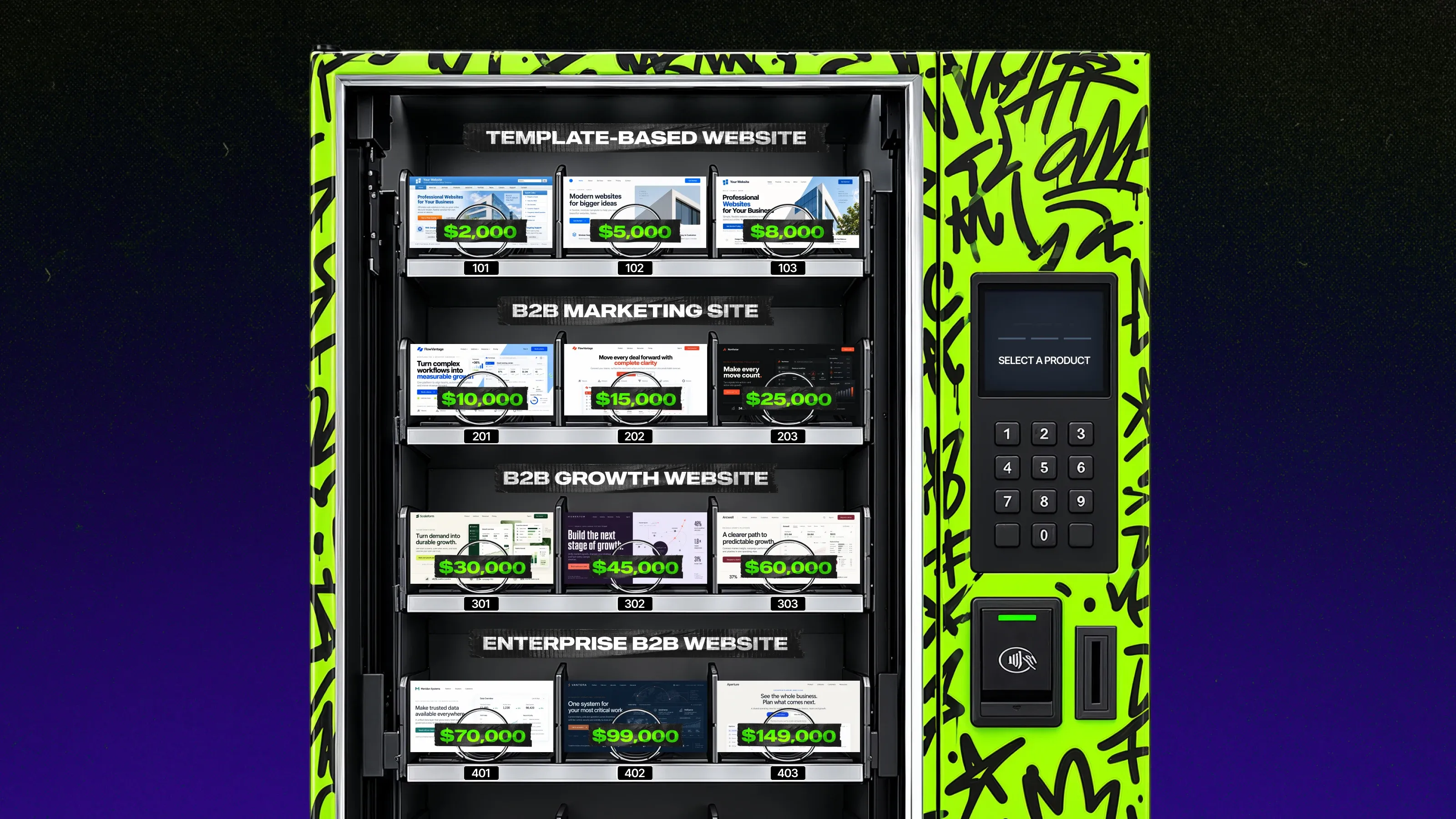
Template-based website
For whom: early-stage B2B companies and pre-Series A startups.
Scope: this tier includes a template-based design, a basic contact or demo request form, and a mobile-responsive layout. It does not include discovery, custom UX, content strategy, copywriting, SEO architecture, CRM integrations, or any custom animations and interactive elements.
Vendor: Freelancer
Red flags:
- No mention of CMS training or proper handover documentation
- Timeline of under two weeks for anything beyond a simple template swap
- Complete absence of a discovery phase (the agency jumps straight into design)
Price: $2,000 to $8,000
Core B2B marketing site
For whom: growth-stage B2B companies.
Scope: this package includes custom design, a brand-aligned visual system, professional copywriting, basic SEO setup, a CMS, contact forms, and one to two third-party integrations. It does not include CRM integration, complex SEO architecture, multi-locale setup, or heavy interactive/motion design.
Vendor: small agency
Red flags:
- Discovery phase reduced to a single kickoff call
- Integrations listed as “included” without specifying which ones or at what depth
Price: $10,000 to $25,000
Full B2B growth website
For whom: series B+ companies and established B2B companies.
Scope: includes discovery, strategy, page architecture, custom UX, heavy interactive or motion design, copywriting, technical SEO, CRM integration, a component-based CMS, and QA. It does not include ongoing content production.
Vendor: established boutique agency with strong B2B experience
Red flags:
- No phase-based timeline with clear deliverables and approval stages
- Integrations listed as a flat add-on without proper scoping
- Copy described as “provided by client” without a structured intake process
- No post-launch support clause or clear ownership transfer terms
Price: $25,000 to $60,000
Enterprise B2B website
For whom: enterprise companies with complex architectures.
Scope: this solution includes discovery, strategy, page architecture, custom UX, a full custom design system with component library, heavy interactive and motion design, copywriting, technical SEO, multi-locale or multi-brand architecture, CRM integration, complex third-party integrations, a component-based CMS, QA, accessibility compliance, and full documentation. It does not include ongoing content production.
Vendor: Full-service brand transformation boutique
Red flags:
- Proposal lacks a formal discovery phase
- Team described without clear seniority levels
- No mention of how scope changes will be handled
Price: $60,000 to $150,000+
Great websites aren't just for big companies
A strong website can make a young company look established, and an established company look impossible to ignore. See how we build websites that raise the bar.
B2B-specific web design services pricing considerations
Qream is a brand transformation boutique that designs B2B websites for companies that have outgrown their current digital presence, and we know that almost all web design pricing articles are written for companies buying a website for the first time. But B2B companies are buying sales infrastructure. The considerations are different.
Longer sales cycles require more pages
In B2B, a single buyer journey might touch eight to twelve pages before a prospect books a demo: the homepage, a use case page, a comparison page, two or three case studies, the pricing page, the about page, and the team page. Each of those needs to be designed, written, and tested.
This is structurally more expensive than the B2C model, where a homepage and a product page often do the majority of the work. B2B sites need to answer objections, build trust, and support multiple decision-makers at different stages—simultaneously. That requires more page types, more content hierarchy, and more intentional navigation design.
Credibility architecture is a real cost line
B2B purchases are high-stakes and slow. Trust architecture—client logos, case studies, quantified results, team bios, security and compliance pages, and social proof—is functional. It directly affects whether a late-stage prospect continues to engage or drops off.
Designing and building credibility systems properly (consistent case study templates, integration with review platforms, structured social proof sections) adds scope that generic pricing models don't account for.
The integration tax
This is the most common source of post-signature budget surprises in B2B web projects. Integrations that appear simple in a proposal often aren't:
- HubSpot CRM: Basic form connection is cheap. Attribution tracking, lead scoring logic, lifecycle stage syncing, and multi-touch pipeline reporting are not. Add $3,000 to $12,000, depending on your HubSpot setup.
- Salesforce: Similar principle—more complex object relationships mean more development time. $5,000 to $20,000 is a realistic range for deep integration.
- Demo booking (Calendly, Chili Piper): A simple embed is inexpensive. Conditional routing by company size, segment, or product interest requires custom logic. $1,500 to $5,000+.
When reviewing proposals, ask specifically, “What integrations are included, to what depth, and what triggers a change order?”
Redesign vs. new build: a different project type
Redesigning an existing site is systematically more complex than building a new one.
In a website redesign, you're inheriting decisions that influence cost: entrenched stakeholder opinions about existing content (“the CEO's message has been on the homepage since 2018, and it stays”), legacy SEO equity that can't be discarded without traffic risk, old integrations that “just need to work,” and a CMS that's either being migrated or abandoned.
Alignment work—getting the organization to agree on what stays, what changes, and what gets cut—is invisible in most proposals but frequently consumes 20–30% of the project timeline. If your company has been through a rebrand, a pivot, or significant product changes since the last site build, build that alignment cost into your expectations explicitly.
From Qream’s experience working with B2B companies on website redesigns, the projects that justify higher investment share one trait: the site is positioned as a growth asset, not a cost.
Post-launch costs are real and consistently forgotten
The launch is not the end. For B2B sites, the following are typically not included in the initial build quote:
- CMS training: How your team edits pages, publishes blog posts, updates case studies.
- Analytics configuration: Goal setup, funnel tracking, heatmap tooling, dashboards. This is often assumed to be included and rarely is.
- Ongoing retainer: Content changes, design updates, A/B tests, integration adjustments. $1,500 to $5,000/month is typical for boutique agency support.
- Hosting and platform fees: Depending on the CMS, annual platform costs range from $300 to $15,000.
When building an internal budget case, model year 1 costs as build cost + integrations + content + post-launch setup + 6-month retainer.
Why proposals change after discovery
Nearly every experienced agency will tell you the same thing: the number they quote before discovery is an estimate, not a commitment.
An example: A B2B SaaS company engages an agency for a 12-page redesign quoted at $45,000. During discovery, it becomes clear that the company is mid-rebrand, has three distinct buyer personas with different messaging needs, requires a HubSpot integration with custom lead scoring, and has legal requirements for a compliance page. The revised scope is 22 pages, two integration layers, and a brand positioning workshop. Final cost: $78,000.
Was the agency acting in bad faith with the original quote? In most cases, no. Custom web design pricing reveals itself during discovery. The risk mitigation strategy is to invest in a paid discovery phase before signing a full project contract—this gives you an accurate scope and a fixed-price engagement aligned with business goals.
How B2B companies budget for web design (and where they go wrong)
Treating the website as a one-time cost
A website is not a capital expenditure you amortize over five years. It's a revenue-generating asset that requires maintenance, iteration, and periodic reinvestment. Companies that treat it as a one-time project tend to end up rebuilding from scratch every two to three years—often at higher cost than if they had maintained it continuously.
A more useful mental model: budget for an initial build, then allocate 15–20% of the build cost annually for maintenance, improvements, and iteration. This is what keeps the asset performing rather than degrading.
How to frame the budget in terms finance will approve
Framing it as an opportunity cost is effective. Consider these inputs:
- Conversion rate impact: If your site currently converts 0.8% of visitors into leads, and the industry benchmark for your category is 2.5%, the gap represents a significant lost pipeline. At 5,000 monthly visitors, increasing conversion from 0.8% to 2.5% gives 85 additional leads per month. With an average cost per acquired lead (CPL) of $200, this equals $17,000 per month, or approximately $200,000 per year in additional qualified pipeline. Even closing half of this gap (raising conversion to ~1.65%) would bring ~42–43 extra leads per month — that’s over $100,000 in annual value.
- Sales cycle efficiency: How many hours does your sales team spend explaining things that the website should convey? At a fully loaded cost of $80–120/hour for a sales manager, twenty minutes per discovery call spent compensating for a weak website is a measurable cost.
- Competitive positioning: If a key competitor updated their site in the past 18 months and you haven't, the visual credibility gap is part of your close rate problem. This is harder to quantify but easy to show—include screenshots in your internal proposal.
When cheap costs more
A B2B company engaged a freelancer to build a 10-page website for $9,000. The site looked clean on launch. Fourteen months later, the company hired a new VP of Marketing. The site had no component-based CMS—every change required developer time. There was no content model for case studies or use cases, so those pages had been skipped entirely. The HubSpot integration was a basic form embed with no attribution. The brand had evolved, and the design was already dated.
The decision: full rebuild. New agency, new scope, $52,000. Total spend over 18 months: $61,000.
An initial investment of $35,000 in a properly scoped project with a component CMS and real integration depth would have saved $26,000 and twelve months of sales friction.
The lesson is not always to spend more. It's understanding what you're actually buying at each price point and whether it will survive your next stage of growth.
Agency vs. freelancer vs. in-house: a decision framework
Each option has a legitimate use case.
Hire a freelancer when the scope is fixed and small (landing page, campaign page, or minor refresh), you have a clear brief and can manage the project yourself, and the site does not need to integrate with complex systems or survive frequent updates.
Hire an agency when the project requires coordinated strategy, design, and development; there are multiple stakeholders; integrations are part of the scope; or the website is expected to perform as a sales asset over 2–3 years.
Build in-house when: you have a high-volume content and design operation that requires ongoing daily changes; you're at a scale where a full-time web team is more economical than continuous retainer spend; or you have highly specialized technical requirements that benefit from institutional knowledge.
For most B2B companies at Series A through Series C, the agency model is the right default. In-house web teams make sense at enterprise scale or for product-led companies where the marketing site and the product experience are tightly coupled.
Let’s transform your website into a revenue engine
In 30 minutes, we’ll map the gaps, define the opportunities, and outline how to turn your digital presence into measurable business growth.

FAQ
A B2B website redesign typically costs between $15,000 and $80,000, depending on company size, scope, and whether the engagement includes strategy and copy.
At the lower end, you're getting a design refresh with a defined page set and basic integrations. At the upper end, you're buying a full strategic rebuild—new messaging architecture, custom UX, CRM integration, and a content system your team can actually maintain.
The number that moves the needle most isn't the page count; it's whether you're also reworking positioning, who writes the copy, and how many stakeholders are involved in approvals.
The single biggest cost driver is scope clarity—or the lack of it. Projects with vague briefs, undefined copy ownership, and multiple decision-makers consistently run 30–50% over initial estimates. Beyond that, the factors that move the number most are: vendor type (freelancer vs. boutique agency vs. full-service firm), whether custom design or a template framework is used, the depth of CRM and tool integrations, and whether a strategy phase is included before design starts. Page count matters, but it's rarely the variable that explains a $20k difference between two proposals for what looks like the same project.
A cheap website solves a visual problem. An expensive one solves a business problem.
At $8,000–$12,000, you typically get a clean, functional site built on a template framework—it looks professional and loads fast, but it's not designed around your buyer journey, it won't integrate deeply with your sales stack, and it will likely need a rebuild within two years if your company is growing.
At $40,000–$70,000, you're getting a site architected around how your buyers actually make decisions: structured use case pages, trust architecture that handles late-stage objections, CRM integration that feeds real pipeline data, and a CMS your team controls without calling a developer. The gap is how long the asset performs and how much sales work it actually does.
Most agencies use one of three models: fixed price, hourly rate, or monthly retainer.
A fixed price is the most common for full site builds—scope, deliverables, and revisions are defined upfront, and any change outside that triggers a change order.
Hourly billing is used when the scope is genuinely unclear or evolving; US and Western European agencies typically run $100–$150/hour, and Eastern European studios $40–$80/hour.
Retainers cover ongoing work after launch—content updates, design iterations, and integration adjustments—usually $1,500–$5,000/month depending on volume.
For most growth-stage B2B companies, yes—but only if the site is built to do actual sales work, not just exist.
The ROI framing that makes the most sense internally: if your site currently converts 0.8% of visitors into leads and industry benchmarks sit around 2.5%, closing half that gap at 5,000 monthly visitors means roughly 42–43 additional leads per month. At a $200 cost-per-lead in paid channels, that's $8,400–$8,600 in avoided acquisition cost every month (or approximately $100,000–$103,000 per year).
A $30k investment that improves inbound conversion and shortens sales cycles by reducing the “explain everything on a call” problem typically pays for itself within 3–4 months.
Planning a website redesign? Let's price it properly
We'll help you define the scope, prioritize features, build a budget, and give you a realistic estimate.

Written by

Qream co-founder | Business growth and strategy
Leads Qream's business development and commercial strategy, bringing experience across sales, customer support, and complex digital projects. Reviews topics around project scoping, agency engagement, strategic partnerships, and growth.